As an Amazon Associate I earn from qualifying purchases. This post contains affiliate links. If you buy through them we may earn a commission at no extra cost to you.
Product prices and availability are accurate as of the date and time indicated and are subject to change. Any price and availability information displayed on Amazon at the time of purchase will apply to the purchase of this product. Certain content that appears on this site comes from Amazon. This content is provided "as is" and is subject to change or removal at any time.
Most outboards that quit on a lake aren’t worn out. They sat.
Before you mix a can, check it on the free 2-stroke fuel mix calculator — it also says which oil an outboard actually needs.
Old gas turned to varnish in the carb over the winter. The impeller spent eight months with its vanes bent one way, took a set, and never pumped right again. On my first boat, water got into the gearcase one summer, I never checked, and it froze in there over the winter and cracked the housing. I’ve had two of those happen to me, and neither one had anything to do with how many hours were on the motor.
So this is the schedule I actually keep on my own small motor, sorted by when you do each job instead of by the hour meter. Some of it takes five minutes at the ramp. A couple of jobs I’ll tell you flat out to pay a shop for.
One ground rule before any of it. Your owner’s manual beats anything I say here, numbers included, because it was written for your motor and this post wasn’t. (Lost yours? The big outboard makers post them online for free, and you can usually find yours by model.)
Hours matter less than the calendar on a small motor
A lot of service schedules are built around hours. Gear oil at 100 hours, plugs at 100, the impeller at a few hundred, plus a break-in change much earlier than that on a new motor. Then there’s the little phrase tacked on the end, “or once a year, whichever comes first.”
For most of us, whichever comes first is the calendar. Every time. My motor sees maybe 30 hours in a good year, give or take, so if I waited on the hour meter I’d be changing gear oil every third summer. Water that got past a seal in year one could’ve sat in there for a long time.
Time does its own damage, too. Rubber takes a set when it sits bent. Gas can start going stale in a couple of months.
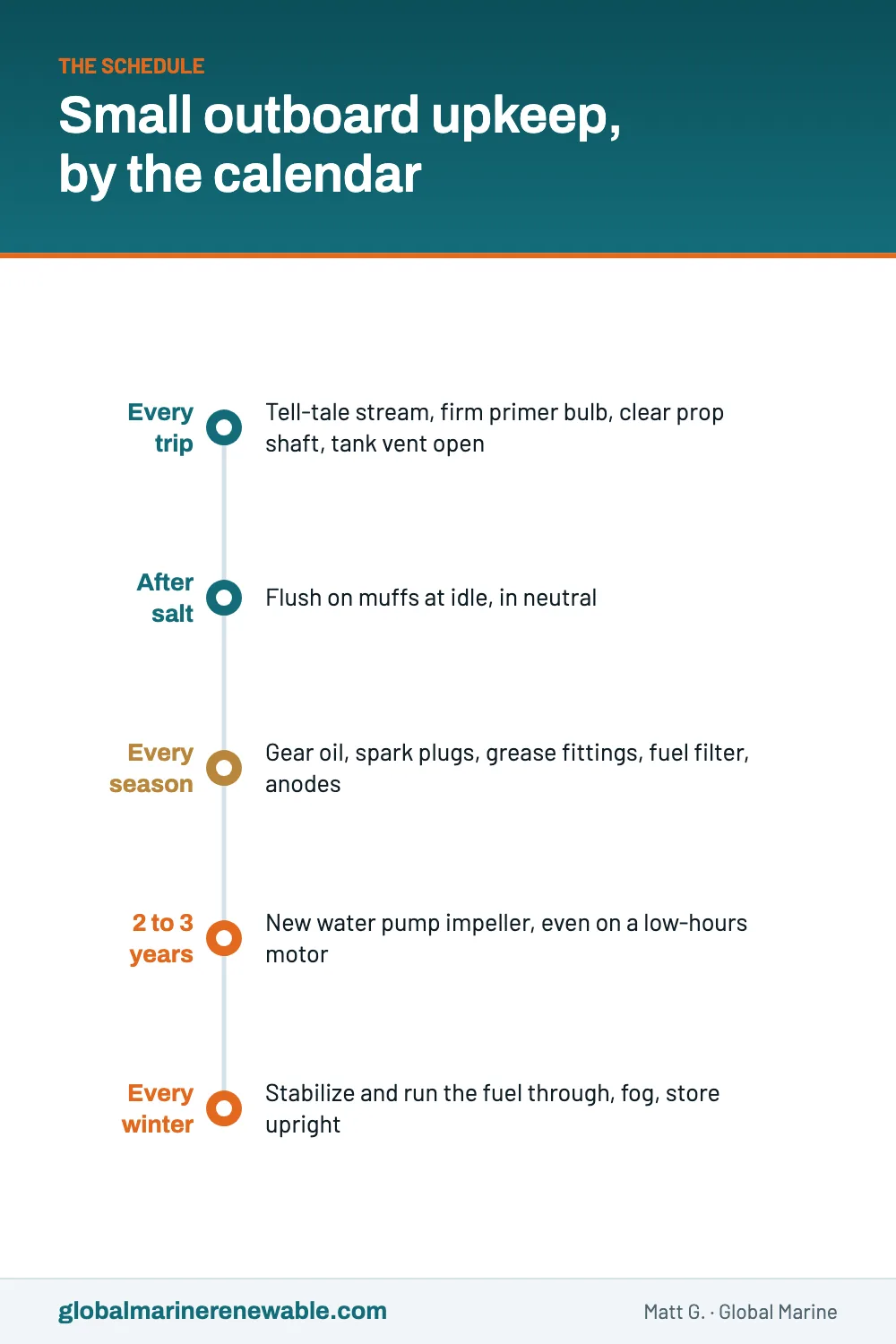
So I don’t plan in hours. I plan in four buckets: every trip, once a season, every couple of years, and how the motor gets stored. That’s honestly the whole system, and the timeline below is the short version.
Every trip: five minutes at the ramp
This is the stuff I do before the boat goes in and again when it comes out. None of it needs a tool.
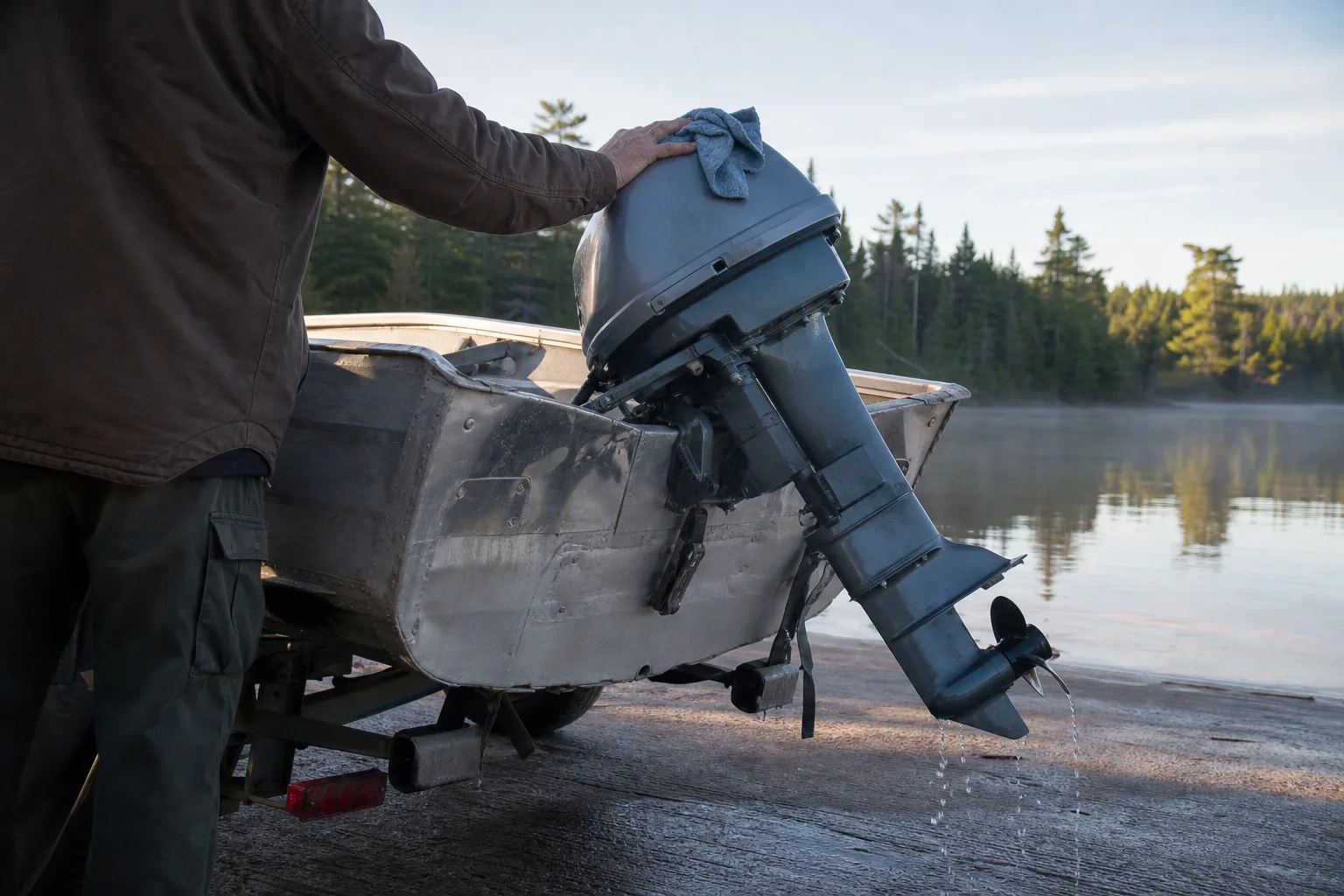
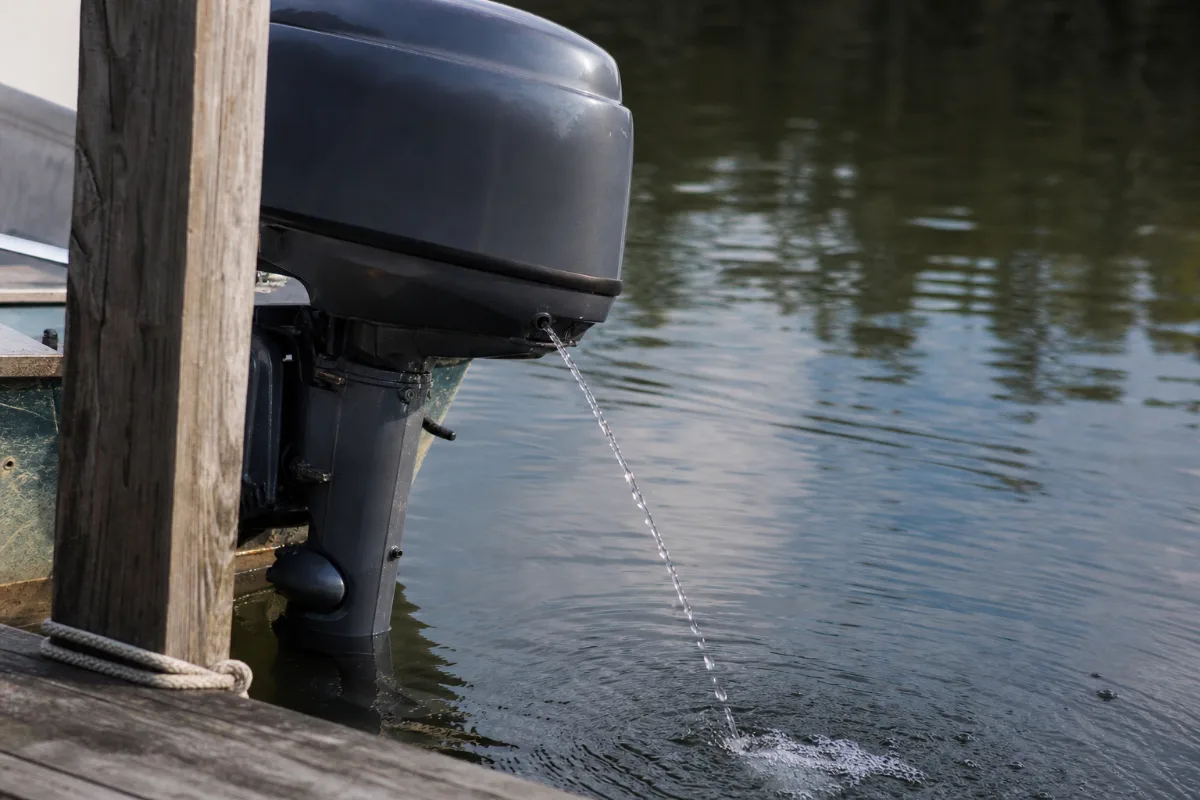
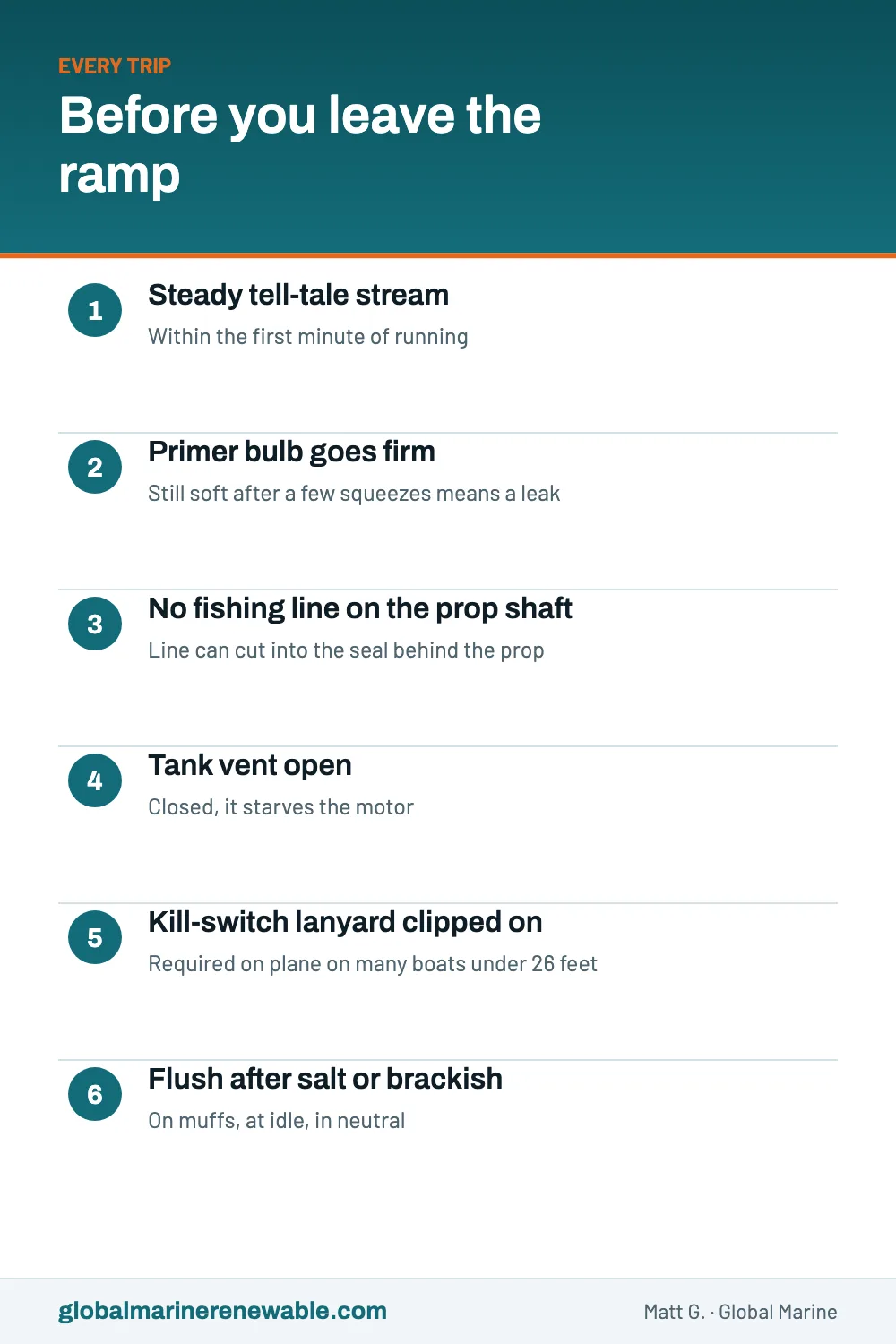
Watch the tell-tale. Start the motor and look for the little stream of water shooting out the side. Everybody at the ramp calls it peeing, and yes, that’s the technical term. A steady stream within the first minute is a good sign the water pump is working. A weak dribble or nothing at all means shut it down and figure out why before you go anywhere. I wrote up the whole order I check that in, because the cause is often a lot cheaper than people fear.
Squeeze the primer bulb. It should go firm after a few pumps. If the primer bulb stays soft, you’ve got an air leak or a fuel supply problem, and you want to find that while you’re still tied to the dock. I found mine half a mile out, right as the wind picked up.
Look behind the prop. Fishing line wraps around the prop shaft and can cut into the seal back there, which is one of the ways water gets into the gearcase. If you spot line, pull the prop when you get home and pick all of it out.
Open the tank vent. Forget to open the tank vent and the motor runs great for a while, then starves for fuel and dies. Ask me how I know.
After salt or brackish water, flush it every single time. Run it on a hose with flush muffs, at idle and in neutral, for a few minutes (and pull the prop first if your manual tells you to). In clean fresh water I’m kinda lazy about flushing, and I’ll own that.
Clip the kill-switch lanyard to yourself, too. Go over the side wearing it and the engine shuts off instead of running on without you. On boats under 26 feet with an engine of 3 hp or more, federal rules say to use the engine cut-off switch when you’re on plane or above displacement speed, give or take a handful of exceptions.
Once a season, or every 100 hours
Most small-motor manuals I’ve read lump a handful of jobs together at “100 hours or once a year.” I do mine in the fall before the motor goes away, since anything I find then has all winter to get sorted. Spring me is always in a hurry, and he cuts corners.
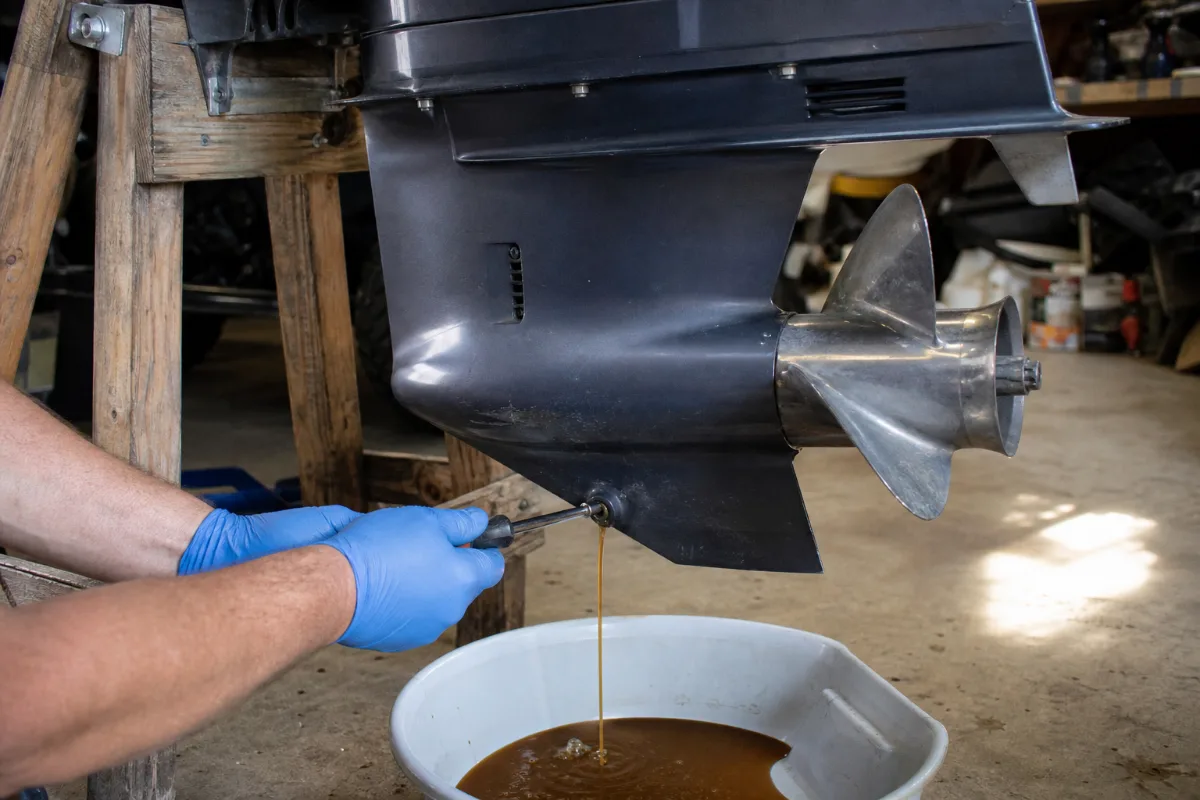
Change the lower unit gear oil. If you only do one job on this list, make it this one. Pull both the bottom drain screw and the top vent screw, and let it drain into a clean pan so you can actually see what comes out. Milky or creamy oil means water is getting in. Water in a gearcase through a freezing winter can crack the housing, and that’s the one that cost me a season on my first boat. I put together a full walkthrough of the gear oil change, including what good and bad oil look like.
Pull the spark plugs. Check the color and the gap, and swap them if they’re fouled or worn. Plugs are cheap, and a tired one is behind a lot of hard starts.
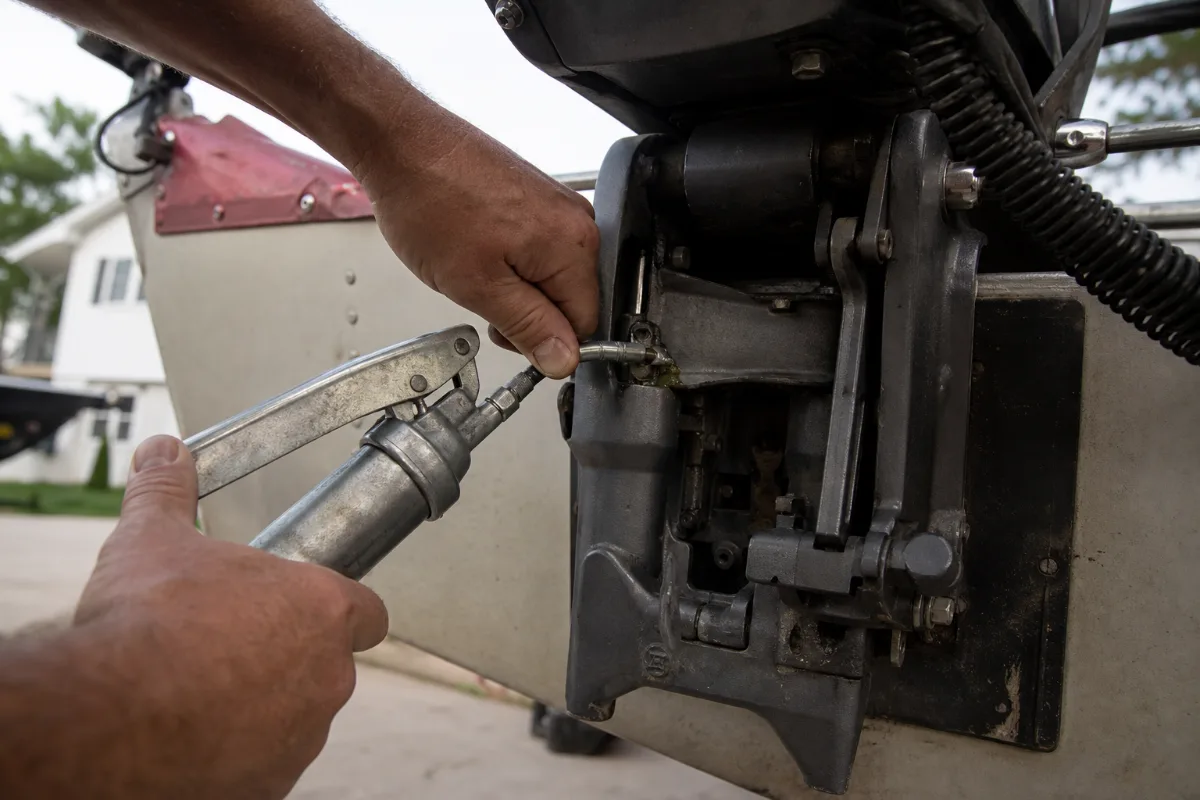
Grease the fittings your manual lists. The swivel bracket and the tilt tube usually have them. Use a water-resistant marine grease, and stop when fresh grease starts pushing the old stuff out. There’s no prize for pumping in more.
While you’re down there, check the fuel filter and the anodes. A clogged filter starves the motor when you open the throttle up. A worn-out anode means the motor’s own aluminum starts corroding in its place, and that happens a lot faster in salt or brackish water. If you run a four-stroke, you’ll also want to change the crankcase oil on whatever schedule your manual gives.
The water pump impeller, every 2 or 3 years
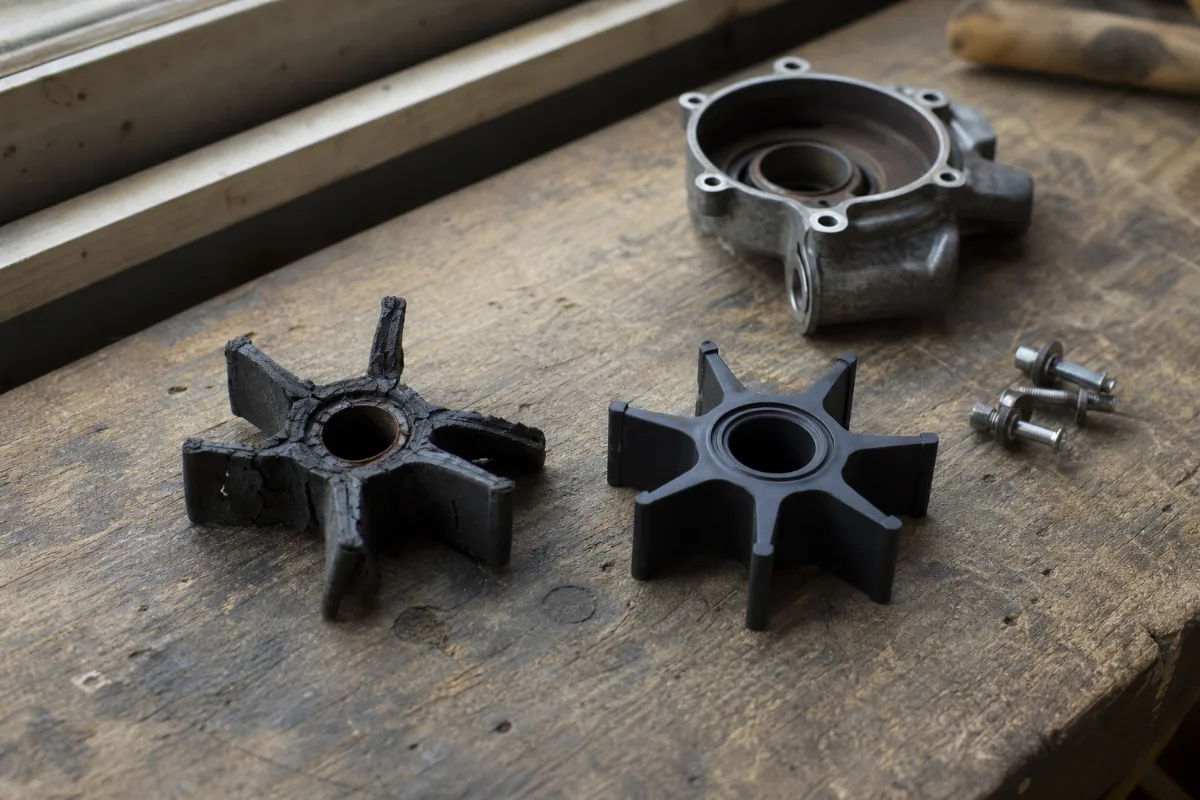
The impeller is a small rubber wheel inside the water pump, down in the lower unit. It pushes cooling water through the motor, and the tell-tale stream is a little of that water coming back out. It’s also a part that really doesn’t like sitting, which is why it gets its own spot on the calendar.
Manuals are all over the place on the interval. Somewhere between 2 and 3 years, or a few hundred hours, is common, and plenty of people go sooner in salt or silty water. Mine gets done every 3 years no matter how little the motor ran, because, turns out, a low-hours impeller that sat bent through three winters isn’t low-wear at all. The vanes go stiff and crack. Sometimes a piece breaks off and gets pushed up into the cooling passages, and then you’ve got two problems instead of one.
Doing it yourself means dropping the lower unit, so it’s a bigger job than the ramp checks or the gear oil. It isn’t hard, though. Give it an afternoon the first time and buy the full kit for your exact model, gaskets and all, instead of just the rubber wheel. For the small motors I’ve done, a kit ran somewhere around $25 to $60.
One thing that saves a do-over. When you slide the pump housing back down over the new impeller, turn the driveshaft the way your manual tells you to while you push the housing down, so the vanes curl the right direction instead of folding backward. Get that one from the manual rather than from me. Rotation is not the same on every motor, and a backward impeller is a short-lived impeller.
Storage decides whether it starts in April
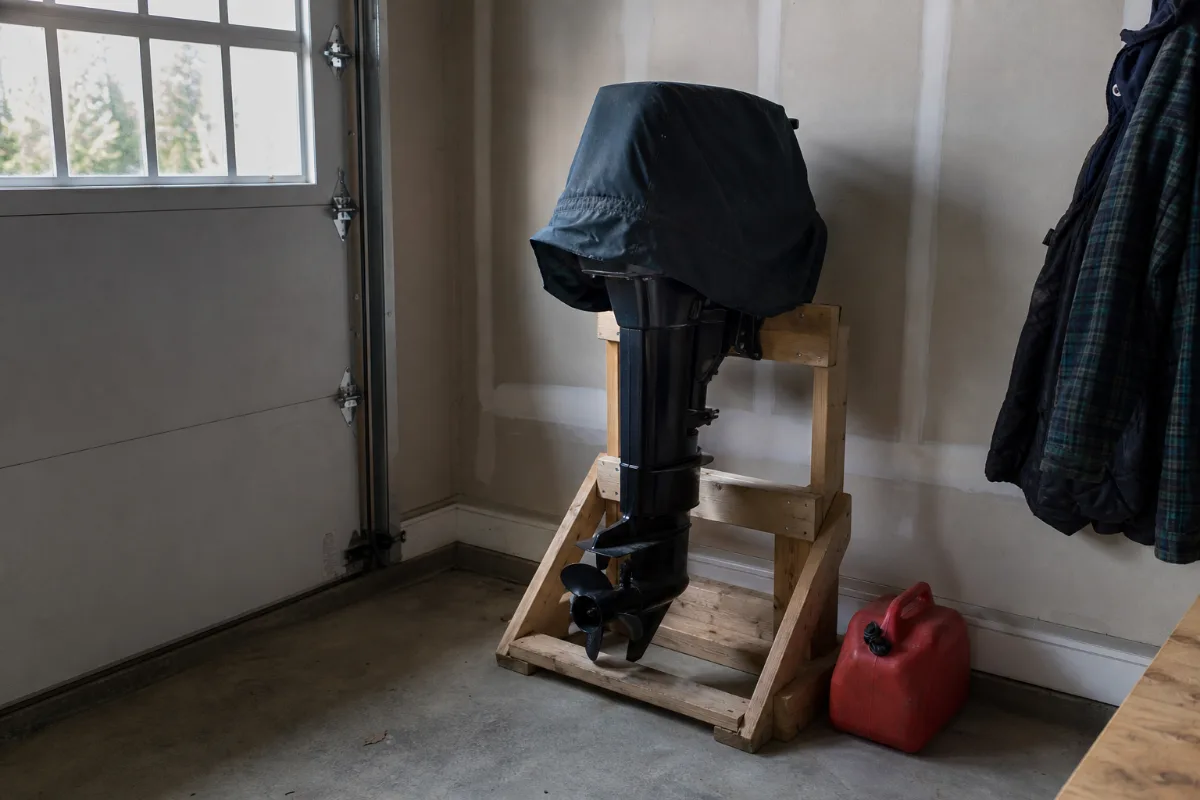
Here’s the part nobody wants to hear. How you put a motor away in the fall has a lot to do with whether it starts next spring.
My routine, short version:
- Add a marine fuel stabilizer to the tank, then run the motor on muffs for about ten minutes so treated fuel makes it all the way through.
- Fog the engine with fogging oil so the cylinder walls don’t rust while it sits. Fuel-injected four-strokes often have their own procedure for this, so read that page of the manual.
- Change the gear oil so there’s no water sitting in the gearcase over the winter.
- Store it upright on a stand, or on its side only the way the manual shows, and keep a cover on it.
Ethanol gas is behind a lot of spring no-starts. E10 pulls moisture out of damp air, and once enough water gets in, the ethanol and water drop out together as a separate layer at the bottom of the tank. No stabilizer reverses that, whatever the bottle says. It’s worth its own post, and so is the full winterizing order, step by step.
And if you skip all of it and the motor won’t idle in April, the fix is usually cleaning a gummed-up carb. Very doable. Also a total pain on a cold garage floor.
Jobs I leave to a shop, and why
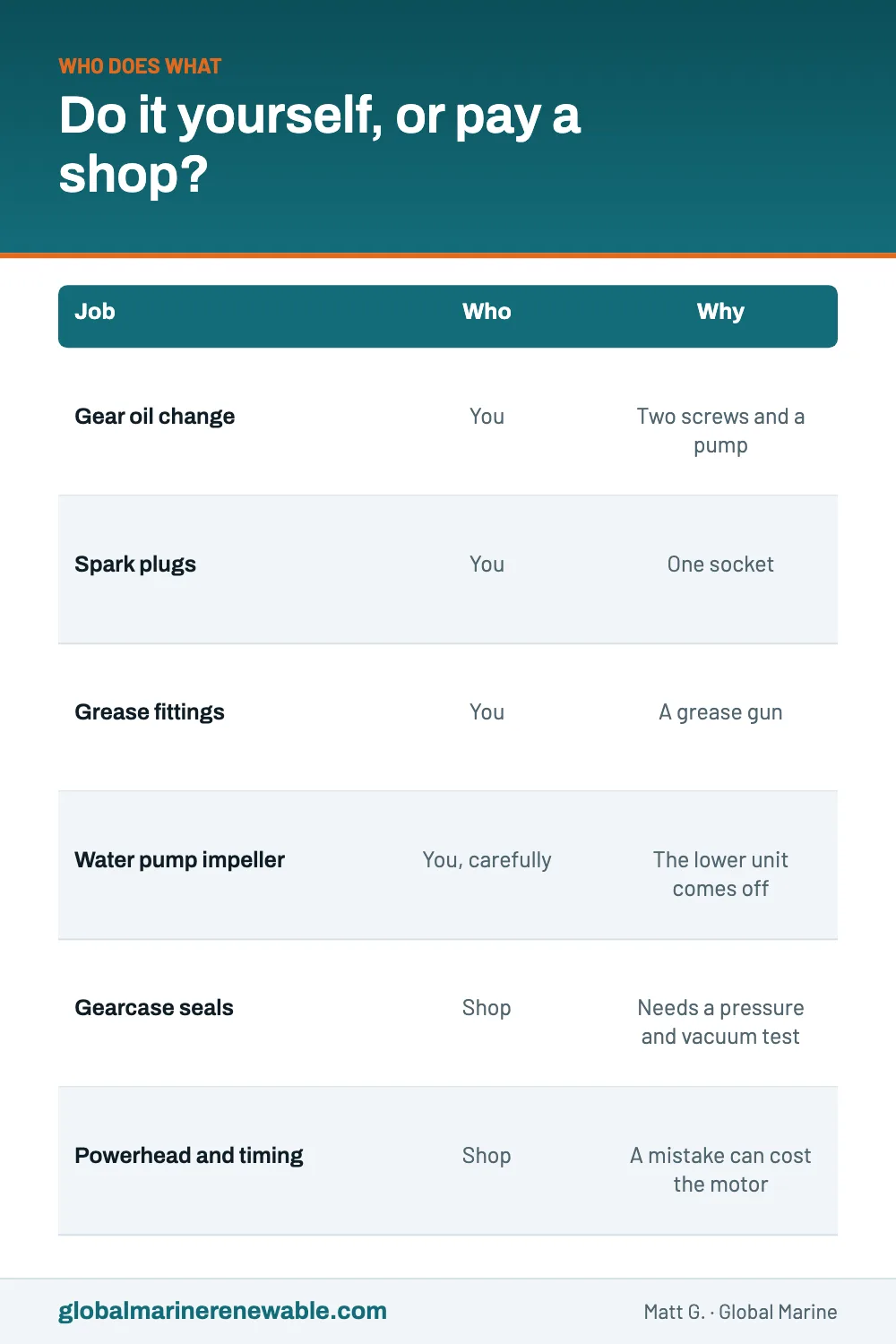
I do my own maintenance, but I keep a short list of jobs I won’t touch, and I’d suggest you keep one too.
Anything inside the powerhead is on it. So is replacing gearcase seals, because a gearcase should be pressure and vacuum tested after a seal job, and that’s a tester I don’t own and don’t need twice a decade. Syncing the carbs on a multi-carb motor goes to somebody who does it every week, and so does anything to do with ignition timing.
My rule is pretty simple. If getting a job wrong can wreck the motor, and the only way to know you got it right is a tool I don’t have, it’s a shop job until I’ve watched someone do it. A motor that ends up running lean can overheat and score a piston, and that’s the gap between a shop bill (annoying) and shopping for a new motor (not annoying, just expensive).
If the motor’s still under warranty, keep every receipt and write the dates down. Some warranties want proof the scheduled service actually happened, and a notebook in the truck costs nothing.
Parts and tools I keep in the truck
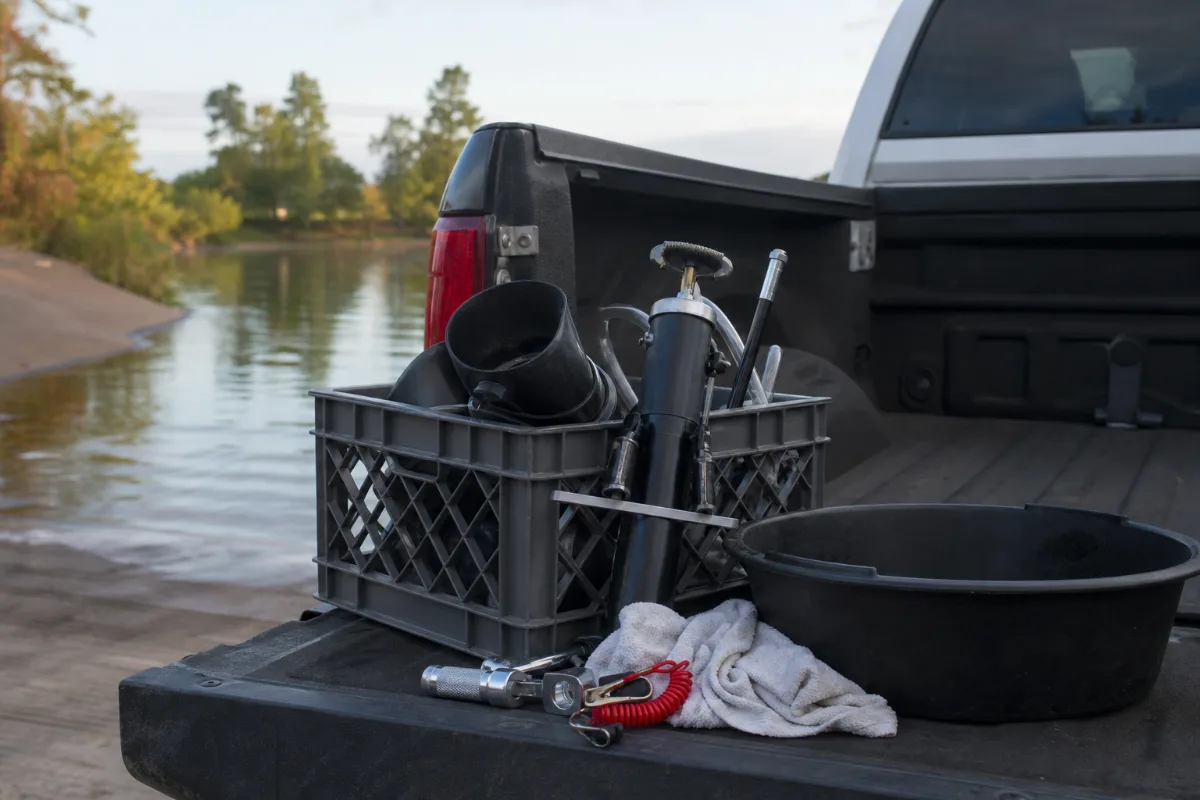
You don’t need a shop for the rest of it. A small kit covers almost everything above, and the whole thing fits in a milk crate that lives in the truck bed.
- Flush muffs and a hose
- A spark plug socket that fits your plugs, plus a spare set of plugs
- A gear lube pump, the gear oil your manual calls for, and new drain screw washers
- A grease gun loaded with marine grease
- A spare kill-switch lanyard, since most motors won’t start without the clip
- Spare shear pins and cotter pins, if your motor has a shear pin prop
- A drain pan and a clean white rag
If you only buy one thing off that list, make it the muffs. Hooked to a garden hose, they let you run the motor at home instead of at the ramp, which is how you flush after salt or check the tell-tale before a trip. The set below is sold as universal, but hold it up against your own lower unit before you trust that word.

- MOTOR ACCESSORY: Keep your boat’s engine in good condition by protecting it with the efficient and durable Shoreline Marine Dual Flow Flusher. This equipment is designed for most inboards and outboards and helps increase its life by protecting it from contaminants.
- PROTECTS ENGINE: This motor flusher helps extend your outboard engine’s life by regularly flushing away salt, silt, and grime after use. Not only clean, but you can also winterize your boat with the help of this essential boat accessory and keep your investment in good condition.
- EASY-TO-OPERATE: You can connect this boat motor flusher to a standard garden hose and help keep your motor clean by flushing away sand, salt, silt, and mud. If you need to tune your engine and make minor adjustments when on the water, you can trust this tool.
$24.99 In Stock
Paid link · price checked October 16, 2026 15:04
That last one sounds like filler. It’s not. A lot of figuring out a small outboard is looking at what came out of it, and you can’t read gear oil in a pan that’s already black.
And if the motor won’t start at all, don’t grab tools first. Work through the no-start checks from the cheapest one up, starting with that lanyard. It’s usually something dumb, and I say that as the guy who’s done most of the dumb things on this list at least once, usually on the water with somebody watching.