As an Amazon Associate I earn from qualifying purchases. This post contains affiliate links. If you buy through them we may earn a commission at no extra cost to you.
Product prices and availability are accurate as of the date and time indicated and are subject to change. Any price and availability information displayed on Amazon at the time of purchase will apply to the purchase of this product. Certain content that appears on this site comes from Amazon. This content is provided "as is" and is subject to change or removal at any time.
An outboard that won’t start is usually something cheap. Not always, but usually, and the cheap stuff takes about 5 minutes to rule out.
Before you mix a can, check it on the free 2-stroke fuel mix calculator — it also says which oil an outboard actually needs.
Mine quit on me once with the boat loaded and the wind picked up ten minutes later, which is a great way to learn this list by heart.
So here’s the order I work through on my own motor, starting with the checks that cost nothing and ending with the ones that cost money. Work it in order and you’ll either fix it in the driveway or know exactly what to tell the shop. Skipping to the middle is how people buy parts they didn’t need.
This is the troubleshooting half of the maintenance schedule I keep. If the motor started fine last season and has been sitting since, jump ahead and read the carb part first.
Start with the checks that cost nothing
Every one of these has caught me out at least once, and two of them have caught me out at the ramp with people waiting.
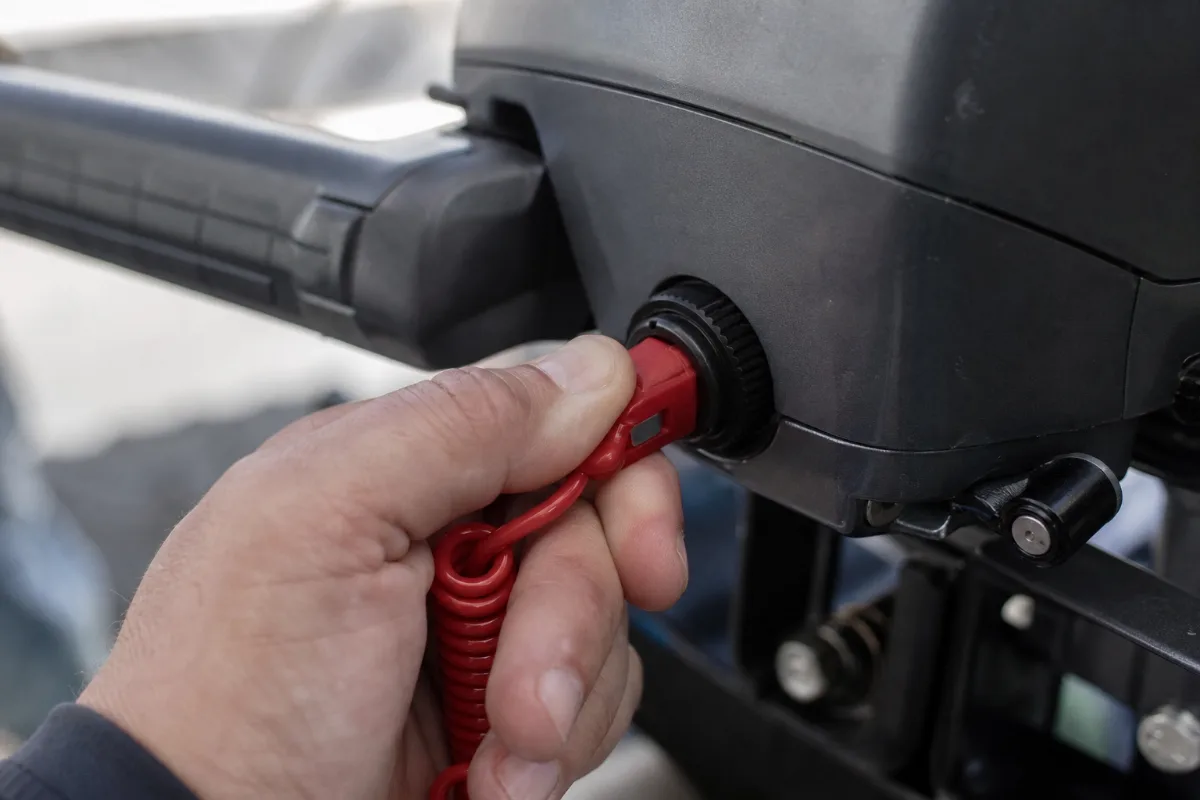
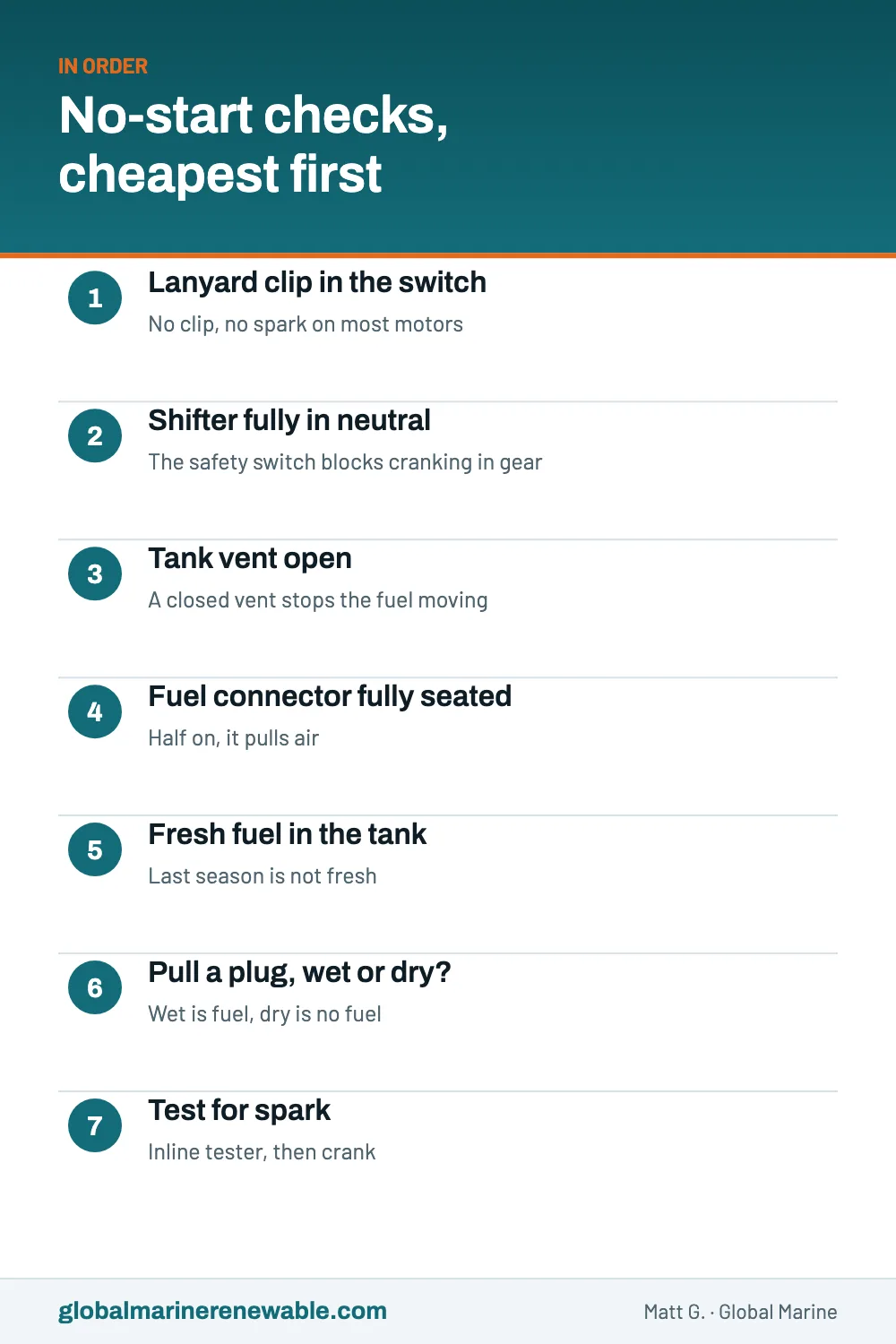
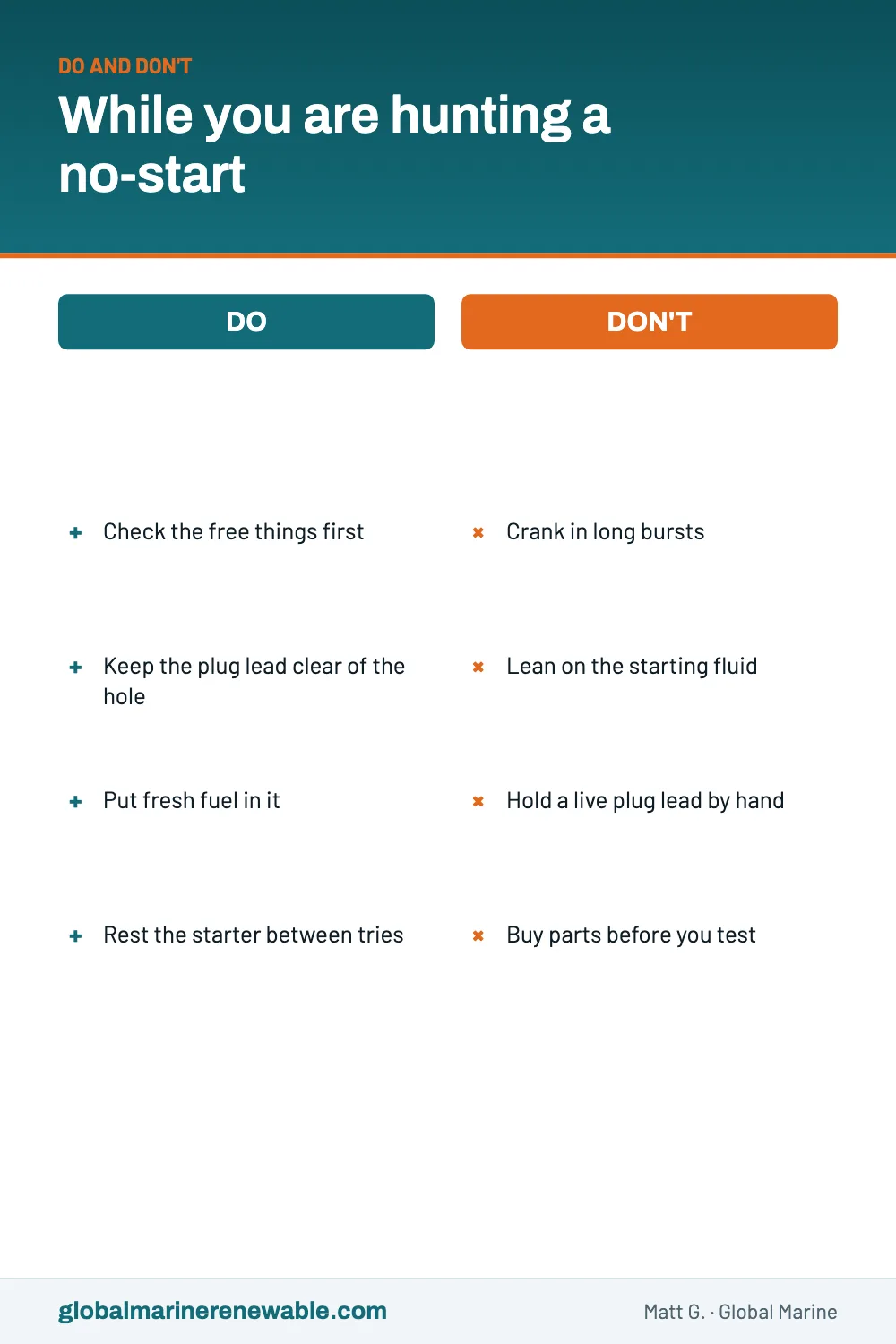
- The kill switch lanyard. No clip in the switch, no spark on most motors. It’s the first thing I check, every single time.
- Neutral. Outboards have a neutral safety switch, so a motor in gear won’t crank. Give the shifter a firm wiggle into neutral.
- The tank vent. Closed vent, no air into the tank, and the fuel stops moving. On a portable tank it’s the little screw on the cap.
- The fuel line connection. Half-seated connectors are easy to do in a hurry and they pull air instead of fuel.
- The battery switch, if your boat has one. Ask me how long I stared at a perfectly good motor with the switch off. (Answer: 20 minutes, and my buddy found it in 3 seconds.)
That’s the free list. Honestly, it fixes a lot of no-starts on its own, and it costs you nothing but 5 minutes of humility.
Cranks but won’t fire, or won’t crank at all
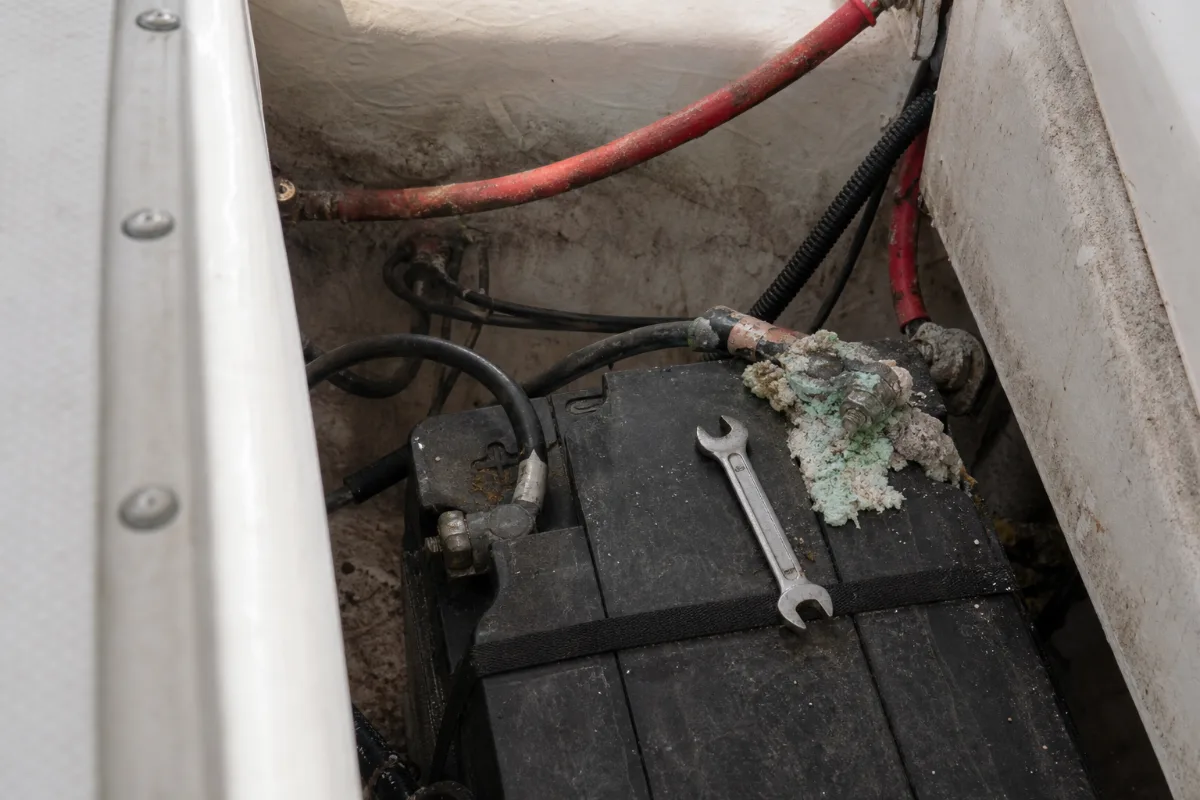
Before you go further, sort the problem into one of two piles, because they lead in opposite directions.
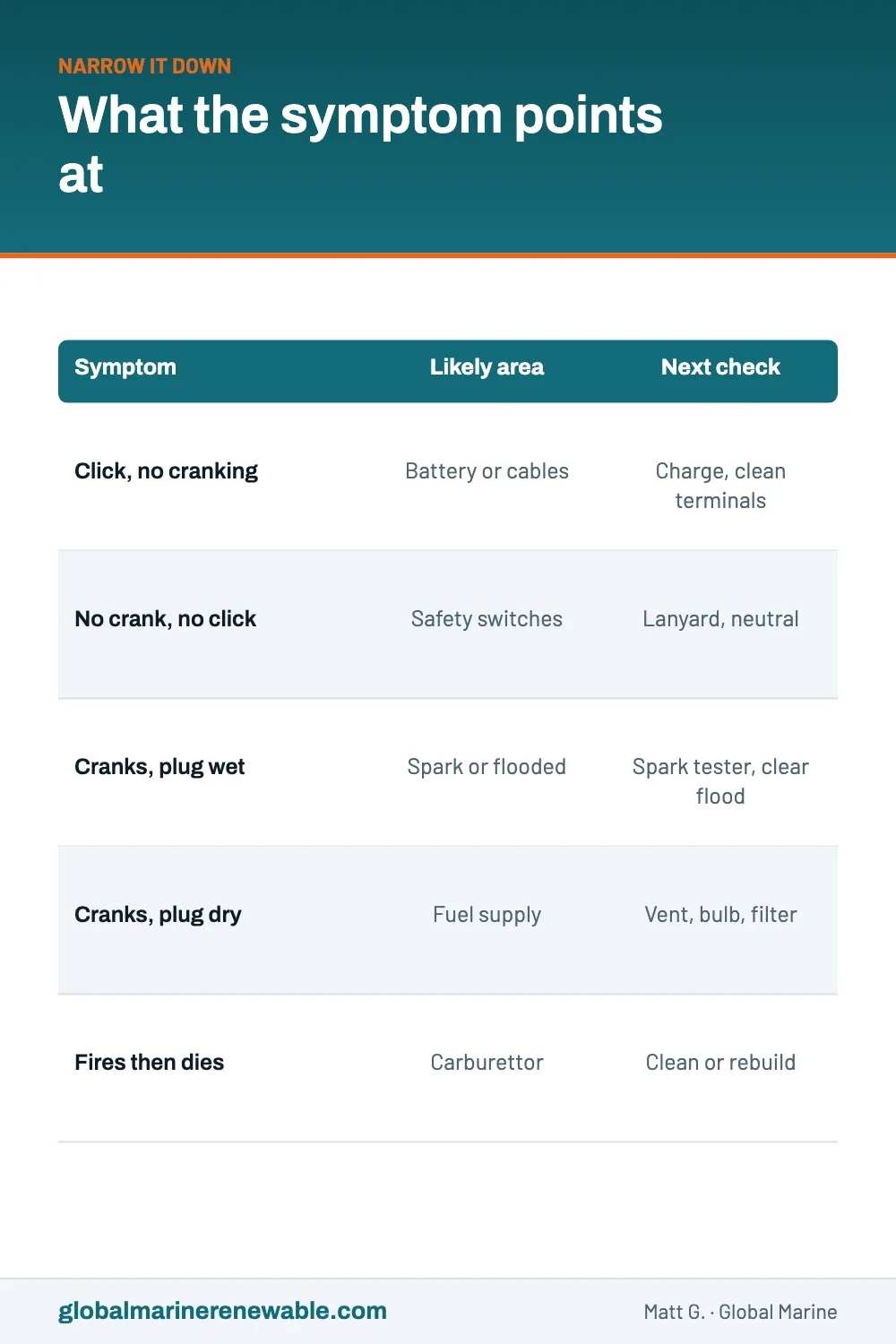
It won’t crank at all. On an electric-start motor that points at the battery, the connections or the safety switches. A clicking sound with no turning usually means the battery is flat or a cable is loose. Corroded terminals look fine until you wiggle them, so wiggle them. Turns out green crust is a great insulator. Keeping a battery charged is most of the battle, and it’s a big part of how long a marine battery lasts.
It cranks but won’t fire. Now you’re looking at fuel, spark or compression, in that order of likelihood. That’s the rest of this post.
On a pull-start motor, “won’t crank” mostly means the rope mechanism or a seized engine. A seized engine is a whole different conversation, and not a fun one.
Fuel: the tank, the bulb and the age of the gas
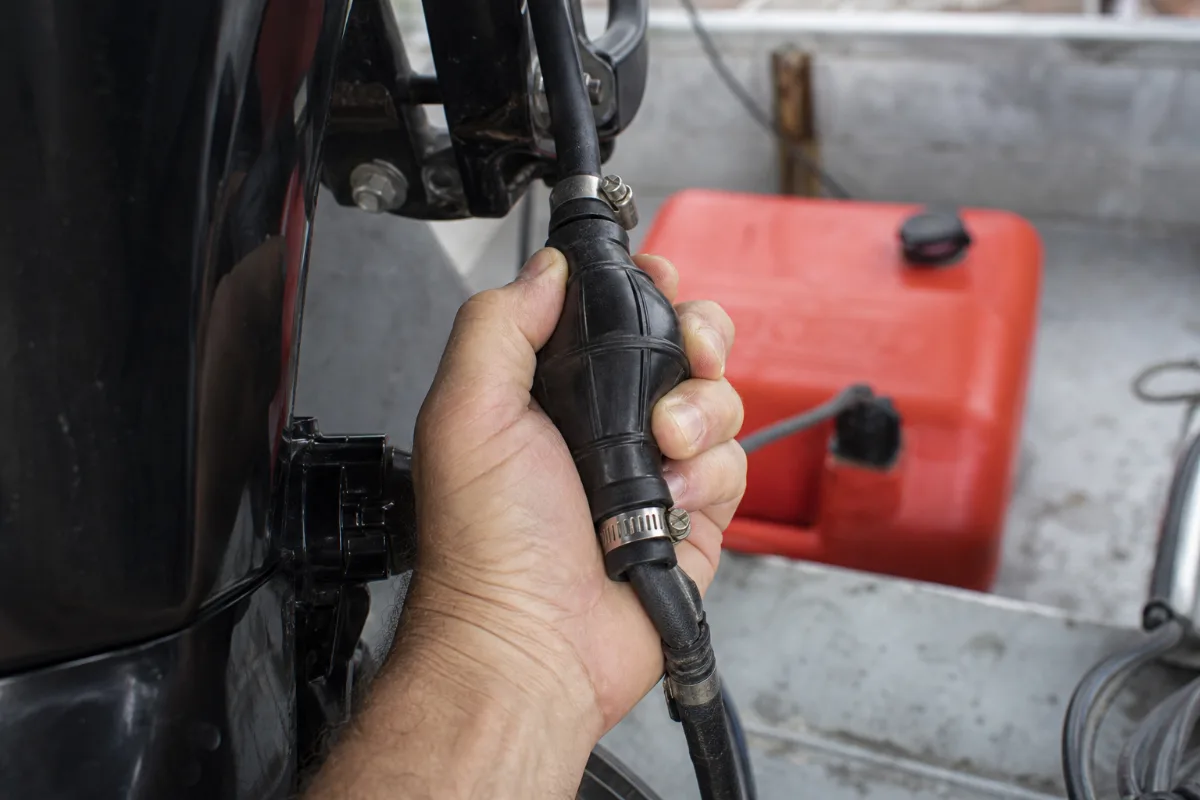
Fuel is where I look first when a motor cranks and won’t catch, because gas goes off faster than people expect.
How old is the gas? Ethanol blend fuel can start going stale in a couple of months. If the fuel in the tank is from last season, don’t fight it. Dump it, get 5 gallons of fresh gas, and start from there instead of spending an afternoon chasing it. Fighting old fuel is a total pain.
Squeeze the primer bulb. It should firm up after a few pumps and stay firm. If it stays soft, you’ve got air getting in somewhere or a blockage. If it collapses flat while the motor runs, the tank vent is closed or the pickup is blocked.
Look at the fuel filter. A clogged filter or a water-separating filter full of water will starve the motor. Clear plastic bowls make this easy, since you can see water sitting in the bottom.
Ethanol is behind a lot of spring no-starts, and what E10 actually does to a small motor is worth its own read.
Spark: pull a plug and look
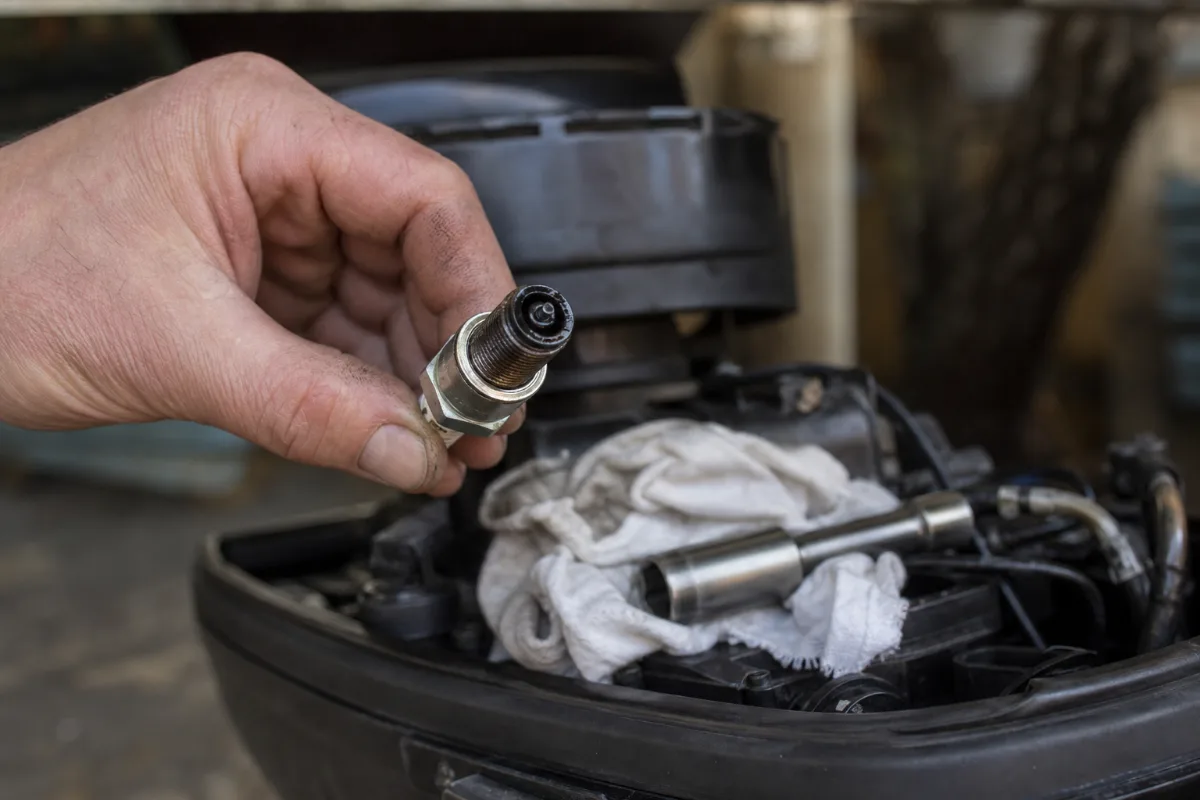
If fuel looks fine, check for spark. This is the step people skip because it feels technical, and it’s honestly the easiest test on this list.
Pull a spark plug and look at it first. A plug that’s wet with fuel means fuel is arriving, so your problem is spark or a flooded engine. A bone dry plug after cranking means fuel isn’t getting there. Either way, that one look splits the problem in half.
Then test for spark itself. An inline spark tester clips between the plug lead and the plug, and it flashes when the ignition fires, so you can see the spark without holding a live lead. Crank the motor and watch it. Mine cost about 10 bucks and has paid for itself several times over.
Keep the plug lead well away from the open plug hole while you crank, because fuel vapor comes out of that hole. And if the tester shows nothing on any cylinder, check that lanyard clip again before you blame the coil.
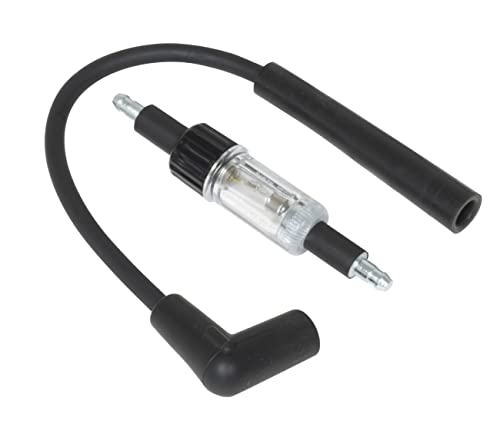
- Gives a Visual Check of the Ignition System.
- Quickly diagnose problems with all ignition systems. Connect the tool between the spark plug and the plug wire.
- The tool is double-ended to offer a straight boot and a 90boot on one tool. With the engine running, the tool flashes a mirror image of ignition spark.
$14.63 In Stock
Paid link · price checked October 16, 2026 15:04
Flooded, or just cold?
A flooded engine smells like a gas station and refuses to fire. It happens when the choke or primer has been used too enthusiastically, which on a cold morning is easy to do.
On a carbureted motor the usual fix is to hold the throttle wide open, with the choke off, and crank it for a few seconds. That pulls air through and clears the extra fuel. Some motors have a specific flood-clear procedure, so check your manual before you lean on the starter.
The opposite problem looks similar. A cold motor that hasn’t had enough choke or primer won’t catch either, and you’ll get a cough and nothing more. If you’re not sure which one you’re dealing with, pull a plug. Wet means flooded, dry means starved.
Give the starter a break between attempts. I keep it to about 10 seconds of cranking, then 30 seconds off. Cranking in long bursts overheats an electric starter, and an overheated starter is not a problem you want stacked on top of the first one.
After a winter of sitting, suspect the carb
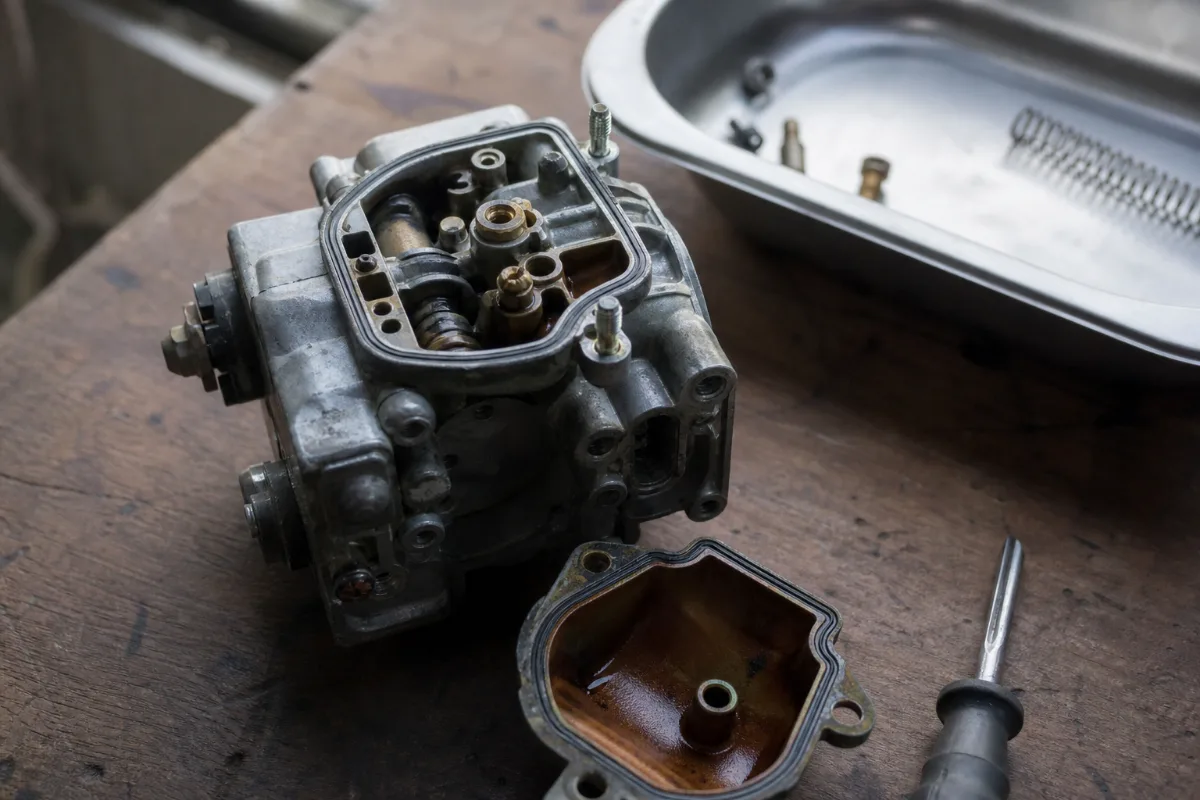
If the motor sat over the winter with untreated fuel in it, the carburetor is the first place I look after the free checks. Gas evaporates and leaves varnish behind, and the passages inside a small carb are tiny.
The symptom shape is familiar: it fires on starting fluid or a primer shot and dies, or it idles badly and picks up once the throttle is open. That’s a carb passage doing a bad job of metering fuel.
Sometimes a clean without removing the carb is enough, and I have a whole walkthrough of cleaning a gummed-up carb. Sometimes the carb has to come off and get properly cleaned, and on a really neglected motor a rebuild kit is the honest answer.
The way to never read this section again is to store the motor properly. Treated fuel, run through the system, before the motor sits.
What I’d pay a shop to sort out
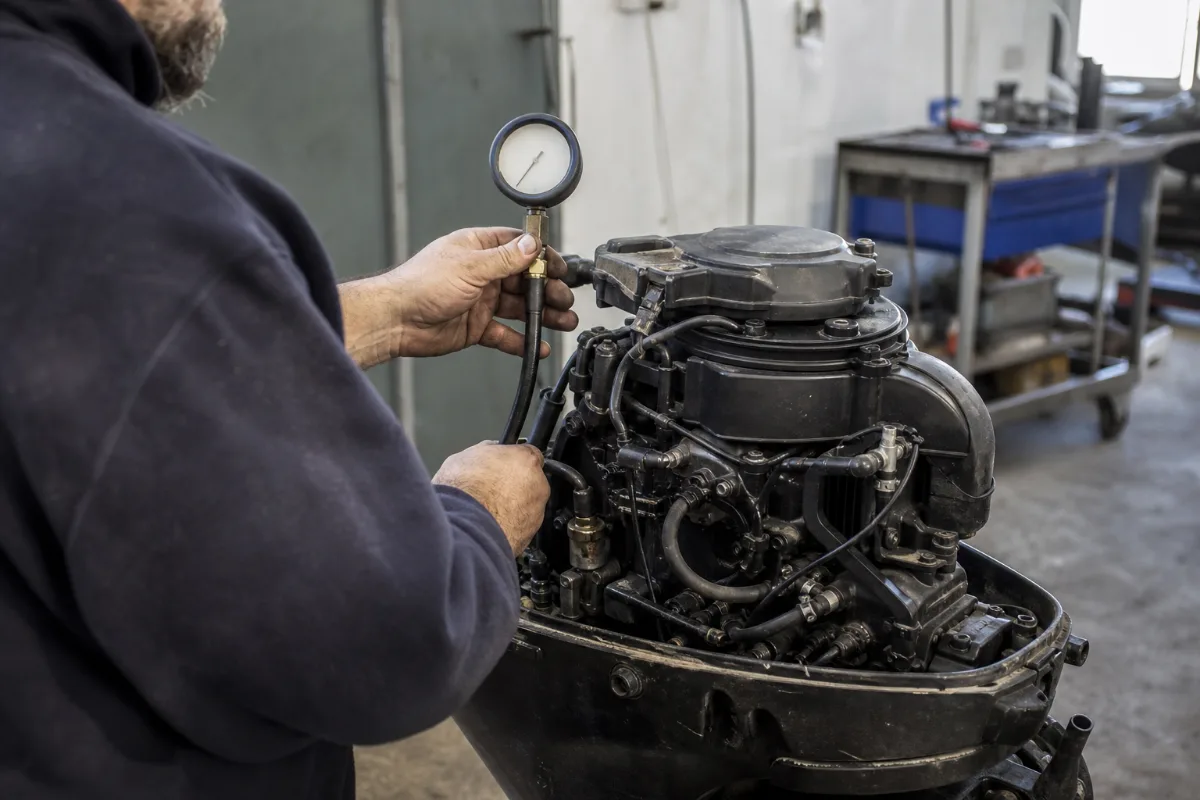
There’s a point where more guessing costs more than a diagnosis. For me it’s here:
- Spark on some cylinders but not others. That’s ignition parts, and testing them properly needs the manual’s procedure and sometimes a meter.
- Good spark, good fresh fuel, still nothing. Next stop is a compression test, and a shop will do it faster than you’ll buy the gauge.
- It started, ran rough, and quit for good. Especially if it overheated first. That needs looking at before anyone puts hours on it.
- Anything electrical you can smell. Burnt insulation is not a wait-and-see thing.
Before you call, write down what you found. Wet plug or dry, spark or no spark, fresh fuel or old, whether it cranks at all. Honestly, 10 minutes of notes can save an hour of shop time, and the mechanic will like you for it.
And if it does turn out to be something dumb, join the club. I once had a motor “fail” on the transom for a whole afternoon because the fuel connector was half on. That one cost me a season of teasing from the guy who spotted it in about 4 seconds.