
The best kayak for a family is usually a wide sit-on-top tandem with a third seat in the middle, or a three-person inflatable, and the one to buy is the one that still has room left when everybody’s in it with their stuff. Not the one with the biggest number on the box.
I’ve been paddling lakes and slow rivers for close to twenty years, and here’s my gripe with almost every kayak review out there. They’re written on flat water with an empty boat. You’ll never paddle in that condition with kids. You’ll paddle loaded, with a cooler, a wet dog maybe, and one child who just discovered they can rock the boat on purpose. So let’s do this the loaded way.
A fair warning first. I haven’t paddled every boat below with a family aboard. The specs come from the makers’ listings and from reviewers who measured them, and I’ll say which is which.
Three Ways to Fit a Family in One Boat

There are really only three setups that work for one adult or two with a kid or two. Each one trades something.
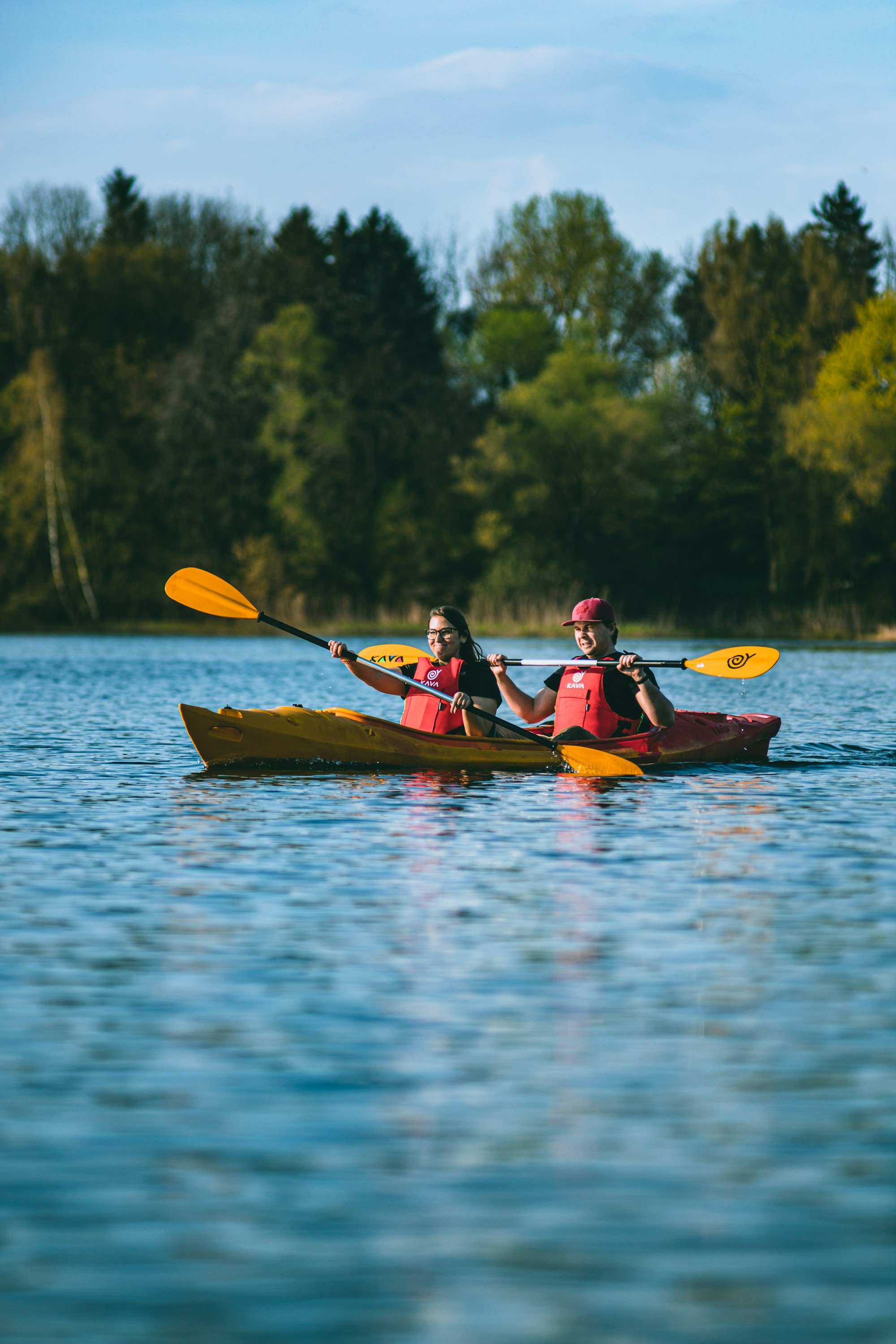
A sit-on-top tandem with a center seat is the most common answer. Two adults paddle from the ends, and a small child rides in the middle. A three-person inflatable gives you more room and a higher weight limit, and it packs into a car trunk, but it catches more wind. The third option is the one people forget: one tandem for a parent and the older kid, and a small kids’ kayak tied alongside, or a second adult boat. That’s two boats to carry to the ramp, sure, but nobody’s crammed in, and I’d honestly pick it for kids over eight or so.
If your kids are already old enough to paddle their own boat, read our kayaks for kids post instead. This one is for the years when they’re passengers.
Do the Weight Math Loaded, Not Empty

Every kayak has a maximum capacity printed on it. Turns out that number is roughly where the boat’s close to swamping. It sure isn’t where it paddles well.
The rule of thumb paddlers pass around is to keep the load under about 70 percent of the max. Some sources say 60 to 70. Eddyline, a kayak maker, says flat out that there’s no industry standard for an “ideal” capacity. So treat 70 percent as a sanity check, not a law. Above it, a boat sits lower, gets slower and tracks worse, and the first time the wind picked up on a loaded boat of mine, I felt every pound of it.
Here’s a real family load. One parent at 180 pounds, two kids at 60 and 45, plus a dry bag, water and snacks at about 20. That’s 305 pounds before anyone sits down. Now hold that up against the boats below. Seventy percent of 500 pounds is 350, of 425 it’s about 298, and of 650 it’s 455.
Add a second adult at 160 and you’re at 465 pounds. That’s over the Malibu Two’s 425 pound max, 93 percent of the Lifetime’s 500, and just past 70 percent of the Sea Eagle’s 650. That’s when the “two boats” option starts looking smart. Our post on whether weight matters in a kayak goes deeper on what extra weight does to a hull.
Three Boats Worth a Look

Lifetime Sport Fisher 10 ft. A hard-shell sit-on-top, about 10 feet by 36 inches, with three seating positions and two padded backrests you move to whichever two you’re using. Retail listings give it a 500 pound capacity. It’s heavy, though, at 73 pounds per one lineup listing, so it’s a two-adult carry to the water. We’ve reviewed the Lifetime tandem on its own if you want the long version.
Ocean Kayak Malibu Two. A 12-foot sit-on-top, 34 inches wide, built for two adults with a small child or a dog in a center seat that’s listed at 16.25 inches wide. Most listings give 425 pounds. One of the distributor’s own pages lists a usable capacity of 375 pounds, which tells you even the maker knows the top number isn’t the comfortable one. Don’t confuse it with the Malibu Two XL, a longer boat at 13 feet 4 inches.
Sea Eagle 370. A three-person inflatable, 12 feet 6 inches long, rated at 650 pounds. Packed, Paddling Magazine lists it at 31 by 19 by 8 inches, which fits in a trunk. The listed weight is 32 pounds. OutdoorGearLab weighed theirs with its bag at 42.8, so plan your carry around the bigger number. The catch with any inflatable is wind. It sits high and light, and on a breezy afternoon it moves like a beach ball with paddles.
Getting It to the Ramp Is Half the Trip

Nobody puts this in the review either. Before a family kayak ever floats, somebody has to lift it onto the car, drive it, lift it off and carry it to the water, usually while a kid asks if we’re there yet.
A hard-shell tandem at 73 pounds is a two-adult job on and off a roof rack. If you’re the only adult on the trip, I’d think hard about that. A cart with two wheels that straps under the hull makes the walk from the parking lot easy, but you still have to get the thing up onto the roof and back down. I’ve watched plenty of people at the ramp wrestle a big tandem off a tall SUV alone, and it never looks fun.
That’s where an inflatable earns its keep. At 42.8 pounds with its bag, by OutdoorGearLab’s scale, one adult can carry the Sea Eagle from the trunk to the shore. You pay for it in setup time, though: pump it up, clip in the seats, then deflate it, dry it and fold it once you’re off the water. With tired kids, that last part takes longer than you’d guess.
My advice is to do a dry run in the driveway. Load the boat on the car, take it off, put it back. If that wears you out at home, it’ll wear you out worse at a busy launch on a Saturday, and a family trip that starts with a fight over the roof rack doesn’t usually get better on the water.
Sit-On-Top Beats Sit-Inside With Kids

Kids fall in. Sometimes on purpose. On a sit-on-top, they slide off, you grab a PFD strap, and they climb back on over the side. On a sit-inside, a capsize means a cockpit full of water and a long swim to shore, towing a boat you can’t empty.
Those holes in a sit-on-top’s deck are scupper holes. They let splash drain back out, so a kid who just did a cannonball off the side doesn’t leave you sitting in a puddle. If they make you nervous, we explain why sit-on-tops have holes. Short version: the boat’s meant to have them.
Who Sits Where

I always put the adult who knows what they’re doing in the back. The stern seat steers, and a kid in the bow can’t help with that, honestly, no matter how hard they splash. The child rides in the middle or the front, where you can see them the whole time.
With two kids and one adult, put the heavier kid in the middle, closer to you. Then check the trim before you leave the shallows. If the bow’s dug in and the stern’s riding high, the boat will wander every time you stop paddling. Shift the dry bag until it sits level. Our post on where the heavier person should sit covers the two-adult setups.
Life Jackets That Actually Fit


This part isn’t up for debate. The Coast Guard’s federal rule says a child under 13 has to wear a Coast Guard-approved life jacket on a recreational boat that’s underway, and a kayak is a boat. Your state may have its own age, so check it.
Kids’ life jackets are sized by weight, not chest size like adult ones. Hawaii’s boating division lists the usual three sizes: infant under 30 pounds, child 30 to 50, and youth 50 to 90. A jacket that’s too big rides up over a kid’s ears in the water, so do the test at home. Put it on, buckle it, lift them by the shoulders. If it slides up past their chin, it’s the wrong size. Here’s our rundown of life jacket types.
The First Trip Out

Pick small, calm water for the first one. Trust me on this. A pond or a quiet cove, not the big open lake. Go in the morning, before the afternoon breeze builds, and stay close enough to shore that you could swim it with a kid in tow. Set a turn-around time before you launch, and turn around at it even if everyone’s having fun. The paddle back is always the long one.
It’s the end of October as I write this, and if you’re shopping now, the first trip is probably next spring. Good. Use the winter to load the boat on the lawn, sit everyone in it, and practice getting in and out at the ramp in your head. Then dress for the water, not the air, on that first spring day. Early season water is a lot colder than a sunny morning makes it feel.