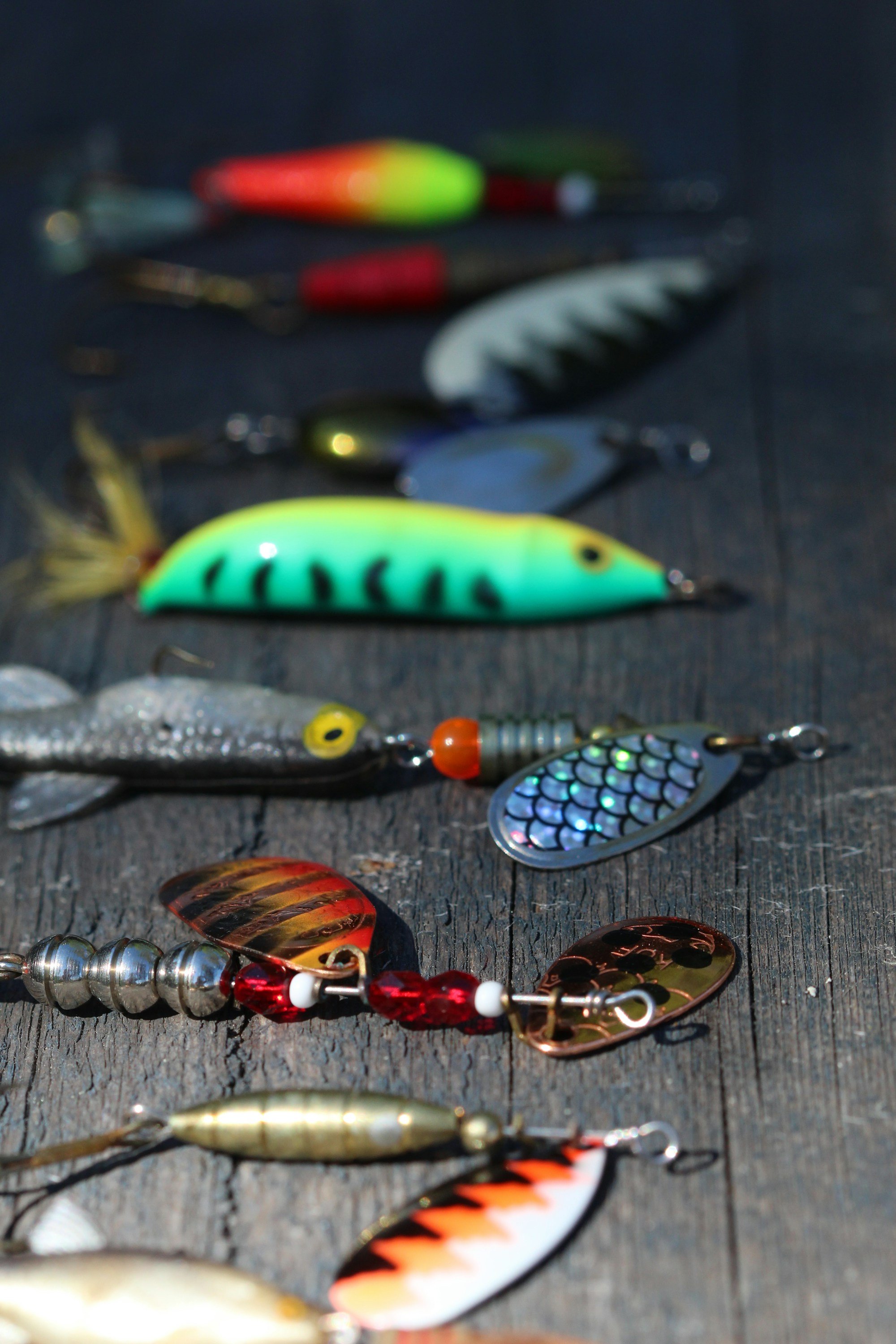

The six fishing lure types worth knowing are crankbaits, jigs, spoons, spinners, soft plastics and topwater lures. A crankbait covers water, a jig works the bottom, and a spoon throws flash. A spinner thumps, a soft plastic crawls, and a topwater lure makes a mess on the surface. Pick by the fish you’re after and how clear the water is.
Honestly, most tackle walls are built to catch you, not fish. One shop aisle can hold hundreds of colors of the same lure. Turns out nearly all of it sorts into those six groups, and once you see that, the wall gets a lot quieter.
I’ve spent about two decades in small boats and kayaks on lakes and slow rivers, and I’m no fishing guide. So here’s how I’ll do this. How each lure is built and how it moves comes from the reference write-ups I read for this piece, and they’re named under the graphics. Where I’m passing on what other anglers swear by, I’ll say so.
Which Lure for Which Fish

Start here if you only want the short answer. This chart lists what anglers most often throw at six common fish. It’s a starting point, not a law, and your local bait shop knows your water far better than I do.
Two notes on that chart. Walleye see well in low light, so they feed hardest at dawn and dusk, on cloudy days, and under choppy water. Anglers even have a name for it. “Walleye chop” means a ruffled surface from a wind of about 6 to 16 mph. So the day the wind picked up and you wanted to head for the ramp might be the day to stay out, if your boat’s up to it.
Smallmouth get pickier as the water cools. The usual advice is to go smaller then, with hair jigs or little spinners, and use soft plastic tubes or spinnerbaits the rest of the year. Anglers run 6- to 15-pound line for them, depending on the water.
How a Lure Actually Gets a Bite

A lure’s just fake food on a hook. It works by looking or moving like something a bigger fish wants to eat, and most are made to look like a hurt or fleeing baitfish. Some don’t look like food at all. They’re built to annoy a fish into biting, playing on its aggression or its need to guard a patch of water. Fishermen have been at this for a long time, too. Archaeologists put lures back at least 12,000 years.
A fish has a few ways of noticing your lure. It can see flash and color. It can also feel you coming through its lateral line, a sense organ along its body that picks up vibration in the water. That’s why a noisy lure can work in water so muddy you can’t see your own paddle blade.
The rest is on you. Every lure gets its action from how you wind the reel, sweep the rod or lift the rod tip. That’s the retrieve, and the reference books put it on par with the lure itself. It’s why two people can throw the same thing and only one catches fish (I’ve been the other guy plenty).
Crankbaits and Plugs: For Covering Water

A crankbait’s a hard-bodied lure, usually with a bill or lip on the front and two treble hooks hanging off it. Wind it in and the lip digs into the water, pulling the lure down and giving it a tight side-to-side wobble. The name comes from that plain, steady cranking on the reel. If you can cast and wind, you can fish one, so I’d call it the easiest lure on this list for a beginner. Give it 30 minutes on one stretch of bank before you decide it’s not working.
There are three flavors. A shallow-diver runs a few feet down and floats back up when you stop winding. A suspending model holds its depth when you stop. A deep-diver sinks, then stays at a steady depth as you reel. As a rule, the bigger the lip, the deeper it goes.
The plug has a good story behind it. James Heddon, a beekeeper from Dowagiac, Michigan, was whittling by a millpond in the late 1800s. He tossed the scrap of wood in as he got up to leave, and a big bass hit it as it wobbled down. He went home and started experimenting, and his Lucky 13 plug is still on sale today.
One close cousin is the jerkbait. It’s a slim minnow shape with a short, steep bill. You flick the rod as you reel so it darts and stalls like a dying baitfish. Pike anglers like them, and so do smallmouth anglers.
Fair warning: all those trebles will find every stump in the lake. On a kayak, unhooking a crankbait from a snag means paddling over to it, and that’s a real chore when the wind picked up an hour ago.
Jigs: For the Bottom and for Slow Fish

A jig’s the simplest lure there is. It’s a hook with a lead weight molded on near the eye, usually dressed with a soft plastic body, rubber skirt or hair. You let it sink, then lift the rod tip in short hops and let it fall again. They’re especially handy for slow-moving fish, and crappie anglers live on light ones.
Sizes run from about 1/80 of an ounce for panfish up to nearly a pound for big saltwater bottom fish. A round head’s the most common. Bass anglers mostly use three other shapes: the flipping head and the football head, plus one built for grass. There’s also the old bucktail jig, dressed with deer hair, and plenty of folks in the northern and midwestern states still tie their own.
The tricky part is feeling the bite. You need a sensitive rod and a tight line, or you’ll never know a fish picked it up. And because the weight has to move too, you’ve got to set the hook harder than you would with a light lure. The little jig in this photo’s clipped to the rod’s hook keeper, which is exactly where it should ride in a boat (ask me how I know).
Spoons: For Flash and Long Casts

Put a kitchen spoon on a hook and you’ve about got it. A spoon’s a curved metal blade, and water pushing on that curve makes it wobble and dart. It throws off sparkles like a baitfish’s scales, and the wobble stirs the water the way a fleeing fish does. Silver and gold finishes add more flash.
This is an old idea. Nordic people were making spoon lures from iron and bronze, even copper, between the 8th and 13th centuries, and the modern spoon seems to come out of Scandinavia in the late 1700s.
You’ll see two main types. A casting spoon’s thick and heavy, so even a 1/4-ounce one flies a long way into a breeze. A trolling spoon’s made of thinner metal and is towed behind a boat. That’s why a spoon suits a small boat with a trolling motor on the transom. You can run slow on a little thrust, let the spoon wobble behind you, and cover a lot of lake while you eat your sandwich.
Spinners and Spinnerbaits: For Murky Water
A spinner has a metal blade that spins like a propeller as you reel. On an in-line spinner, that blade turns around a straight shaft. On a spinnerbait, a wire bent at about 60 to 90 degrees holds the hook at the bottom and the blade on top. That safety-pin frame guards the hook point, which is why spinnerbaits slip past weeds better than you’d expect.
The blade’s the whole show, and it does two jobs: flash and vibration. Different shapes favor one or the other, so match the blade to the water.
The Indiana blade sits between those two and is the one you’ll find on most in-line spinners. Spinnerbaits often run a Willowleaf with a Colorado just ahead of it, so you get some of both. If I only owned one in muddy water, I’d want the Colorado, since you can feel its thump through the rod and know it’s working.
Soft Plastics: For Slow, Picky Fish
Soft plastics are rubbery lures shaped like worms, lizards, frogs and small fish. They’re usually rigged on a jig head, which is why this group and the jigs above overlap so much. A swimbait’s the fish-shaped version, with a tail that kicks as it’s pulled through the water.
Plastic worms are on nearly every list of what catches largemouth. You drag them slowly, let them sit, and wait. It’s not exciting, and I think that’s the reason it works. They’re also cheap. A $5 pack lasts a good while, and you won’t cry when you lose one to a stump.
One tip I wish I’d read years ago. Black bass lean hard on scent when they feed, so stuff on your hands can put them off. That means sunscreen, bug spray and tobacco. Wash up before you handle a soft plastic. On a hot day on the water that’s easy to forget, since you’re wearing half a bottle of SPF 50.
Topwater Lures: For the Fun Part
Topwater lures float, and they look like prey on the surface. Some pop, some burble, and some buzz. Nothing else in fishing feels quite like seeing a fish come up and hit one 20 feet from your boat.
They’re the hardest group here to fish well. Working one takes time to learn, and there’s a whole technique called “walking” that swings the lure side to side, so it swims like something alive. The usual advice from other anglers is to fish them early and late, when the water’s calm. I can’t prove that with any data, but I’ve never heard anyone argue the other side.

Smallmouth have a real reputation here. They’re known for how hard they fight on topwater, and many anglers rate them above any other black bass for that.
What I’d Put in a Small Tackle Box First
You don’t need the whole wall. A loaded kayak has no room for it anyway, and every extra box changes how the boat sits and how well it’s tracking. If I were starting over with about $40, I’d buy five things and learn them properly. (Yes, I own far more than five. Do as I say.)
That covers the top of the water, the middle and the bottom. Before you buy, it’s worth reading how to organize a tackle box, because a small box only stays small if you’ve got a system. Tie your lure on with an improved clinch or a Palomar knot, or a small snap if you plan to swap lures a lot. Our guide on how to tie a fishing hook walks through the knots. And if you’re after bass from a kayak this season, I wrote up how fall largemouth fishing works too.
Go Easy on the Fish You Let Go

Lures have a nice side benefit if you release what you catch. A fish tends to swallow a lure less deeply than live bait, and deep hooking is tied to higher death rates in release studies. Taking fewer baitfish out of the water doesn’t hurt either.
Keep the fish wet while you work on the hook, and be quick about it. Pike need extra care, for your sake as well as theirs. They’ve got a mouthful of sharp teeth, so bring long forceps. The pike guides I read suggest 30-centimeter clamps and barbless trebles to make unhooking simpler.
Rules vary a lot by state, too. Some set a minimum size on walleye (15 inches is the Michigan figure you’ll see quoted), and some cap how many rods you can run. So check your state’s fishing regulations before you go. Then pick one lure from that list, learn it for a season, and see what the fish think.