The best bass day I had last year came on a gray morning in late October. It was 41 degrees at the ramp (I checked twice), and my fingers didn’t want to tie a knot.
The lake was empty. Turns out that’s a good sign. The bass boats had pretty much all gone home for the year, and the fish were up shallow, eating like they knew what was coming.
That’s fall bass fishing from a kayak in one morning. It can be the best fishing of the year, and it happens in water cold enough to kill you if you go in wearing the wrong clothes. Both halves matter, so here’s both: where largemouth go as the water cools, what I throw at them, and what I wear so a flip stays a bad afternoon and nothing worse.
Fall Starts When the Water Cools, Not When the Calendar Says
Bass don’t read calendars. They read the water temperature.
Mike Bednarski, the fisheries chief at Virginia’s Department of Wildlife Resources, wrote a fall piece I keep going back to. He says water temperatures drop from their summer peak, typically the upper 80s in Virginia, into the 70s and 60s, and that change makes fish move. Summer patterns fall apart.
His advice for that stretch is short (I wish I’d read it ten years earlier). If you don’t catch a fish in your first half hour in an area, move.
A kayak is slower than a bass boat, so I take that seriously (I’m not paddling across a reservoir on a hunch). I pick one arm of the lake, give the mouth of a creek half an hour, and then either stay or work deeper into it.
He also says the fish stay active as the water falls into the 50s and slow down a lot once it gets into the 40s. So the one number I want before I make a cast is the water temperature. My fish finder shows it in the corner of the screen. If you’re shopping for one, our kayak fish finder roundup is where I’d start, and a cheap thermometer on a cord does the job if you’d rather not spend the money yet.
Turnover Is Real, but It’s Short
Somebody at the ramp will blame turnover for every bad day between September and Christmas (I used to be that guy). Bednarski calls that an excuse.
Here’s what actually happens. As the top of the lake cools, it gets denser and sinks, and it mixes with the water at the bottom. That bottom water is often short on oxygen and full of nutrients, so for a while the whole lake gets worse and the fish get stressed. He says turnover usually happens as the water falls into the low 60s and upper 50s, and it resolves in about a week or two.
So it’s a week, maybe two. Not a season. And it’s the deep, open main lake that turns over, the big water you’d paddle across to reach the creeks, so that’s the part to skip while it’s happening.
When you hit it, his fix is a kayak angler’s dream. Look for big creeks that are shallow, under 6 feet, because shallow water doesn’t stratify and may not turn over at all. Better yet, a lot of those creeks have fresh water running in, which keeps things more stable. His favorite bait there is a soft stickbait, wacky rigged, on a spinning rod, thrown at shallow targets.
That’s skinny water a bass boat has a hard time getting into. A kayak slides right up it, and that’s genuinely the best thing about fishing from one on the water in the fall. I’ll paddle up a creek until the hull starts scraping, then turn around and fish my way back out with the current.
Find the Shad and You’ll Find the Bass
Fall is when the year’s crop of baitfish has grown up. Bednarski says the young fish born in the spring are 3 to 4 inches long by now, and in most reservoirs that means shad. Bass key on them and stay on the hunt.
That’s why fall is feast or famine. The bass move with the bait, so a spot that was on fire Tuesday can be dead on Thursday. Honestly, that’s the part that makes people quit in October.
So I watch for bait before I watch for bass. Birds working the surface (gulls, mostly, on my lake). Shad flicking on top at first light. Clouds of bait on the sonar in the back half of a creek. Where I fish, the shad push up into the creeks as the water cools, and the bass follow them in.
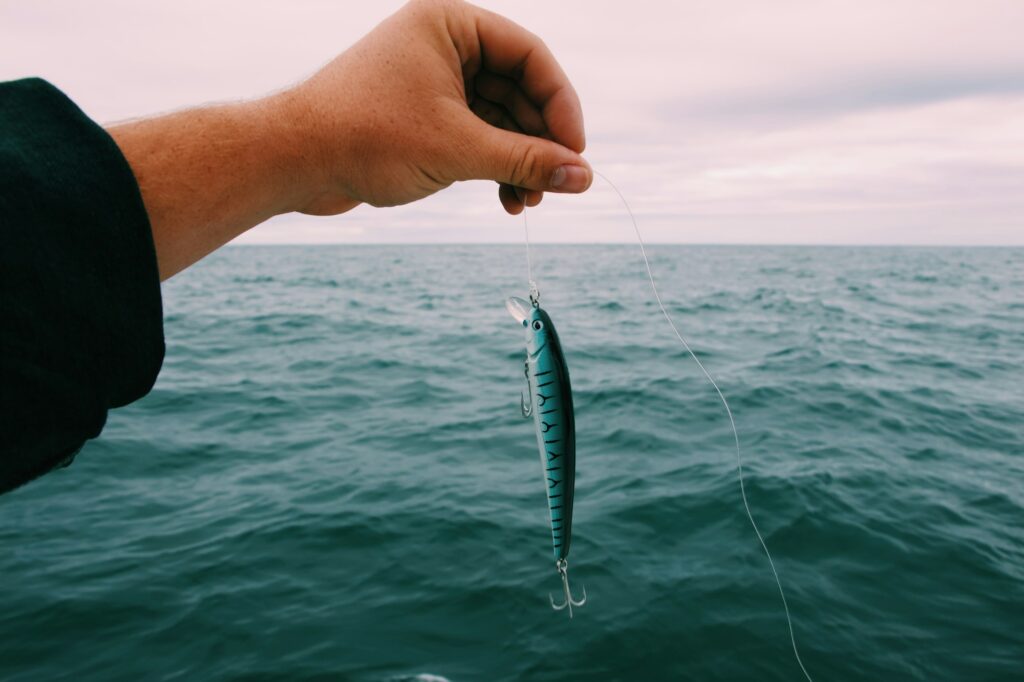
For baits, he says fast movers like topwaters and rattlebaits are great for finding fish that are on shad. He also says not to sleep on a soft plastic swimbait on a jighead, since with hundreds of them on the market you can match the bait almost exactly. I keep a few 3-inch and 4-inch swimbaits in a pale shad color, because that’s the size he says the baitfish have reached. A minnow-shaped jerkbait like the one in the photo stays tied on too, since it’s about the size and shape of a 4-inch shad.
What I Keep Rigged, by Water Temperature
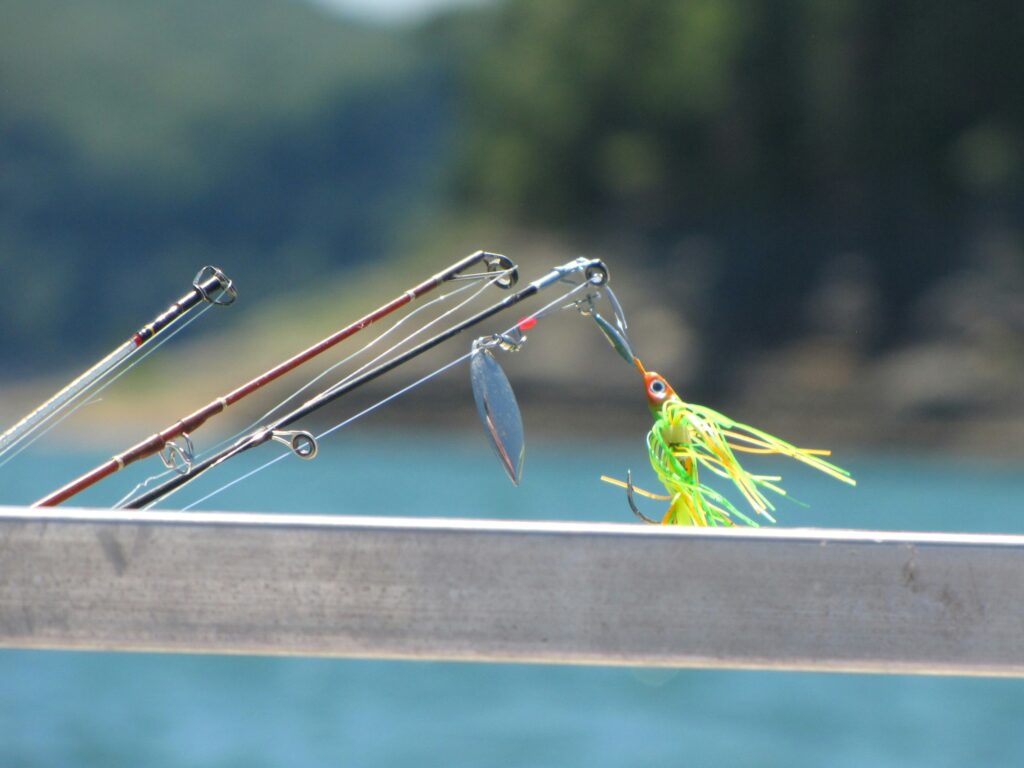
Room is tight on a kayak. I carry four rods at most (I tried six once, and never again), and once the boat is loaded with a crate, an anchor and a cooler, even four feels like a lot. In the fall they’re rigged by the water temperature.
Bednarski’s rule of thumb is that above 55 degrees, active baits work well: topwaters, spinnerbaits, rattlebaits and crankbaits. Below 55, you may need to slow down. But he says it’s always worth trying an active bait in colder water, and that some of his best buzzbait days came in 52-degree water. So the topwater rod doesn’t come off the boat just because the gauge says 54.
Here’s how the four rods line up for me.
The slow end of that list matters more than people think. A wacky-rigged stickbait falls slowly and just sits there, and on a cold, bright day after a front, it’s sometimes the only thing they’ll eat.
One kayak thing about fishing slow: you have to hold the spot. The last time the wind picked up on me out on a point, I drifted off it every single cast until I gave up and dropped anchor. Our guide on how to anchor a kayak covers the anchor trolley, which lets you set the boat at an angle to the wind instead of swinging on a rope tied off the side.
Late Fall: Points, Steep Banks and the Last Green Weeds
As the water keeps cooling, the weeds die back. Bednarski says hydrilla, water willow and lily pads start dying off and thinning out in September. That does two things. It leaves the baitfish fewer places to hide, which kicks off the fall feed. And it leaves the bass fewer places too, so they bunch up on whatever weeds are left.
So fish what’s left. He says largemouth will hold on vegetation even as the water gets into the 30s, and that he’s had great days on thinning lily pads in 4 feet of water when it was 45 degrees. For that, he suggests a shallow crankbait, a suspending jerkbait or a small swimbait on a light jighead.
Late fall is also big-fish time. He says you can catch your biggest bass of the year as the water falls into the low 50s and upper 40s. Steep shorelines and points outside of coves can hold big fish, especially over hard bottom, and his pick there is a jig and pig. His personal best largemouth came that way, on a black jig and pig in 49-degree water (mine came on a spinnerbait, but who’s counting).
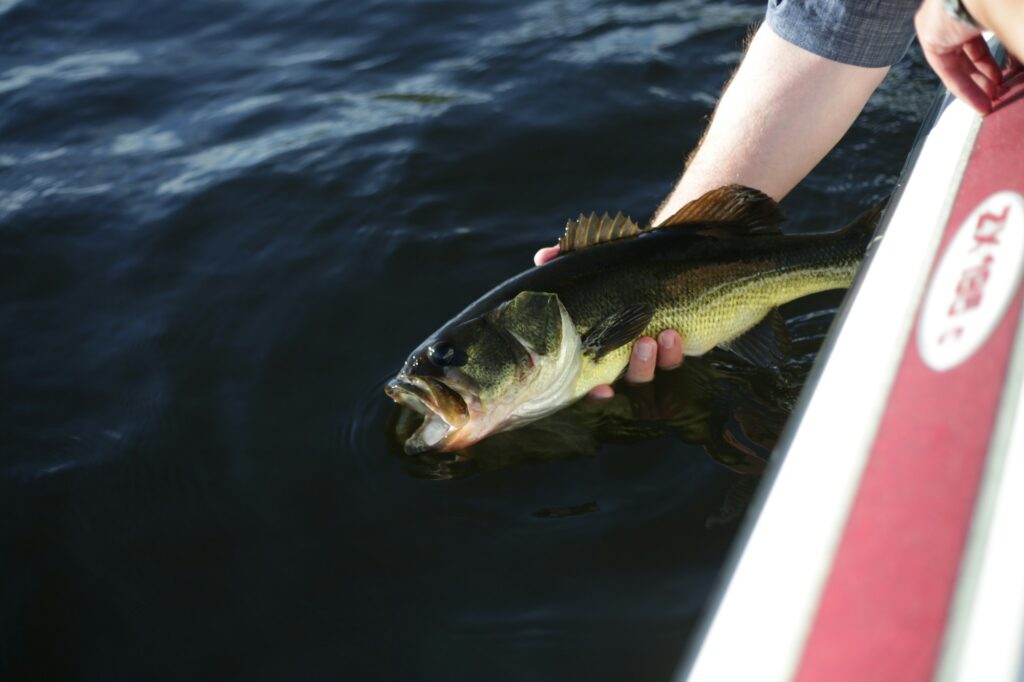
You won’t get many bites doing that. That’s the trade, and on a cold November morning I’ll take it.
The Water Is Colder Than the Air Says
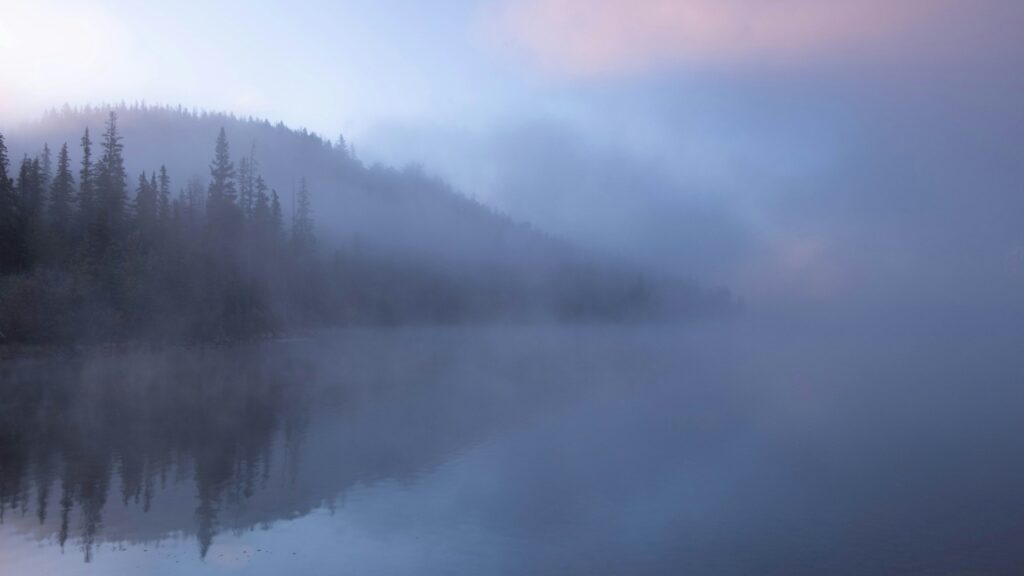
Look, now the other half. The same water that makes fall bass fishing great is the water that kills paddlers.
The National Center for Cold Water Safety draws the line at 70°F. Below that, it says, water feels quite cold to most people, and you should wear thermal protection. Below 77°F, breathing is already affected. And 50°F to 60°F is what it calls the maximum intensity cold shock range: complete loss of breathing control, and swimming failure.
Now put those numbers next to the fishing ones. Turnover hits in the low 60s and upper 50s. Trophy time is the low 50s and upper 40s. Just about every fall day worth fishing sits inside, or below, the worst cold shock range there is.
The air doesn’t change any of that. A fall morning can feel raw at the ramp and close to summer by 2 in the afternoon, and the water hardly moves a degree the whole time. The center says the air can be 80 or 90°F, but if the water is cold, you’d better be dressed for immersion in a wetsuit or a drysuit. It also says water pulls heat away from your body 25 times faster than air does, and that in water below 60°F, an average person can hold their breath only about a third as long as in warmer water.
A warm October afternoon fooled me once. I paddled out in a cotton hoodie because it was 68 degrees at the ramp, and my gauge read 56 for the whole trip. Nothing happened. That was luck, not judgment, and I know it.
Wear the Life Jacket, and Dress for a Swim
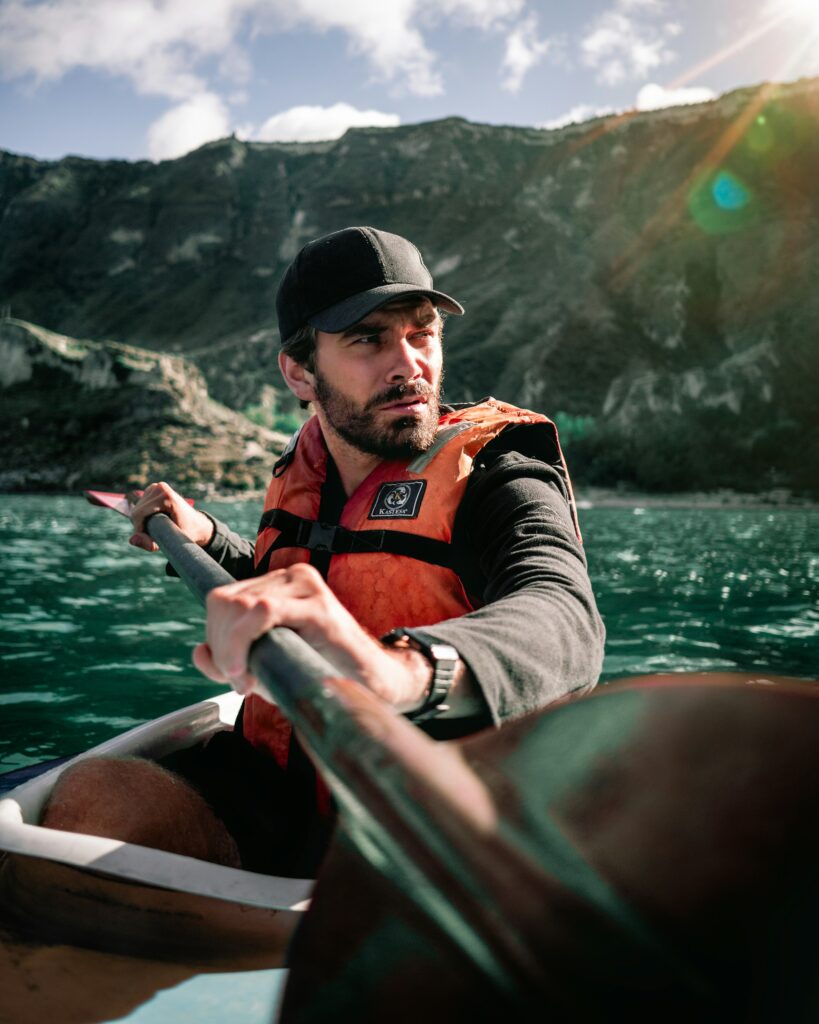
The Coast Guard’s 2024 boating report counted 556 deaths. Where the cause of death was known, 76% of the victims drowned. Where life jacket use was known, 87% weren’t wearing one. Kayaks alone accounted for 89 deaths, and 77 of those were drownings.
So the PFD goes on at the ramp and stays on. Not stowed behind the seat. On. The cold water center points out that most people find it very hard, or flat-out impossible, to put a PFD on once they’re already in the water.
It also says a manual inflatable is a bad choice for cold water, because you have to pull the tab yourself, and cold shock can scramble your head before you do. So in the fall I wear a foam vest. If you’re picking one, our list of the best kayak fishing PFDs is a good place to start.
For clothes, I go by the water, not the air. I wear a wetsuit early in the fall and a drysuit with fleece under it once the water’s in the 50s. A float coat isn’t the same thing, either. The center says float coats don’t give the protection of a wetsuit or drysuit that fits the water temperature.
None of that gear is cheap, and the drysuit cost me more than my first kayak did (by a lot). It’s still the one purchase I’d make before another rod. Fall is short, the fishing is good, and the whole point is to paddle back to the ramp with a story you get to tell yourself.