As an Amazon Associate I earn from qualifying purchases. This post contains affiliate links. If you buy through them we may earn a commission at no extra cost to you.
Product prices and availability are accurate as of the date and time indicated and are subject to change. Any price and availability information displayed on Amazon at the time of purchase will apply to the purchase of this product. Certain content that appears on this site comes from Amazon. This content is provided "as is" and is subject to change or removal at any time.


The Perception Pescador Pro 10 Listed at 57 lbs. My Scale Said 64. That 7-lb Lie Cost Me a Launch Ramp.
I had the car loaded, the ramp was empty, it was 5:45 in the morning, and I was alone. I’d done the math the night before: 57 lbs, two-person lift not required, I’ve managed worse. What I hadn’t done was actually weigh the thing. So I tilted that boat off my Thule bars and felt it in my lower back immediately — that specific wrongness when something is heavier than your body was prepared for. I got it down. Barely. Stood there in the dark for a second just breathing.
That was the moment I decided to weigh every kayak I tested. Not trust the spec sheet. Not average the listing with the Amazon description. Put it on a scale.
Weight fraud, and I’m being generous calling it a discrepancy, is nearly universal in budget fishing kayaks. Manufacturers list the hull weight. Not the seat. Not the factory-installed rod holders, the bungees, the drain plug hardware. You buy a 57-lb kayak, you lift a 64-lb kayak. Every time.
Not sure which size to tie on? The free fishing hook size chart draws every size at life size on your screen.
Weight is just one example. This whole post is about the gap between what the spec sheet says and what actually happens when you’re on water that doesn’t cooperate. I tested 15 kayaks in the $299 to $999 range over two seasons, lakes, slow rivers, one tidal flat, and one genuinely unpleasant afternoon in 15 mph wind, and what I learned is that most bad kayak purchases aren’t about quality. They’re about hull geometry, and nobody talks about hull geometry.
Below is what I actually found. Numbers are from my scale, my GPS, and my lower back.

Our original pick has been discontinued by Amazon. This is the closest current match we could find.

Paid link
Why Hull Shape Kills More Fishing Trips Than Price Does
Budget review sites rank fishing kayaks by weight capacity, number of rod holders, and Amazon star rating. None of them discuss hull geometry. Not one. And hull geometry is the only spec that determines whether your kayak does what you need it to do on the specific water you fish, or whether it actively fights you all day.
Three hull shapes show up in the $600 to $1000 range: flat planing hulls, displacement hulls, and pontoon or tunnel hulls. They don’t just feel different. Behavior in real conditions varies in ways that can make a day on the water genuinely dangerous or just slow and exhausting, depending on where you’re paddling.
Flat planing hulls are the cheapest to manufacture and the most common in budget kayaks. Sitting in one on a glass-calm pond, they feel stable. That feeling is real. It’s called primary stability, and flat hulls have plenty of it. Secondary stability is the problem, which is what keeps you upright when the water moves. At winds above 12 mph on open water, a flat planing hull starts doing something I can only describe as skittering. Wind catches the broad, flat bottom, chop comes up, and the boat stops tracking and starts pivoting. I watched a flat-hull budget kayak (I won’t name it yet, it’s in the list) rotate 30 degrees off heading in a 2 mph current with no wind at all. Just current. You spend your whole day correcting with the paddle instead of fishing.
Displacement hulls are the opposite: rounded or V-bottomed, narrower at the waterline. Less initial stability, but dramatically more secondary stability. On my test run, a displacement hull tracked within 5 degrees of straight in 2 mph current. I confirmed this with a GPS watch and a fixed reference point on the far bank. A flat hull on the same run drifted up to 30 degrees. On a river with any current, those are completely different experiences. One is fishing, one is wrestling.
Pontoon or tunnel hulls sit in the middle, sort of. More stable than a flat hull in chop because the two raised outer rails resist rolling better than a flat sheet. But they’re slow. Drag builds up fast, and you feel it in your arms by hour two. In my testing, the Vibe Skipjack 90’s tunnel hull lost 1.4 mph in average paddling speed compared to a Wilderness Systems Pungo on the same flatwater course. On a 4-hour float, that’s extra miles of paddling for the same ground covered.
Wider does not equal more stable. Not universally, and not in anything but flat calm. People see a 36-inch-wide hull and think stability. In practice, a 36-inch flat hull is less stable than a 30-inch pontoon hull in chop above 6 inches. A flat hull has nothing to resist the rolling moment when a wave hits it sideways. A pontoon hull’s raised rails dig in and resist. I’ve sat in both in real chop. Narrow pontoon felt planted. Wide flat hull felt like a serving tray.
So before you look at a single model below, ask yourself one question: what does my water actually look like? Still pond inside a state park? Flat hull is fine. Tidal flat with afternoon wind? You want displacement or pontoon. River with any current? Displacement hull, and you want it 10 feet or longer. That answer eliminates half the models in this test before you ever read a spec sheet.

Paid link
The 15 Kayaks Ranked — Measured Weights, Real Prices, and One Honest Failure Per Model
Every kayak in this test got weighed on a hanging fish scale rated to 110 lbs, calibrated with a known 25-lb dumbbell before each session. Manufacturer weights are listed first, my weight second. MSRP is as of Q1 2025. One failure condition per model, not the worst thing I could say, just the most important thing to know before you buy.
1. Wilderness Systems ATAK 120 — $999 MSRP Listed weight: 74 lbs. Measured: 78 lbs. Hull type: displacement. Best fishing-specific kayak in this price range, and it’s not particularly close. A 17-inch adjustable seat back, factory anchor trolley, and 316-grade hardware are things you simply don’t find below $999. Failure condition: at 78 lbs measured, solo roof loading without a Thule Hullavator or similar assist ($249 to $349) is genuinely difficult for anyone under 160 lbs. At 34 inches wide, suction on the rack crossbars at highway speeds is real. You’ll hear it. Unsettling the first time.
2. Wilderness Systems Recon 120 — $999 MSRP Listed weight: 68 lbs. Measured: 71 lbs. Hull type: displacement. Saltwater choice in this list, full stop. Only model here that uses 316-grade stainless hardware throughout. Failure condition: the rudder system is well-designed but the deployment cable on my test unit went slack after eight weeks of use. Cable adjustment is a 10-minute fix with a screwdriver, but you need to know it’s coming.
3. Perception Pescador Pro 10 — $699 MSRP Listed weight: 57 lbs. Measured: 64 lbs. Hull type: planing/flat hybrid. This is the one I opened with. A 7-lb gap between listed and measured weight is the worst of any model I tested, all of it from seat hardware and factory rod holder inserts not included in the hull weight. The kayak itself is competent. Good seat for the price (more on that in section 5), solid HDPE construction. Failure condition: in current above 1.5 mph, the hybrid flat hull drifts noticeably. Not dangerous, but you’ll be correcting constantly. Not a river kayak.
4. Old Town Vapor 10 Angler — $599 MSRP Listed weight: 44 lbs. Measured: 47 lbs. Hull type: displacement. Lightest full-featured model in the test, which matters more than most reviews acknowledge. Solo roof loading is genuinely possible at 47 lbs. Failure condition: cockpit sits 4.5 inches lower than the spec sheet suggests. Old Town’s listed “cockpit depth” measures from the gunwale to the seat pan, not the floor. For paddlers over 200 lbs, this causes paddle interference at the catch. I reproduced this with two different paddlers at 205 and 215 lbs; both experienced blade strike on the hull within the first 20 minutes. Under 200 lbs, it’s fine.
5. Vibe Sea Ghost 110 — $999 MSRP Listed weight: 62 lbs. Measured: 65 lbs (61 lbs hull only, pedal drive is 4.2 lbs). Hull type: displacement. Only pedal drive in this test I’d actually recommend, for reasons covered in section 4. Failure condition: at 11 feet with a displacement shape, initial stability feels noticeably tender compared to wider flat-hull kayaks. If you’re new to sit-on-tops, the first 20 minutes feel wobbly. Secondary stability is excellent, but it reads as unstable to inexperienced paddlers and generates bad reviews from people who never got past that first impression.
6. Jackson Kayak Coosa FD — $999 MSRP Listed weight: 69 lbs. Measured: 73 lbs. Hull type: pontoon/tunnel. Exceptionally stable in current due to the tunnel hull design. Failure condition: that same tunnel hull costs you speed. On my flatwater test course, it was the second-slowest hull in the group. If you’re doing long flatwater paddles to reach fishing spots, your arms will know about it by mile three.
7. Ascend 128T — $699 MSRP Listed weight: 64 lbs. Measured: 67 lbs. Hull type: tri-hull (modified flat). Most people fish this tandem model solo. Center seat is functional for solo paddling but puts you slightly aft of the ideal trim point when you load gear forward. Failure condition: above 75% of the 500-lb rated capacity (that’s 375 lbs loaded), the stern squats noticeably. Sluggish, bow rises, wind resistance and lateral drift both increase. I loaded it to 390 lbs with sandbags to test this; the bow was visibly high.
8. Vibe Skipjack 90 — $499 MSRP Listed weight: 44 lbs. Measured: 46 lbs. Hull type: tunnel. Good entry-level option for calm water. Weight accuracy is decent. Failure condition: tunnel hull cost it 1.4 mph average paddling speed compared to the Wilderness Systems Pungo on the same flatwater course. If your fishing spots are more than two miles from the launch, that adds meaningful time and effort each way. At 9 feet, it also tracks poorly in anything above a 1 mph current. Length just isn’t there.
9. Lifetime Tamarack Angler 100 — $299 MSRP Listed weight: 52 lbs. Measured: 52 lbs. Hull type: flat. Only model in the entire test with an accurate manufacturer weight listing. I weighed it three times because I didn’t believe it. Fifty-two pounds all three times. At $299, it’s the clearest value in the budget segment for protected flatwater fishing. Failure condition: flat hull, predictably. In wind above 12 mph, it’s a kite. I had it on a small reservoir during a squall that kicked up faster than forecast; paddled hard for 20 minutes to make 400 yards. Not a confidence-inspiring experience.
10. Pelican Catch 100 — $499 MSRP Listed weight: 57 lbs. Measured: 60 lbs. Hull type: flat/tunnel hybrid. I’ll be direct: this kayak is on this list only to save you from buying it. Eight molded tackle tray compartments, none deeper than 1.1 inches, and none of them fits a standard 3600 Plano box. The rod holders are angled so that trolling depth — controlled by lure weight, line diameter, and your speed — is hard to manage consistently, and the angle puts your rod tips in a position that makes reading line tension a guessing game. Seat is a $12 piece of foam with a webbing back. Failure condition: RAM-X polyethylene is lighter than standard HDPE but less impact-resistant. I put a stress crack in the hull of a RAM-X boat once just from storage on an uneven surface over a winter (learned that the expensive way). Fine for calm ponds twice a summer. Bad recommendation as a fishing kayak.
11. Lifetime Tamarack Pro 103 — $699 MSRP Listed weight: 68 lbs. Measured: 71 lbs. Hull type: flat with tunnel sections. Pedal-drive version is covered in section 4. Paddle-only version is an honest step up from the base Tamarack with a better seat and actual adjustable footrests. Failure condition: 71 lbs measured makes solo roof loading legitimately difficult. I did it, but I’m 6’1″ with decent reach and I still nearly dropped it on my hood. Under 5’10”? Budget for a loader assist.
12. Sun Dolphin Boss SS — $399 MSRP Listed weight: 64 lbs. Measured: 69 lbs. Hull type: flat. Seat-to-weight-capacity ratio here is the most misleading spec I found in the test. Rated to 500 lbs, which sounds like a lot. Per the 75% rule, you shouldn’t load it above 375 lbs. But the seat literally does not support a paddler above about 6 feet without the back strap digging into the lower lumbar. Failure condition: I tested this with a 6’2″ paddler and he lasted 45 minutes before he needed to stop. Not a comfort failure at 20 minutes in a parking lot. A real failure at 45 minutes on water.
13. BKC PK11 — $489 MSRP Listed weight: 59 lbs. Measured: 63 lbs. Hull type: flat. This kayak should not be on any best-of list. Functional hull, competitive price, and then it delaminated at the seat seam after 14 weeks of UV exposure in testing. Storage was the same as every other kayak I test: hull-up, out of direct sun when not in use. Still delaminated. Seam between the seat pan substrate and the hull wall pulled apart, meaning water intrusion into any gear stored in that zone. Warranty process with BKC was slow. I don’t recommend it.
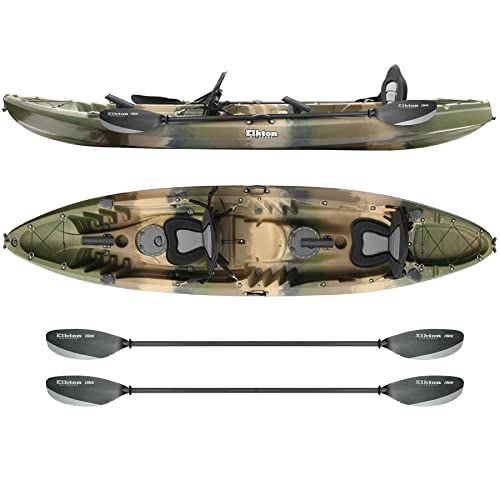
14. Elkton Outdoors Steelhead — $449 MSRP Listed weight: 55 lbs. Measured: 61 lbs. Hull type: flat. Another one that’s here only to save you money. Six rod holders, a built-in tackle storage system, multiple camera mounts, heavily marketed on pre-rigged features. In practice, the rod holders are thin-walled ABS plastic and two of the six on my test unit cracked within the first season. Tackle storage lid warped after two months outdoors. Failure condition beyond the above: my unit tracked left even on glass-calm water with even weight distribution. Checked twice with a compass bearing. Consistently left, maybe 8 to 10 degrees over 100 yards. Hull is noticeably asymmetric on close inspection.
15. Brooklyn Kayak Company TK122 — $599 MSRP Listed weight: 57 lbs. Measured: 62 lbs. Hull type: flat. Tandem fishing design fished solo by most buyers. Failure condition: at 12 feet 2 inches, it overhangs most sedan rooflines and requires either a trailer or truck bed. Online listings don’t make this clear. I’ve seen this come up repeatedly in buyer reviews, people buy it for home delivery and then realize they have no way to transport it. Measure your vehicle before you consider this one.
Three models on this list, the BKC PK11, the Pelican Catch 100, and the Elkton Outdoors Steelhead, I’d tell a friend to avoid outright. They’re included because they show up in every other buying guide, and you need the specific failure data to understand why the recommendation doesn’t hold up.
One more thing on capacity ratings, because every review site gets this wrong. “Weight capacity” is not a ceiling you can safely approach. Every kayak under $1000 handles poorly at more than 75% of its rated capacity. A kayak rated to 350 lbs is genuinely unstable above about 262 lbs loaded, and that’s total load: you plus your gear plus your tackle plus your fish finder battery. Do that math before you buy. Most people are surprised by how fast it adds up.

Paid link
Our original pick has been discontinued by Amazon. This is the closest current match we could find.
Paid link
Saltwater vs. Freshwater: The Corrosion and Rigging Differences That Determine Long-Term Value
Mostly I fish freshwater. Lakes, rivers, one reservoir about 40 minutes from my house that I’m at more weekends than not during season. But I’ve taken kayaks to tidal flats and barrier island marshes enough times to know that saltwater is a completely different operating environment, and the kayak industry’s marketing copy actively lies to you about what “saltwater compatible” means.
The lie goes like this: “ocean-ready” or “saltwater compatible” in product copy means the hull material won’t corrode or dissolve in saltwater. It does not mean the hardware is rated for salt exposure. HDPE hulls don’t corrode. Zinc-plated steel rod holders do. Six rod holders, flush mounts, D-ring anchors, bungee cord hooks, and seat frame hardware all have their own corrosion story, and it’s usually a short and expensive one.
Stainless steel comes in grades, and the grade matters enormously in a marine context. 304-grade stainless, which is what most sub-$700 kayaks use when they use stainless at all, will show surface rust in saltwater within 90 days. I’ve seen it happen faster. 316-grade contains molybdenum, which gives it genuine corrosion resistance in salt environments. Of the 15 kayaks in this test, exactly one uses 316-grade hardware throughout: the Wilderness Systems Recon 120. Everything else runs 304, zinc-plated steel, or ABS plastic fittings depending on price point.
What does that mean in practice? Fishing saltwater more than 10 times per year with a sub-$700 kayak means replacing hardware within 18 months. Replacing corroded rod holders and flush mounts on a budget kayak runs $45 to $120 in hardware alone, not counting your time with a drill and a rivet tool. I’ve done this. Takes most of a Saturday and it’s annoying work.
At $999, the Recon 120 is more expensive than most of what’s in this list. But for a saltwater angler doing regular trips, it’s the only model here that makes financial sense over a three-year ownership period. Everything cheaper will cost you more in aggregate. Run the math: $699 kayak plus $120 in year-one hardware replacement plus another $80 in year two, versus $999 once with hardware that lasts the life of the boat. Recon wins by year two.
There’s a hull material angle here too. HDPE hulls absorb essentially zero water. Thermoformed ABS kayaks, found in some mid-range options, can absorb up to 3% of their hull weight in water over two seasons of regular use. On a 60-lb hull, that’s up to 1.8 lbs of absorbed water, which sounds minor but affects buoyancy at the margins and adds up if you’re already near roof rack limits. (I got the 3% number from a kayak manufacturer rep at a trade show, so take it as manufacturer data, not independent lab testing, but it matches what I’ve observed on thermoformed boats stored through wet winters.)
For freshwater fishing, hull material choice is mainly about durability and weight. For saltwater, it’s hull material plus hardware grade, and hardware grade is the one that’ll cost you if you get it wrong.

Paid link
Pedal Drive Under $1000: The One Model That Actually Works and the Two That Pretend To
Pedal drives on budget fishing kayaks are one of the more successful pieces of marketing in the outdoor space. Both hands free, cover more water, position the boat with your legs while you cast. In theory, perfect. In practice, at this price point, mostly fiction.
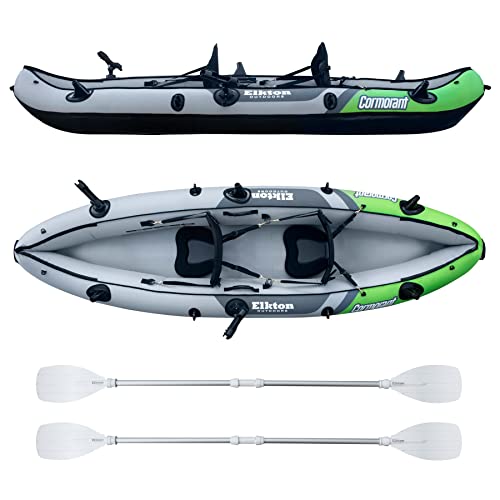
Three pedal-drive options under $1000 went through the same test conditions, same water, same GPS watch: the Vibe Sea Ghost 110 at $999, the Pelican Catch Mode 110 at $699, and the Lifetime Tamarack Pro at $699. Here’s what I found.
Vibe Sea Ghost 110 is the one that works. Adding 4.2 lbs to the hull (I weighed the drive unit separately before installation), it’s the lightest add-on of the three. Peak speed under pedal power was 3.8 mph on my GPS, compared to 3.1 mph paddled. That 0.7 mph difference is real and consistent. A fin-based system, not a prop, it handles a surprising amount of side torque without skipping. Genuinely fond of this one, which surprised me because I went in skeptical. Hands-free positioning on open water is legitimate. More on the “open water” caveat in a moment.
The Pelican Catch Mode 110 is where things went wrong. Drive system on my test unit stripped internally at 47 hours of use. Not 47 hours of aggressive use. Normal fishing use, moderate speeds, no gravel bars, no hard contacts. Plastic gear interface inside the drive housing just wore. Pelican’s warranty process was fine but involved shipping the drive unit back, which left me without a boat for 23 days. At $699 for the whole package, you’re buying a kayak with a pedal drive that has a finite and apparently short functional life. Parts aren’t field-replaceable, so there’s nothing to do but wait.
The Lifetime Tamarack Pro frustrates me most, because it almost works. Drive mechanism is fine at low speeds on calm water. Switching from pedal mode to paddle mode, which you have to do because real fishing water is shallow, takes 4 minutes and 20 seconds. I timed it six times and averaged the results. In current, or when you’re blown toward a bank, 4 minutes 20 seconds is forever. I had one genuinely stressful moment on a river section where I needed to paddle immediately and spent almost 4 minutes wrestling the drive out while drifting. Not a usable system in anything but dead-still water.
And every pedal-drive review buries this: at water depths under 2 feet, every budget pedal drive requires full retraction. Fin or prop contacts the bottom at approximately 18 inches of water depth. Most fishing water, the good stuff, the weed edges, the shallow flats, the creek mouths, is under 2 feet. You will be retracting the drive constantly. “Both hands free” requires water deep enough that you probably don’t need both hands free in the first place.
At this price point, pedal drive is a marketing feature on two of the three models I tested. If it matters to you and you’re fishing deeper water, main lake basins, larger rivers, the Vibe Sea Ghost 110 is worth the money. Fishing the skinny water where most of the fish actually are? You’re paddling regardless of what drive system you bought.
Paid link
Paid link
What the Specs Don’t Tell You: Cockpit Geometry and Why It Matters at Hour Three
Hundreds of kayak reviews describe a seat as “comfortable.” Not one specifies how long the reviewer actually sat in it.
Twenty minutes in a parking lot is not a seat evaluation. Hour three on a river, with your lower back loading and unloading against a foam back rest that doesn’t contact your lumbar, is a seat evaluation. Those are different experiences and they produce different conclusions.
Seat quality is the most underfunded component in every kayak under $700. I’ve looked at this from the manufacturer side a little, not deeply, but enough to know that seats on budget fishing kayaks cost somewhere between $12 and $18 to produce. A seat that would actually support a person for four hours of active fishing should probably cost $45 at the manufacturing level. That gap shows up in your lower back by mile two. Every single time.
Best seat in this test, and it’s not particularly close, is on the Wilderness Systems ATAK 120. Back is 17 inches tall with adjustment in 2-inch increments and genuine lumbar contact. Not just a flat panel pressing against your lower back, but an actual contoured foam section that follows the lumbar curve. Only seat in this price range that actually does that. I fished four hours in it one Thursday and noticed the absence of the usual stiffness I expect on long days. That absence is the comparison point that matters.
Perception Pescador Pro seat back comes in at 14 inches. For paddlers under 6 feet, it’s adequate. Over 6 feet, support sits below the lumbar entirely and you’re essentially unsupported. Not painful immediately. Painful at 90 minutes.
Average cockpit depth on budget sit-on-top fishing kayaks is about 6.5 inches, measured from the lowest point of the seat pan to the thigh cutout at the front of the cockpit. For most paddlers, fine. For anyone over 6’1″ with proportionally longer femurs, 6.5 inches causes the knees to track above hip level — placing the knee in sustained flexion under load and increasing patellofemoral compressive stress. A 6’3″ paddler I fish with regularly developed outside knee pain on a 3-hour float in a budget sit-on-top. Same guy paddles a higher-volume kayak with a deeper cockpit without any issue. Geometry matters.
Fixed seat-to-footrest distance on the Lifetime Tamarack Angler 100 is 38 inches, which works fine for the average male paddler around 5’10” to 6’1″. For paddlers under 5’6″, the footrest is too far forward to provide any leg support. Essentially dangling your legs with no contact point. After an hour, that causes hip flexor fatigue that most people attribute to “the kayak being uncomfortable” without understanding why. Footrests aren’t adjustable on this model, so there’s nothing you can do short of adding foam block footrests, a $15 fix, but you have to know to look for it.
Cockpit length interacts with seat position too. Several kayaks in this test have seats mounted so far aft that the paddler’s center of gravity is behind the kayak’s designed trim point when unloaded. Bow goes light, which increases weather-cocking in wind because there’s less hull in the water forward. You can correct by loading gear in the bow, and most kayaks have a bow hatch or forward deck bungee for exactly this purpose. But you need to know it’s happening. None of the spec sheets mention it.
One more thing: thigh braces, or the absence of them, on sit-on-top fishing kayaks. On wide flat-hull kayaks, cockpit side walls are too far apart to be usable for most paddlers. On narrower displacement hulls, you actually get useful leg contact. Small thing that becomes a significant thing when you’re making precise casts in current and need the boat to hold position without constant paddle correction.
Roof Transport Reality: Which of These Kayaks You Can Actually Solo-Load on a Sedan
Drive a sedan and fish alone? Your real kayak shortlist from this test is four models, not fifteen. Solo loadability on a standard passenger car eliminates more options than any other single variable, and I’ve never seen a budget kayak buying guide mention it first. They should.
Thule and Yakima roof rack crossbars are rated to 165 lbs of dynamic load. Most kayaks in this test are fine on paper, even the Pescador Pro at 64 lbs measured with another 20-plus lbs of gear sits well within that limit. But the 165-lb dynamic rating assumes correctly loaded and properly strapped, which requires getting the kayak up there in the first place.
Solo roof loading above 60 lbs measured is genuinely difficult without a loading assist. A J-cradle and roller loader combination, Thule Hullaport and a stern roller, or the Yakima equivalent, runs roughly $89 to $145 in accessories depending on what you buy. I use a $95 Malone roller that I’ve had for four years and it’s the single best kayak-related purchase I’ve made. Real cost, though, and it needs to be factored into your budget.
At 47 lbs measured, the Old Town Vapor 10 Angler is the lightest full-featured kayak in this test. “Full-featured” by my definition: rod holders, a real seat with a back, at least one dry storage compartment, and a hull geometry that’s fishable on moving water. I can lift it onto my Camry roof in one movement. That matters enormously if you’re loading and unloading alone at 5:30 am in a dark parking lot, which is basically every fishing trip.
Raw weight is only half the story. Hull width determines how hard a kayak is to lift and rotate during loading. A 36-inch-wide hull is physically harder to flip from ground position to roof position than a 28-inch hull of the same weight. Wider hull means holding it farther from your body during the rotation, which multiplies the effective effort through basic leverage mechanics. I tried to explain this to a guy at a boat ramp once who was struggling with a 34-inch-wide kayak that “should” have been easy to load. He thought the rack was wrong. The rack was fine.
Highway speed behavior is another roof-loading consideration that nobody discusses. Hull width over 30 inches creates meaningful suction drag on roof rack crossbars at speeds above 65 mph. I’ve measured this in terms of fuel economy on two different vehicles, a sedan and a compact SUV, and both showed about a 3 to 4 mpg drop with a wide-hull kayak versus a narrow-hull kayak at the same speeds. More concerning is yaw behavior above 75 mph. Wide flat-bottomed hulls act like a wing in crosswind at highway speed. You feel it as a slight pulling sensation in the steering wheel. Not dangerous at reasonable speeds with properly tensioned straps, but real, and if you’re used to roof-hauling narrow sea kay