To tell a largemouth bass from a smallmouth, close the fish’s mouth and look at where the jaw ends. On a largemouth the upper jaw runs past the back of the eye. On a smallmouth it stops at the eye or before it. That one check is right almost every time, and it takes about two seconds on the water.
I’ve fished lakes and slow rivers out of small boats for close to twenty years, and I still check the jaw before I trust the color.
Color lies. The jaw doesn’t.
If you’re brand new to bass fishing, my fishing tips for beginners cover the basics first.
The Jaw Test Takes Two Seconds
Hold the fish so its mouth is fully closed, then look along the top lip. On a largemouth, the jaw extends beyond the back of the eye. On a smallmouth, it doesn’t reach that far.
The name gives it away once you’ve seen a few side by side. A largemouth’s mouth looks too big for its head, like it could swallow a softball, and a decent one honestly could. A smallmouth’s mouth looks normal-sized for the fish.
Do it with the mouth shut. When a bass opens wide, the jaw slides forward and the line gets harder to read, which is how people talk themselves into the wrong answer at the ramp.
It works on little fish too. A 9-inch largemouth already has the long jaw, and a 9-inch smallmouth already has the short one, so you don’t have to wait for a big fish to practice. Every dink you catch is a free lesson.
Horizontal Stripe or Vertical Bars
The second check is the pattern on the side. A largemouth is usually green with dark blotches that join into a horizontal stripe running nose to tail along the middle of the fish.
A smallmouth is green with dark vertical bands instead, and it often looks bronze or brown. That’s where the old nicknames brownie and bronze bass come from.
Here’s the catch.
Color shifts with the water and the light. Fish from stained or weedy water look darker, and the bars on a smallmouth can fade until you barely see them. So I treat color as the tiebreaker, never the first answer.
One more tell, once you’ve handled a few. Smallmouth often have a red or brown eye, and a largemouth’s eye can go red too. It isn’t a rule I’d bet a fish’s legal status on, but on a bright day it’s often the first thing you notice when you lip one.
Look at the Dorsal Fin
Spread the fin on the bass’s back. A largemouth has a nearly divided dorsal fin, with a spiny front part and a soft back part and a deep dip between them. It almost looks like two fins.
On a smallmouth the two parts stay joined by a much shallower notch, so it reads as one long fin. The soft back part of a smallmouth’s fin has 13 to 15 rays, a little more than the 12 to 13 on a largemouth, but you’ll never need to count them if you’ve done the jaw check.
Careful with your hand here. Those front spines are sharp, and a bass that flips while you’re spreading the fin will find your thumb.
The Spotted Bass Problem
In a lot of southern lakes and rivers there’s a third black bass in the mix, and it fools people every season. A spotted bass looks a lot like a largemouth at first glance. It’s green on top and has a dark band along the side.
Three things give it away. A spotted bass has a rough tooth patch on its tongue that you can feel with a fingertip, rows of small dark spots along its lower sides, and a jaw that stops at the back of the eye like a smallmouth’s. A largemouth usually has no tooth patch.
So if the jaw says “not a largemouth” but the side has a horizontal band instead of bars, rub the tongue (gently, with one fingertip).
Rough means spotted bass.
Where Each One Lives

Habitat narrows it down before you ever see the fish. Largemouth bass hang around cover like logs, rock ledges, weeds and docks, and they do well in all kinds of water. Think farm ponds, lily pads, grass lines and the slow back ends of lakes. In autumn they follow the baitfish, which I wrote about in fall largemouth fishing from a kayak.

Smallmouth want it cooler and clearer. They like big clear lakes, over 100 acres and deeper than 30 feet, and cool streams with clear water and gravel. Rocky points, gravel flats and current breaks behind boulders are where I’d look first.
Plenty of lakes hold both. In my experience, when the wind picked up on a lake like that, the smallmouth showed up along the rocky bank it was hitting while the largemouth stayed tucked back in the weeds. Same lake, two different neighborhoods.
How Big Each One Gets
Largemouth get bigger.
It isn’t close. The all-tackle world record is 22 pounds 4 ounces, first caught by George Perry in Georgia in 1932 and tied by Manabu Kurita in Japan in 2009.
The smallmouth record is 11 pounds 15 ounces, a fish from Dale Hollow Lake on the Tennessee and Kentucky line in 1955. Most smallmouth you’ll catch are a fraction of that, and a 3-pounder is a good fish almost anywhere.
Growth depends on the water. In Texas, largemouth grow 4 to 6 inches their first year, 8 to 12 inches by two years and about 16 inches by three. Pound for pound, though, a smallmouth fights harder, and anybody who’s had one jump three times next to the boat will tell you the same.
Spring Puts Both of Them Up Shallow

The easiest time of year to see the difference for yourself is the spawn, because both species move shallow to nest. Largemouth in Texas start spawning when the water reaches about 60°F, anywhere from February to May depending on where you are. The males fan out nests in 2 to 8 feet of water, and they pick quiet, weedy spots over anything but soft mud.
Smallmouth key off nearly the same number. When the water approaches 60°F, the males move into spawning areas, usually near shore in lakes or just downstream of a boulder in a stream, out of the current. Then they guard the nest for up to a month.
So in spring you’ll find largemouth beds back in the pads and smallmouth beds on hard bottom off the points. Same rule as the rest of the year, just easier to see. If you fish for bedding bass, check your state’s rules first, because some waters close or limit it, and get those males back on the nest fast.
What I Throw at Each One

You don’t need two tackle boxes, but the baits do lean different ways. If the names below are new to you, start with my rundown of fishing lure types.
- For largemouth: a soft plastic worm worked slowly through cover, a topwater frog over weeds and pads, and a spinnerbait along grass lines when the water’s stained.
- For smallmouth: a tube or a small crankbait bounced over rock and gravel, and a jerkbait in clear water when they’re chasing.
The pattern under the lure list is the same one as the habitat. Largemouth bites come from inside cover. Smallmouth bites come from over hard bottom. Fish the bait where the fish lives and the species mostly sorts itself out.
Handle Them So They Swim Off

If you’re letting fish go, how you hold them matters as much as how you hook them. Wet your hands before you touch the fish, because dry hands strip the slime coat that protects it from infection.
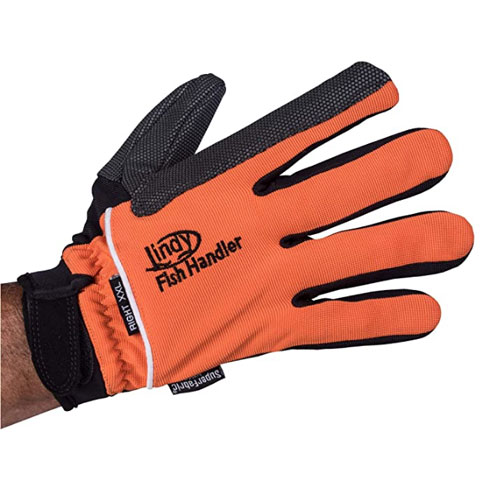
Gloves are fine if they’re smooth rubber. Cloth or rough gloves take that slime off just as fast as dry hands do, so I leave mine in the truck.
Grab a bass by the lower jaw, but don’t bend the jaw back. Keep your fingers out of the gills and the eyes. And keep the fish out of the water no longer than you could hold your breath, which is a good rule I try hard to follow when somebody wants a photo.
With a big fish (anything over about 4 pounds, in my book), put your other hand under its belly so it’s held flat instead of hanging from its lip. A heavy bass hanging straight down from its jaw can get hurt. That two-hand hold is also the better photo, so everybody wins.
Check Your State’s Rules Before You Keep One
This is where getting the ID right actually costs you something. Many states set bag and size limits by species, with lake-by-lake exceptions, so a fish that’s legal to keep as one bass might be illegal as another.
Read your state’s fishing regulations before the season, and check the sign at the ramp for that lake’s own rules. Some lakes use a slot, where fish inside a set size range go back in no matter what, so a measuring board on the boat pays for itself the first time you need it. If you can’t tell what you’ve got, snap a photo and let it go. That’s never the wrong call.