The best way to store fishing rods is standing up in a rack, somewhere nobody walks past, out of the heat, with nothing bending them and the drag backed off on every reel. That’s it. A wall rack in the garage and rod tubes for the drive cover most of it, and if you’ve got a boat, add upright holders. The fancy part isn’t the rack. It’s keeping rods out of the places where they actually break.
I’m Matt. I’ve run small boats and paddled lakes and slow rivers for the better part of twenty years, and I do my own maintenance because the other option is a bill. I’m not a rod builder. The storage rules below come from Daiwa’s own rod care page, from Aaron Martens’ rod care column on Bassmaster, and from Keith Sutton’s reel care guide in Game & Fish. Where it’s just my garage talking, I’ll say so.
Most Rods Break Off the Water

Here’s the line from Daiwa that changed how I store mine. “The vast majority of rod breakages occur nowhere near the water, in fact most happen in places of storage or in transit.” Not on a big fish. In the garage and in the truck, mostly.
Read that twice.
Daiwa’s own examples of an accident include a car door and a ceiling fan (yes, a ceiling fan). It also says rod breakage is very rarely a manufacturing fault, with instances well below 1%. So when your rod snaps, turns out it’s usually something you did to it days or weeks earlier, and the fish just found the weak spot.
That matches my own record. The rod that broke first in my garage never saw a fish that day. It was a 6-foot-6 medium spinning rod leaning in a corner behind the mower, got knocked flat when I pulled the mower out, and I stepped on the tip in the dark. Honestly, a five-dollar rack would’ve saved a rod I liked a lot more than five dollars.
Leaning rods in a corner, like the pair in that photo, is how most of us start. It’s also how most of us lose one. Daiwa’s list says it plainly: don’t ever leave your rods lying on the ground, and don’t store them where they could get bumped or knocked.
Stand Them Up in a Rack, Out of the Walkway

Daiwa’s advice is to store rods “in a vertical, out of the way position, preferably in a designated rod rack.” Martens said the same thing from the angler’s side. He always stored his rods vertical when he could, because that keeps the blanks straight.
Out of the way is the part people skip. Daiwa warns against storing rods “in places of use and thoroughfare,” which is a polite way of saying not next to the door you carry the cooler through. In my garage the rack lives on the back wall, past the workbench, where nobody walks unless they’re going fishing.
There are three kinds of racks worth a look. A floor rack holds the butts in a base and the rods in a slotted bar up top, and it’s the easiest to load. A wall rack does the same thing with clips, so the floor stays clear. A ceiling rack holds rods flat overhead, which is great in a crowded garage, as long as each rod lies straight. Martens’ rule for any rod laid down was never with a bend in the blank, because over time the rod will “take” that bend and it’ll be ruined.
One more thing about the rack. Leave room between rods so the guides don’t tangle and the tips don’t rub. On my wall that’s about 4 inches between clips, 8 rods across a 3-foot board, with the tallest 7-foot rods on the end where nobody brushes past. Martens used rod sleeves for the rods he wasn’t using, partly for that reason, and they’re cheap.
Clean the Rod and the Guides Before They Go Away

Put a dirty rod in the rack for the winter and you’ll find crusted guides in April. It’s kinda gross. Daiwa says to clean your rod after each and every use, and it describes the job simply: take the reel off and wash the rod down with soapy fresh water to remove all salt residue. Once it’s dry, a spray lubricant on the reel seat is all it says you’d ever need.
Martens called the guides the most important part. Minerals in some lakes and grass in others build up on them and can damage your line. He cleaned his with a soaked Q-tip, rubbing it around the inside and the outside of every guide, and he said a soft plastic brush is fine but never a wire one, because that’ll ruin a guide.
I do the Q-tip trick too, and I like it for a second reason. If the cotton catches on something as it goes around, I look closer at that guide before the rod goes in the rack. Finding a problem in November is a lot better than finding it with a fish on.
Martens also wiped the handles down with rubbing alcohol on a white towel. Cork and foam soak up a whole season of bait and sunscreen. Clean yours before storage and they won’t smell like June when you pull them out (ask me how I know).
Back Off the Drag on Every Reel

The rod is only half of it. Sutton’s guide in Game & Fish says to store each reel with its drag loosened between trips. If you leave the drag tight, the drag washers stay compressed, and you can end up with a jerky or ineffective drag. Loose drag, happier washers.
His rinse order is worth copying. Tighten the drag before you rinse, especially on spinning reels, to keep water out. Rinse with fresh water at light pressure straight from the hose, never a spray nozzle, because high pressure can force grit and salt inside the reel. Let it dry. Then loosen the drag for storage.
That last step is the one I used to forget. It’s also the one that matters for the winter, when a reel can sit cranked down for 4 or 5 months straight.
Lube goes on light. Sutton says to use a fine, light lubricant on the moving parts, no heavy oil or grease, and not to use WD-40 or Vaseline on any reel parts. Funny enough, Martens did use WD-40 to clean rod guides, which is a different job on a different part. Keep the can away from the reel.
How often? Sutton says most manufacturers recommend re-lubing at least monthly, more with heavy use, and at the very least once during each season you fish. For me that once-a-season job happens the same afternoon the rods go in the rack, which takes about an hour for the eight rods I own. If you only do one thing from this post, back off your drags.
Strip the Line for a Long Layoff

If the rods are going away for a couple of months, Sutton’s advice is to strip the line off and leave it off until just before your first trip of the new season. That way you start the year with fresh line instead of line that sat coiled on a spool all winter.
I’ll admit I don’t strip every reel. The spare rods with cheap line, sure. The two reels I fish every weekend in spring get a close look instead, and new line if it’s faded or frayed, which is part of Sutton’s test for any line. Old line has cost me a season’s best fish once. I’m not doing that again.
When you re-spool in spring, Sutton gives two handy numbers. Fill a baitcasting reel to about 90 percent of its capacity. On a spinning reel, leave at least 1/8 inch between the line and the edge of the spool lip, so the line doesn’t spring off in loops.
On the Boat: Upright in Holders, Never Over the Gunwale

Boats are rough on rods because everything bounces. Martens warned against laying a rod over something hard like the boat gunnel and letting it bounce on the same spot, because that weakens the blank and could make it break later under pressure, like when you’re fighting a big bass.
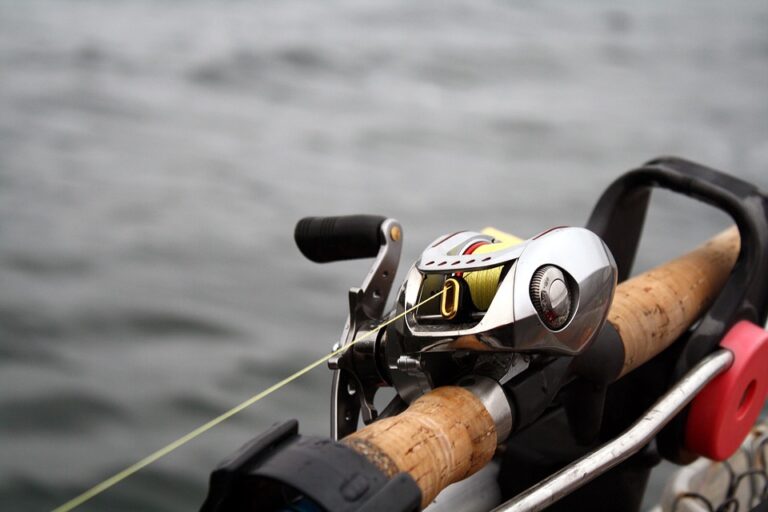
On my boat the rods ride upright in holders whenever we’re running between spots, the same way they sit in that photo. When the wind picked up on the lake last spring and the chop got ugly, the only rod that got hurt was the one my buddy had laid across the seats. The tip bounced off the transom the whole way back. It looked fine.
It snapped on the next good hookset.
For off-season, the rods come off the boat entirely. A boat locker gets damp and hot and nothing in there is straight. Sutton’s guide even calls out reels stored in a boat locker without being washed after a day in saltwater. If you’re putting the boat away too, our boat winterizing checklist walks through the rest of it.
In the Truck: Tubes, Sleeves and No Heat

Transit is the other half of Daiwa’s warning, and heat makes it worse. Its list says don’t store rods in a bent or loaded position, “especially in a high heat environment such as the back of a car. Rods can become permanently bent in this situation.” Martens put it shorter: never store a rod in a hot place like your car or truck, because heat can weaken them.
So the rods ride in the cab or in a tube, and they never live in the truck between trips. Daiwa says to use rod bags and rod tubes when traveling in a car or plane. Martens carried his rods to the boat in cases. Sutton describes the opposite, tackle banging around in the back of a pickup on a dusty road, and that’s the picture to avoid.
If you drive an SUV and want the rods up and out of the way, I looked at the options in the best fishing rod holders for an SUV. Whatever you use, the rule is the same as the garage. Keep your rods straight and supported. And don’t let them cook in a parked car at the ramp while you launch.
And if one breaks anyway, it happens to all of us. Here’s how to repair a fishing rod, and what’s worth fixing. Then build the rack. Twenty minutes with a drill and a few screws is cheaper than the next rod.