
Where a boat spends the winter comes down to a roof or a cover. A roof costs the most and asks the least of you. A cover outside costs the least and asks the most, mostly in how well it goes on and how often somebody checks it.
Most boats spend the off-season on land, not in the water. That’s the default for good reason. The harder part is picking the right patch of land and deciding what goes over the top.
Prices below are per foot of boat. That’s how almost every yard quotes them, so it’s the number I’d ask for first.
Water Is What Winter Storage Fights

Every storage choice is really fighting one thing.
Water. Water left in a boat adds weight and soaks foam and fabric until they’re ruined. Then it freezes. Freeze damage is the big one, because a cracked part doesn’t show itself until spring, and by then it costs you a season.
So before the boat goes anywhere, it gets dry. Tilt the outboard all the way down so it drains. Empty the freshwater and sanitation tanks. Pull the drain plug and set the bow a bit high so nothing pools inside.
Livewells and washdowns hold water in their pumps and lines. Run each pump until it’s dry. If you still hear gurgling, the line didn’t empty on its own. Blow it out with compressed air, or run propylene glycol antifreeze through it (the environmentally safe kind sold for boats, not the stuff in your car).
The fuel tank is the one tank you don’t empty. An empty tank collects condensation, and that water ends up in the fuel. Fill it, add stabilizer, and run the engine 10 to 15 minutes so the treated fuel gets all the way through. The motor has its own steps, and how to winterize an outboard motor walks through them in order. If you’d rather tick boxes, there’s a printable outboard winterizing checklist too.
Cushions and canvas come off and go somewhere dry, like a garage or basement, and the curtains go with them. Roll clear vinyl curtains instead of folding them, or they’ll crease. The battery comes out as well, onto a trickle charger in a ventilated spot, and that habit has a lot to do with how long a marine battery lasts. Then a few heavily scented dryer sheets in the lockers help keep mice from moving in.
Indoor Storage: The Most Money, the Least Worry
Indoor storage runs about $50 to $200 per foot for the season. Outdoor storage in a yard runs about $20 to $50 per foot. On a 20-foot boat, that’s roughly $1,000 to $4,000 inside against $400 to $1,000 outside.
What the extra money buys is simple. Indoors, you don’t need a cover at all. Nothing to bail after a storm, nothing to sag under snow.
Your own garage is the best deal of all if the boat fits on its trailer. I’d measure the height with the boat sitting on the trailer (T-top included) before counting on it.
If you’re paying for space, ask what the price includes. Commercial yards usually carry some security and insurance, but the details vary a lot. The time to find out is before the boat goes inside, not after something happens to it.
Rack Storage: Tight Quarters and Strict Rules

Dry-stack racks hold boats several levels high on steel arms, and a forklift brings yours down when you ask. It’s tidy and it’s quick — until you want to work on the boat.
The catch is the contract. Rack storage tends to come with the strictest rules of any option, and they exist because boats packed this tight are a fire risk for everyone around them. Common ones:
- No work of any kind on the boat
- No outside contractors
- No heaters or portable generators
- Batteries disconnected
Read every page, even if you’ve signed a storage contract somewhere else. A rack contract reads differently from an outdoor one, and no two yards write them quite the same way, so the rules you remember from last winter may not be the rules you signed this time.
Covers are another rule to check. Some yards require shrink wrap for rack boats. A reusable cover that pools water puts real weight up on that rack, and enough of it could bring the rack down.
So a rack suits a boat you want left alone until spring. Plus the yard does all the lifting. It’s a poor fit if you were planning to rebuild a carburetor in February.
Outdoor in a Yard, on a Trailer or on Blocks

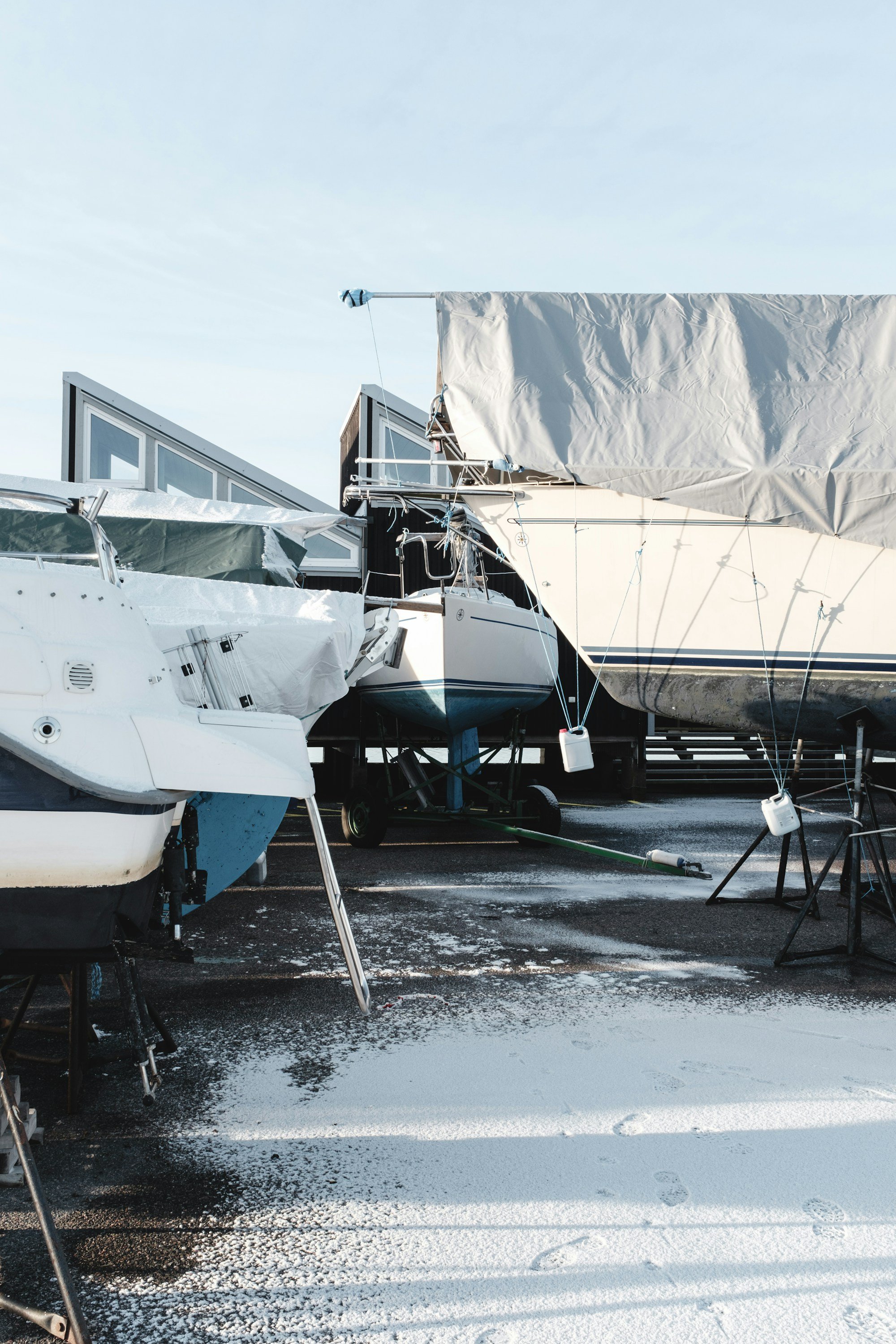
Outdoor storage is where most boats end up, and at $20 to $50 a foot it’s easy to see why. A row of pontoons under blue covers on a lot beside the lake is about as common a winter sight as there is.
If the boat lives on a trailer, the yard just needs room to park it. If it doesn’t, the marina hauls it out and sets it on blocks or jackstands. That haul-out runs anywhere from a few hundred dollars for a small runabout to thousands for a big boat, on top of the storage fee. And you pay again in spring to get it back to the ramp and into the water.

Plenty of full-service marinas sell the whole winter as a package. They haul the boat and block it. Then they winterize it and shrink-wrap it. Expect anything from a bit under $1,000 to several thousand, depending on the boat and the region.
Honestly, for a first winter with a new-to-you boat, I’d pay for the package. A tech who winterizes engines every week of the fall is less likely to miss a drain than anyone doing it for the first time.
Outside, though, the cover does all the work. Which brings up the real decision.
Shrink Wrap or a Reusable Cover?

Shrink wrap is the default for a reason — several, actually. It protects a boat well, and somebody else puts it on in the fall and cuts it off in the spring, so there’s next to nothing for you to do. Plenty of owners end up with it simply because nobody mentioned a reusable cover.
Shrink wrap runs about $15 to $28 per foot for a basic install, and it’s good for one season. It seals the boat completely, which is the point. But it seals you out too. If you think you’ll want to get aboard during the winter, ask for a zipper door when it goes on.
Ask about vents as well. A sealed boat traps condensation, and that’s how mildew gets started. Good installers add vents as part of the job.
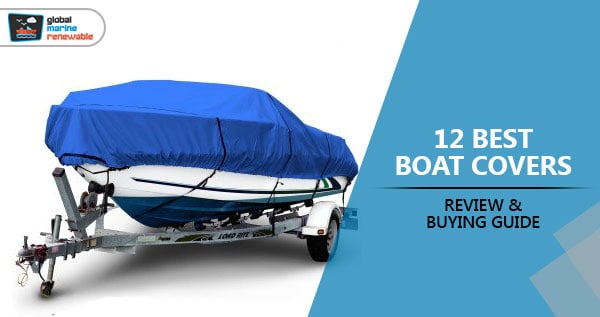
A reusable cover costs more up front and nothing the next fall. Per foot of boat, a heavy marine tarp runs about $5 to $6, a generic cover about $9 to $17, and a semi-custom cover about $19 to $54. A full custom cover runs about $62 to $250 a foot. The warranties spread out just as wide.
Over one Maryland winter, nine reusable covers were tried on boats from 17 to 25 feet, some on trailers and some on jackstands or lifts. The semi-custom covers came out with the best balance of fit and value for the money. A full custom cover pays off if you’ll keep the boat a few years. A heavy marine tarp can get a budget boat through, as long as it’s put on well and checked often.
The cheap blue poly tarp from the hardware store isn’t on that list. Those rarely last more than a couple of seasons. They rip or sag under snow, and when the wind picks up they flap hard enough to wear through gelcoat.
Two fabric notes before you buy. Polyester starts out stronger than acrylic but loses strength faster, so marine acrylic usually lasts longer. And “water resistant” isn’t the same as waterproof. For a winter cover, I’d only buy waterproof.
Getting a Cover to Shed Snow

A reusable cover is only as good as the way it goes on. Turns out the fabric isn’t what fails first. Water pooling on top is. Most covers needed bailing after rain or snow, and the supports that came in the box weren’t strong enough. Fabric stretched and stitching pulled. Some poles snapped outright.
So plan to add support. Extra poles and strapping tent the fabric so water runs off instead of sitting there loaded on top. Pad the top and bottom of each pole (a carpet square works) so it doesn’t punch through the cover or mark the deck. A scrap of nonskid shelf liner under the base keeps it from sliding.
Pad every corner and sharp edge too, the windshield frame included. Pool noodles work. So do old towels. Covers wear through at those points, usually a few weeks in, once the fabric has settled.
Measure before you order. Get the length and width plus the girth, then everything that sticks out: the outboard, bow rails, a radar arch, rod holders. T-tops and towers make a cover harder to fit, though they tent it nicely. And check that the straps reach whatever they’ll tie to.
That’s where one hard rule comes in. Never tie a cover to the jackstands. In wind or under a load of snow, the pull can drag a stand out from under the hull.
A couple of small habits pay off next fall. Mark the bow and stern on the cover with a permanent marker, plus the centerline. Then write your name and the boat’s name on it. Under covers, every boat in a yard looks pretty much the same.
Read the warranty as well. Most cover one replacement for bad seams or fabric that leaks. Damage from wind or pooled water usually isn’t covered, and neither are tears from sharp edges. So snap a few pictures of the cover once it’s on right.
Checking On It Over the Winter

Stored isn’t the same as finished. Not even close. I’d check a covered boat at least once a month and after every heavy snow or rain. You’re looking for pooled water and a cover that’s slipped or torn.
Mice, too.
In a yard, park away from boats on jackstands. Don’t move or adjust a stand, even a little. If you climb a ladder to look under the cover, tie it off at the top.
Power is the other thing to leave alone. Undersized extension cords, and several cords plugged end to end, are what keeps marina owners up at night all winter. They can start a fire on their own, and so can the charger or heater plugged into them. If you need power for any off-season work, ask the marina first.
A boat left in the water, or up on a lift, is a different kind of visit. Bring a friend. Docks get icy, and a fall into the water this time of year can be fatal.
Which Storage I’d Pick
Here’s how I’d split it, by situation.
- Room in your own garage: keep it there. It’s free, and indoors needs no cover.
- You want to forget it until spring: indoor, or a rack if the boat fits one and you won’t need to work on it.
- Outdoors for one winter: shrink wrap, with vents and a zipper door.
- Outdoors for years to come: a semi-custom cover with extra poles, checked every month.
Whatever you pick, the boat that comes out best in spring is the one that went in dry. Plug out, fuel stabilized, battery on a charger, no water left in the lines. Get that part right and almost any of these options works.
Get it wrong, and even the best cover won’t save the engine.