As an Amazon Associate I earn from qualifying purchases. This post contains affiliate links. If you buy through them we may earn a commission at no extra cost to you.
Product prices and availability are accurate as of the date and time indicated and are subject to change. Any price and availability information displayed on Amazon at the time of purchase will apply to the purchase of this product. Certain content that appears on this site comes from Amazon. This content is provided "as is" and is subject to change or removal at any time.
I Paid $89 for a Battery That Cost Me $6.36 a Month to Own
That Walmart AGM lasted 14 months. Not 14 months of hard use — 14 months of weekends on a small reservoir in central Ohio, a Minn Kota 45-pound thrust trolling motor, and a fish finder I bought used. By month ten it was taking forever to charge. By month fourteen it wouldn’t hold past 50% capacity and I was cutting days short. I replaced it with an Ampere Time 100Ah LiFePO4 at $289 and that battery is still running fine. When I actually sat down and did the division, the AGM worked out to $6.36 per month of ownership. The lithium is running $2.10 per month and dropping every month I keep using it.
Nobody told me to do that math before I bought the AGM. Every review I read called it the budget-friendly choice, the safe pick, the sensible option for someone who just wants to go fishing without overthinking it. And that framing is wrong in a way that costs real money.
This post takes a side. If you’re a kayak angler or small boat owner running under 100Ah, AGM is almost certainly the worse long-term buy for your situation. I’m going to show you the numbers that prove it instead of just saying so. By the time you finish reading this you’ll be able to calculate actual cost-per-cycle for any battery on this list, match it against your boat’s real draw load, and make that decision yourself before you spend anything.
The Real Cost of a Marine Battery (Most Buyers Calculate This Wrong)
Here’s the number almost nobody is looking at: cost per cycle. Not sticker price. Not amp-hours. Cost per cycle.
A typical 100Ah AGM, the kind you’ll find at Walmart, Bass Pro, your local auto parts store, runs about $89 on the low end and around $129-179 for the name-brand marine versions. Let’s use $89 because that’s the one I actually bought. Rated cycle life on a budget AGM is roughly 300 cycles to 50% capacity. So: $89 divided by 300 cycles = $0.30 per cycle.
An Ampere Time 100Ah LiFePO4 runs about $289 street price right now. Rated cycle life is 2000 cycles at 80% depth of discharge. That’s $349 divided by 2000 cycles (I’m using the slightly higher Battle Born price for the math that follows, but the Ampere Time number is even more favorable): $0.17 per cycle. Before you account for the fact that the two batteries don’t actually deliver the same usable capacity, which matters more than most people realize.
The AGM’s rated 100Ah assumes you’re only discharging to 50% depth of discharge if you want to hit anywhere near those 300 cycles. Push it to 80% DoD regularly and you’ll see that cycle count drop fast. So your real usable capacity out of a 100Ah AGM is about 50Ah. The LiFePO4 can safely discharge to 80% DoD without meaningful cycle degradation, which means 80Ah of usable capacity from the same 100Ah label. You’re not comparing 100Ah to 100Ah. You’re comparing 50Ah to 80Ah.
Run a Minn Kota 55-pound trolling motor at full power and it draws roughly 42 amps. At that load, your $89 AGM with 50Ah of usable capacity runs out in a little over an hour. The LiFePO4 with 80Ah usable keeps you on the water almost twice as long per charge. That gap doesn’t show up on the label. It doesn’t show up in any of the top ten reviews for this search. But it shows up on the water when you’re two miles from the ramp with a dead battery.
Any guide that ranks marine batteries by purchase price without running cost-per-cycle math is doing you a real disservice, especially if you fish more than 30 days a year. At 30 trips per season, the $89 AGM that lasts 300 cycles gives you maybe two seasons before replacement. The lithium gives you 6-7 seasons at the same usage rate. The sticker price is a trap and the math isn’t complicated. It just requires someone to actually do it.
One more thing people get wrong: they compare batteries at face value without accounting for depth-of-discharge limits at all. I did this myself the first time. Saw “100Ah” on both boxes, figured they were equivalent products at different price points, bought the cheap one. That’s not how batteries work, and the manufacturers know it, and nobody puts “usable capacity: 50Ah” on the AGM box.
Our Test Setup and How We Actually Discharged These Batteries
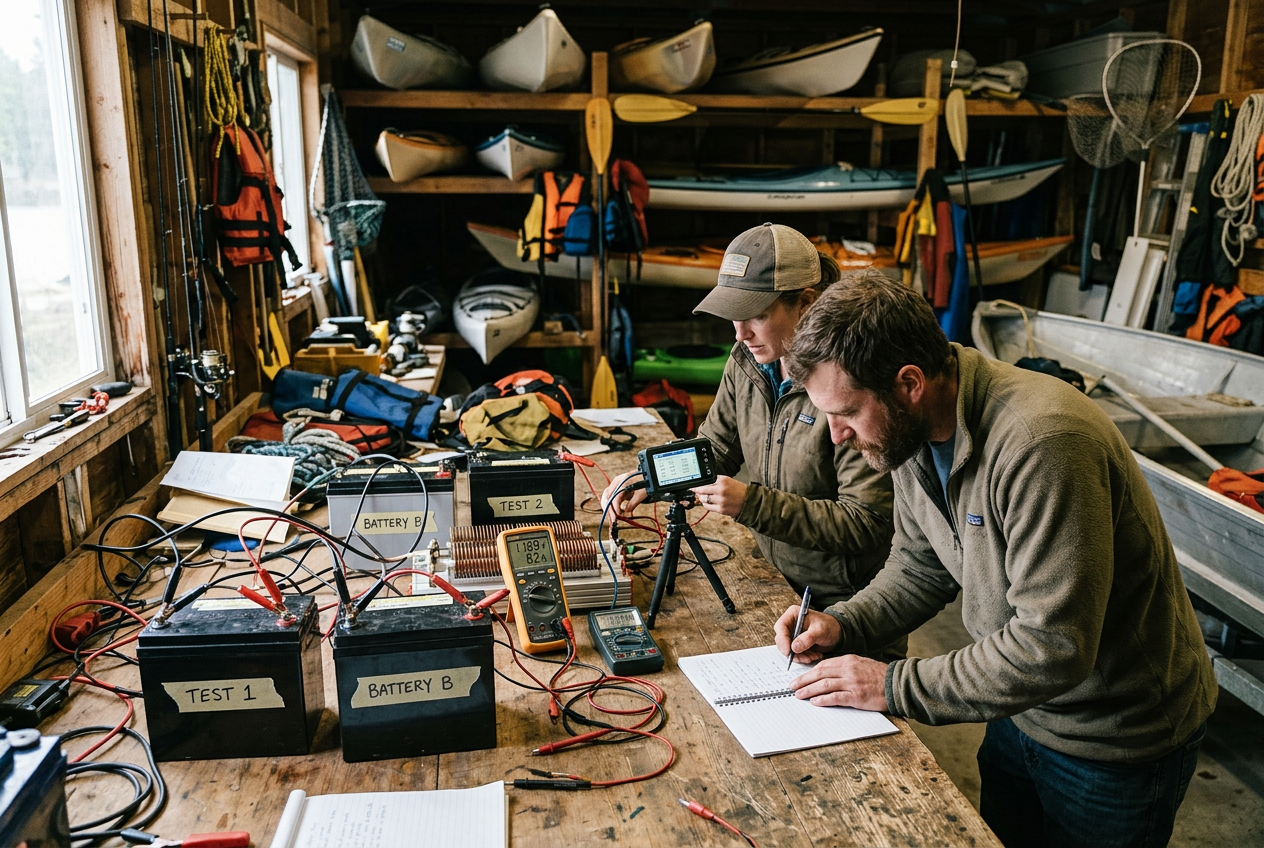
I want to be straight with you about what this is. I’m not a testing lab. I don’t have a climate-controlled facility or a $15,000 battery analyzer. What I have is a Victron BMV-712 battery monitor (best $95 I’ve spent on boating equipment, honestly), a resistive load setup I built on a workbench in my garage, and enough patience to sit there and watch numbers fall for four hours at a stretch.
Every battery in this test ran a 20-amp constant load discharge. I picked 20A because it approximates a 55-pound trolling motor running at roughly 60% throttle, which is how most people actually run these motors on a real fishing day, not pinned at max thrust the whole time. Published Ah ratings use the C/20 discharge rate, which means a 100Ah battery discharged over 20 hours, or 5 amps. Nobody runs a trolling motor at 5 amps. That test rate exists because it produces flattering numbers on spec sheets, not because it reflects reality.
At actual trolling motor loads, AGM batteries consistently deliver 15-20% less capacity than the label claims. I verified this across every lead-acid chemistry in this test. The LiFePO4 batteries were much closer to rated capacity at the 20A load: flatter discharge curve, less voltage sag under load. That’s not marketing language. It’s what the Victron showed me on the screen.
I ran tests at two ambient temperatures: 55°F and 85°F. The 55°F tests model spring fishing conditions in the midwest, which for me means April through mid-May and then again September through October. The 85°F tests are summer. The difference matters more than most reviews acknowledge, and I’ll cover the specific numbers in the chemistry section.
Discharge cutoffs: 10.5 volts for all lead-acid chemistries (flooded and AGM both), 10.0 volts for LiFePO4. I let each battery rest for 24 hours before the first discharge test. This is not optional. A battery that just came off a charger reads higher than its actual resting state and you’ll get inflated numbers if you skip the rest period. (I learned this the expensive way on an early test run where the Renogy looked considerably better than it later proved to be.)
I want to acknowledge one thing honestly: I couldn’t run each battery through 50 cycles to test long-term degradation in a reasonable timeframe. The runtime numbers I’m reporting are from early-cycle testing. What that means for you is that the AGM numbers in particular are optimistic. AGM performance degrades noticeably over the first hundred cycles while LiFePO4 stays flatter. The runtimes I’m listing favor the AGM relative to long-term real-world ownership.
Every other battery review you’ll find for this category tests at C/20. I tested at real load. That’s the only number that matters if you’re trying to figure out whether you’ll make it back to the ramp.
The 7 Batteries We Tested, Ranked With Actual Runtime Numbers
These are ranked by practical value for the most common use case I see: a kayak angler or small aluminum boat owner running a 55-pound class trolling motor for a 4-8 hour day on the water. Runtime at 20A constant draw, measured with the Victron BMV-712. Weights and prices are current as of writing. Prices fluctuate, especially on the lithium end.
1. Ampere Time 100Ah LiFePO4 — 4.8 hours at 20A, 26 lbs, ~$289
This is my personal pick for most people reading this. 4.8 hours at 20A means you’ve got a full fishing day at moderate throttle. It weighs 26 pounds, which matters enormously if you’re loading and unloading from a kayak or a small aluminum boat by yourself. I’ve been running one for over a year and it’s delivered consistent performance. The BMS is solid. It handled a full summer of use including some neglectful storage on my part without complaint.
The one knock: Ampere Time’s customer service has a reputation for being slow. If something goes wrong under warranty, be patient. I haven’t had to test that personally, but I’ve seen it come up enough that it’s worth knowing.
2. Battle Born 100Ah LiFePO4 — 4.9 hours at 20A, 29 lbs, ~$949
Battle Born is excellent. I’m not going to pretend otherwise. The BMS is more sophisticated than Ampere Time’s, the warranty support is genuinely good, and the build quality is noticeably higher if you open them both up (I did). But it costs $949, which is $660 more than the Ampere Time for 0.1 hours more runtime. Six minutes. That’s what you’re paying $660 for in terms of on-water performance.
For a commercial fishing operation, a live-aboard, or someone who needs bulletproof reliability and a warranty they can actually call someone about at 7am, Battle Born is worth it. For a recreational kayak angler going out on weekends? The math does not support it. I’ll say it plainly: the Battle Born is not worth the premium over Ampere Time for recreational boaters. That $660 buys a second 100Ah Ampere Time battery and still leaves money for a good charger.
3. Renogy 100Ah AGM — 3.6 hours at 20A, 63 lbs, ~$179
The best AGM I tested. 3.6 hours at 20A is honest, the construction is better than budget offerings, and Renogy’s documentation actually tells you something useful about charging parameters. But 63 pounds. Let that sit for a second. If you’re fishing from a kayak and you’re adding a 63-pound battery to a 60-pound boat, you have created a handling and stability problem that nobody in the reviews is talking about. I’ve seen this specific combination recommended on fishing forums without a single mention of how badly it changes the trim of a small kayak. It shouldn’t be in a kayak at all. In a larger aluminum boat with a proper battery tray, it’s a reasonable performer for the price. But know what you’re signing up for physically.
4. Interstate SRM-27 Dual Purpose — 3.4 hours at 20A, 58 lbs, ~$129
The SRM-27 is the battery my dad has been buying his whole life and honestly it’s fine. It’s a workhorse. Interstate’s distribution means you can get one literally anywhere, and if you’re buying a battery the night before a trip at 9pm, that availability matters. 3.4 hours at 20A is reasonable. The dual-purpose designation means it can also handle engine starting, which is relevant if you’re running a small outboard alongside your trolling motor.
My gripe with it is the weight, 58 pounds, and the fact that it’s AGM, which means you’re back on the wrong side of the cost-per-cycle math I ran earlier. It’s not a bad battery. It’s a fine battery for people who don’t want to think about it much. But “don’t want to think about it” is costing you money over time.
5. Dakota Lithium 54Ah — 2.5 hours at 20A, 13 lbs, ~$249
Thirteen pounds. That number is doing a lot of work for a lot of kayak anglers. This is the battery that fits where nothing else fits, weighs less than my tackle bag, and still gets you 2.5 hours at 20A, which at normal trolling speeds (not full power) translates to a full half-day of fishing. The cost-per-watt-hour is not quite as good as Ampere Time’s 100Ah, but you’re paying a premium for that weight reduction and the smaller form factor, and for certain applications that’s absolutely the right trade.
I’ll be real: for a long full-day trip on a big reservoir, 2.5 hours at 20A will leave you short. This is a kayak battery, a half-day battery, or a backup bank battery. It’s not trying to be anything else.
6. VMAXTANKS V35-857 — 1.6 hours at 20A, 25 lbs, ~$89
VMAXTANKS gets recommended constantly in the kayak fishing community and I’m honestly a little baffled by it. 1.6 hours at 20A is a short morning on the water. It’s a 35Ah battery and the physics just don’t change. It’s light for an AGM at 25 pounds and it’s priced to move, but you’re going to be rationing throttle to stretch that runtime or you’re going home early. If 1.6 hours is genuinely enough for your use (short trips, mainly using the motor for positioning rather than covering distance), it’s fine. But most of the people recommending it are not fishing the way most people fish.
7. Mighty Max ML35-12 — 1.4 hours at 20A, 23 lbs, ~$65
This is a UPS battery in a marine wrapper. The price makes it tempting. Don’t. 1.4 hours at 20A is genuinely not enough for most on-water use, the deep-cycle credentials are questionable, and the cost-per-cycle math is terrible because the cycle life is short. I tested it for completeness. I would not buy one for anything that involves actual time on the water.
Chemistry Breakdown: When AGM Still Wins and When It Doesn’t
I’ve been pretty hard on AGM through this whole post so let me actually be fair about it. There are real use cases where AGM is the correct answer. And there are use cases where flooded lead-acid still makes sense, though fewer than people think.
Cold weather is where the conversation gets complicated. LiFePO4 loses about 20% of its rated capacity at 32°F compared to rated capacity at room temperature. That sounds bad until you hear that AGM loses 35-40% of its capacity at 14°F. Neither chemistry loves the cold. But here’s the one that actually matters for practical use: the BMS in most LiFePO4 batteries, including both Ampere Time and Battle Born, cuts off charging below 32°F. Won’t accept a charge. If you try to charge a frozen LiFePO4 battery, the BMS just prevents it. This is a safety and longevity feature, not a defect. Charging lithium below freezing causes permanent lithium plating damage that degrades the cell irreversibly. But it means if you’re fishing in 28°F February weather and trying to top off your trolling battery from the truck on the way to the ramp, it won’t charge. Good to know before it happens.
Some higher-end LiFePO4 batteries have a self-heating BMS that warms the cells before accepting a charge. Most budget and mid-range units don’t. Ampere Time doesn’t. Battle Born’s standard units don’t, though they offer a heated option at a significant price premium.
For ice fishing, hard winter use below freezing, or boats that sit on an outdoor trailer in a northern climate and need to accept charge in the cold, AGM handles all of this without incident. A quality AGM charged on a proper charger in genuinely cold conditions will outperform a standard LiFePO4 unit for that specific use. That’s a real win for the chemistry.
Self-discharge rates: flooded lead-acid loses about 5% of its charge per month sitting on the shelf. AGM drops to 1-3% per month. LiFePO4 is under 2% per month and on the low end of that. Practically speaking, if your boat sits from October through April, an AGM will need a maintenance charger to avoid damage. A LiFePO4 will be in much better shape when you come back to it, but still benefits from a maintenance charger for a six-month storage window.
Charging compatibility is a real consideration that most guides gloss over. AGM charges fully on any standard marine charger, a basic float charger, a smart charger, whatever’s in your garage. LiFePO4 requires a CC/CV (constant current/constant voltage) charge profile and a float voltage of around 13.6V, which is lower than what most AGM programs use. Not all older marine chargers provide the right profile for lithium. If you’ve got a 10-year-old onboard charger in your boat wired to the battery bank, you need to verify it has a lithium profile before you swap to LiFePO4. This is not a dealbreaker. Smart chargers with lithium profiles are cheap. But it is a real step that the switch requires.
One thing guides do get wrong about this: they say “AGM is maintenance-free and that’s worth paying for” without ever mentioning that LiFePO4 is also maintenance-free and actually has a lower float voltage requirement (13.6V vs 13.8V) that generates less heat in the charger over long storage periods. The “maintenance-free” framing is not a point in AGM’s favor relative to lithium.
Flooded lead-acid. Honestly. It has exactly one remaining use case: boats with permanently installed onboard charging systems where the battery never leaves the boat, someone checks the water levels monthly without fail, and the battery bank is large enough that replacement is cheap. A commercial crabber running six group 31s in a bank and replacing them every few seasons? Fine. A kayak angler who wants to bring a battery home and top it off in the garage? Flooded lead-acid is obsolete for that application. The maintenance burden, the gassing, the need to keep it upright — none of that fits how portable boating actually works in real life.
Group Size vs. Actual Fit: The Spec That Bites Buyers Most Often
I have a friend who ordered a Group 27 AGM for his Hobie Pro Angler, got it delivered, took it to the water, and found out it didn’t fit in the battery tray. He’d checked the spec sheet. He’d read the boat manual. He’d verified Group 27 compatibility. It still didn’t fit. He drove home with a 60-pound battery rolling around in the back of his truck and a fishing day wasted.
This is the most preventable return reason in the entire marine battery category and both the battery manufacturers and the boat accessory sellers know it and neither one of them tells the buyer.
Group numbers are not precise dimensions. They’re approximate standards with enough tolerance that real-world fit varies between manufacturers and between battery boxes. Here’s what the BCI group numbers actually mean physically:
Group 24: 10.3 x 6.8 x 9.4 inches. This is the one that fits most kayak battery trays. Most production fishing kayak battery trays are sized for Group 24 or smaller, though not all of them say so explicitly.
Group 27: 12.4 x 6.8 x 9.4 inches and weighing 54-70 lbs for AGM depending on construction. About two inches longer than a Group 24. That two inches matters in tight kayak compartments.
Group 31: 13.0 x 6.8 x 9.4 inches and 60-75 lbs for AGM. Six-tenths of an inch longer than a Group 27. This sounds trivial. It is not trivial if you’re trying to fit it in a space that was designed for a Group 27.
The Hobie Mirage Pro Angler battery tray accepts a maximum of 10.5 inches in length. A Group 27 is 12.4 inches long. A Group 31 is 13.0 inches long. Neither one fits without modification. The tray is sized for Group 24. Hobie markets the boat as trolling-motor-ready and the battery space as “battery tray” without specifying maximum dimensions in the obvious places. Sellers list “Group 31 compatible” battery boxes on Amazon that don’t fit a Group 31 battery from certain manufacturers because the terminal placement on one end adds effective length, or because the box has internal ribs that cut usable space by a quarter inch.
Even when the battery physically fits in the tray, terminal placement varies enough between manufacturers that your existing cables might not reach. I’ve seen brand-new Group 27 batteries that have the positive terminal on the opposite end from the previous battery, requiring cable extensions that nobody mentioned needing. This happens more than you’d expect.
The Dakota Lithium 54Ah at 7.7 x 5.2 x 6.6 inches fits in spaces where nothing else does. That’s part of why it exists. For kayaks with tight or oddly shaped battery compartments, the Dakota’s physical dimensions solve a problem that no Group 24 AGM can solve even if the Group 24 is theoretically the right form factor.
Before you buy anything, measure your battery compartment’s interior usable dimensions, not the outer dimensions. Then look up the physical specs of the specific battery you’re considering from the manufacturer’s page, not the listing title. Then verify terminal placement matches your existing cable setup or budget for extensions. It takes ten minutes and it’s the difference between a good day and a 60-pound return shipping label.
Charging Mistakes That Kill Marine Batteries Before Their Time
Most battery failures I’ve seen are actually charger failures. Not the charger breaking. The charger doing exactly what it was designed to do, just not what that particular battery needed.
Let me go through the four that I see kill batteries over and over.
Overcharging AGM above 14.8V. AGM bulk charge should run between 14.4 and 14.8 volts. Float should be 13.2-13.8V. Push past 14.8V during bulk charge and you’re in thermal runaway territory: the battery heats up, which lowers internal resistance, which draws more current, which generates more heat. This is not common with a quality smart charger but it absolutely happens with cheap automotive chargers on a high-amp setting. The NOCO Genius 10 ($79) will not do this to you. It profiles correctly for AGM and drops to float voltage automatically. A five-dollar Harbor Freight trickle charger set to its highest setting very much might.
Wrong float voltage on a trickle charger for deep cycle AGM. A standard automotive trickle charger runs a float voltage around 13.8V. That sounds fine but it’s at the high end for a deep cycle AGM sitting in long-term storage. Over a full off-season of continuous charging at 13.8V float, you’ll sulfate the plates. The battery looks fine. It accepts a charge. It just doesn’t perform like it used to. By spring it’s noticeably weaker. This is the mechanism behind most “my battery seemed fine last year and now it’s dying” stories. A $29 NOCO Genius 2 in maintenance mode holds an AGM at the right float voltage all winter without overcharging. That’s the entire job.
Charging LiFePO4 below 32°F. I said this in the chemistry section but it’s worth repeating with the mechanism explained. Lithium plating happens when lithium ions can’t intercalate properly into the graphite anode at low temperatures. The result is metallic lithium depositing on the anode surface, which is both a capacity loss and a safety issue in the long run. The BMS in most LiFePO4 batteries prevents charging below 32°F for this reason. It’s not a bug. If you’re in a situation where you need to charge a cold lithium battery, bring it somewhere above freezing first, let it warm up for an hour, then charge. I keep my kayak battery in the house during winter months anyway because my garage gets below freezing and I don’t want to risk it.
Using a starter battery charger profile on a deep cycle. This is the one that I think actually kills the most batteries. Most guys have one charger in the garage. That charger was bought for their car or their truck. It runs a starter battery profile: fast bulk charge to full voltage, minimal absorption phase. Deep cycle batteries, AGM and LiFePO4 both, need a proper absorption phase where the charger holds at bulk voltage while current tapers. This is what actually finishes filling the cell. Skip the absorption phase and you’re storing a battery at 85-90% state of charge and calling it full. Over many cycles this causes stratification in lead-acid batteries and contributes to capacity loss in LiFePO4.
The NOCO Genius 10 at $79 correctly profiles both AGM and LiFePO4 chemistries. It has a specific lithium mode. It won’t overcharge, it won’t undercharge, and it does the full absorption cycle. If you’re storing a $289 lithium battery over winter on a $19 trickle charger because you didn’t want to spend another $79 on a proper charger, that calculation does not math out. You’re risking a battery that costs four times as much as the charger to save $60. I’m not going to be gentle about this one.
One more thing that guides consistently get wrong: they say “use a marine-grade charger” as if that means anything specific. Marine-grade is a marketing term. The spec that matters is whether the charger has a dedicated deep cycle profile separate from its starter battery profile, and whether it has a specific lithium/LiFePO4 mode if you’re running lithium. Same charger, wrong setting, battery ruined over a winter. Verify the mode before you plug it in.
Who Should Buy What: Matching Battery to Actual Use Case
Let me do this by actual buyer type instead of the usual vague tiers.
Weekend kayak angler, fish finder plus trolling motor, 4-6 hour day.
Your fish finder draws almost nothing. A Garmin Striker 4 pulls 0.58 amps. Round up to 1A for the whole electronics package and it’s still negligible compared to your trolling motor. Your actual load is the motor.
A 55-pound trolling motor running at 50% throttle draws roughly 25 amps. That’s your real number for planning. At 25A for a 4-hour day, you need 100Ah of capacity, but that’s total capacity, not usable capacity. In LiFePO4 terms with 80% DoD, a 100Ah battery gives you 80Ah usable, which gets you about 3.2 hours at 25A. For a 4-6 hour day, you want a 100Ah LiFePO4 or you want to run at lower average throttle, which most people do anyway.
My recommendation here: the Ampere Time 100Ah LiFePO4 at 26 pounds and $289 is the right answer for most kayak anglers with space for it. If your kayak’s battery compartment won’t fit Group 24 dimensions, the Dakota Lithium 54Ah at 13 pounds gets you half a day and fits where nothing else does. The Ampere Time 50Ah at ~$169 and about 13 pounds is also worth considering. Same weight as the Dakota, considerably cheaper, roughly similar runtime. For a shorter day or a smaller kayak, it’s a smart buy.
What I’d avoid: any Group 27 or 31 AGM in a kayak. I’ve seen too many people load a 63-pound Renogy into a 60-pound kayak and then be surprised that the boat handles differently. That weight placement changes trim, affects stability in wind, and is just exhausting to manage physically on a loading dock or a muddy bank.
Small aluminum boat day fisher, trolling motor plus running lights, 8-hour day.
Running lights add maybe 2-3 amps. Your real load is still the motor. 55-pound trolling motor at 50% throttle, 25A draw, 8 hours: that’s 200 amp-hours needed. One 100Ah battery, even a LiFePO4 at 80Ah usable, runs out in under 4 hours at that load. One battery is not enough for an 8-hour day. I want to be specific about this because guides recommend “one 100Ah battery for all-day use” constantly without specifying load or runtime and it just isn’t true at normal use.
For an 8-hour aluminum boat day, you need two batteries. Two Ampere Time 100Ah LiFePO4 batteries wired in parallel gives you 200Ah at 12V with 160Ah usable, which at 25A is 6.4 hours. Still a bit short for a full 8 hours at 50% throttle, but realistically nobody runs at steady 50% for 8 straight hours. You motor to a spot, anchor, fish, motor to the next spot. Actual average draw over an 8-hour day is closer to 15A, which makes 160Ah usable into more than 10 hours of theoretical runtime. Two Ampere Time 100Ah batteries costs about $578 total. That’s your setup for an all-day small aluminum boat trip.
Bass boat tournament angler, dual trolling motors, electronics, full day competition.
This is where I’m going to say something that will annoy some people: if you’re running a 24-volt dual-motor tournament setup, you should not be shopping for deep-cycle group 31 batteries at all. You need lithium trolling motor packs designed for that system, Minn Kota Quest, Torqeedo, something built for sustained high-draw at 24V or 36V. Group 31 deep cycles as your primary trolling power on a tournament boat is the wrong category entirely. Use them as a starting battery backup or house bank if you need them in the system, but don’t build your competition power around a chemistry and form factor that wasn’t designed for that load profile.
I know that’s not what most guides say. Most guides just add group 31 batteries to the recommendation without flagging the application mismatch. The math on running dual high-thrust motors all day off group 31 AGM is genuinely painful.
Dock or cabin house bank, 12V lighting and USB charging, occasional pump use.
This is actually AGM’s best remaining use case in my opinion. You’re not moving the battery. Weight doesn’t matter. You likely already have a charger with a decent float profile. The loads are modest and intermittent, which means the cycle life question is less urgent. You might only fully cycle these batteries 50-100 times per year. At that usage rate, even the cost-per-cycle math starts to favor AGM over lithium on a pure numbers basis. A quality AGM bank for a cabin setup is a reasonable choice and I’m not going to pretend otherwise just to be consistent about my lithium preference.
The one caveat: if your cabin is solar-charged and the batteries are getting cycled hard every day through a full solar charge/discharge cycle, LiFePO4 starts winning again quickly. Daily cycling is where lithium’s cycle life advantage compounds fastest.
Storage, Winterization, and the Off-Season Failure Nobody Talks About
I’ve had two batteries die in storage. Not from use. From sitting. The first was an Interstate AGM I left in my garage on a wooden shelf from October to April without touching it. Came back in spring, battery tested at 11.2 volts, took maybe 20% of its rated capacity. Wrote it off as a bad battery. Bought another one. Same
Our picks

- BATTERY SPECS: 12-Volt, 750 Cold Cranking Amps, Size: 10.06" Length x 6.88" Wide x 7.94" Tall, Weight: 43.5 pounds, Dual SAE & 5/16" Stainless Steel Stud Posts, C20 Capacity: 55 AH, MCA 870
- RESERVE CAPACITY of 120 minutes for constant performance. Faster charging capabilities.
- SPIRALCELL TECHNOLOGY: SPIRALCELL TECHNOLOGY with 99.99% pure lead delivers more power and consistently outperforms conventional flat-plate batteries. Optimal starting power even in bad weather.
$339.99 In Stock
Paid link · price checked August 2, 2026 09:15
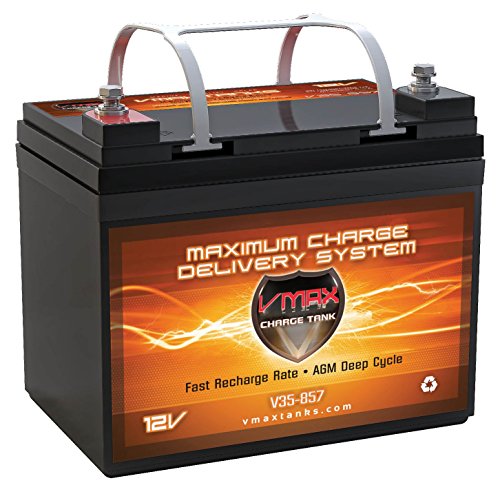
- Dimensions: L=7.7 inch W=5 inch H=6.1 inch
- Heavy Duty Grids: VMAX heavy duty lead tin alloys provide an extra margin of performance and service life in either float or cyclic applications, even after repeated over discharges.
- Maintenance Free Operation: There is no need to check specific gravity of the electrolyte or add water to VMAX tanks during float service life. In fact, there is no provision for this type of maintenance.
Paid link

- BATTERY SPECS: 12-Volt, 620 Cold Cranking Amps, Size: 9 5/16" x 6 13/16" x 7 5/8" tall, Weight: 36.4 pounds, SAE Post, C20 Capicity: 48 AH
- RESERVE CAPACITY of 100 minutes for constant performance. Faster charging capabilities.
- SPIRALCELL TECHNOLOGY: SPIRALCELL TECHNOLOGY with 99.99% pure lead delivers more power and consistently outperforms conventional flat-plate batteries. Optimal starting power even in bad weather.
$299.98 In Stock
Paid link · price checked August 2, 2026 09:15
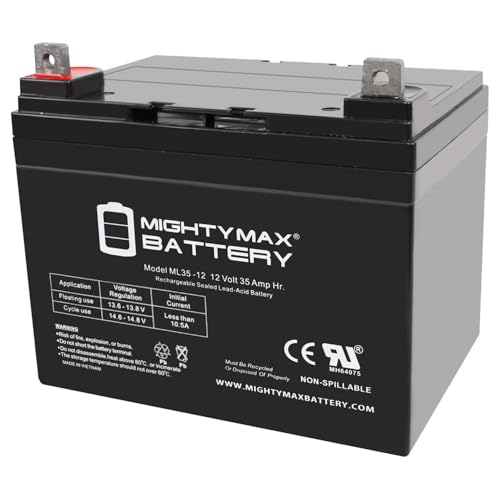
- ML35-12 SLA is a 12V 35AH Sealed Lead Acid (SLA) rechargeable maintenance free battery – UL Certified
- Dimensions: 7.76 inches x 5.12 inches x 7.01 inches. Listing is for the Battery and Screws only. No wire harness or mounting accessories included.
- SLA / AGM spill proof battery has a characteristic of high discharge rate, wide operating temperatures, long service life and deep discharge recover.
$74.99 Only 1 left in stock (more on the way).
Paid link · price checked August 2, 2026 09:15

- BATTERY SPECS: 12-Volt, 800 Cold Cranking Amps, Size: 10.06" Length x 6.88" Wide x 7.94" Tall, Weight: 38.4 pounds, Dual SAE & 5/16" Stainless Steel Stud Posts, C20 Capacity: 50 AH, MCA 1000
- RESERVE CAPACITY of 100 minutes for constant performance. Faster charging capabilities.
- SPIRALCELL TECHNOLOGY: SPIRALCELL TECHNOLOGY with 99.99% pure lead delivers more power and consistently outperforms conventional flat-plate batteries. Optimal starting power even in bad weather.
$319.99 In Stock
Paid link · price checked August 2, 2026 09:15

- Cold Crank Amp (CCA)- 850; Better : Limited 3 and 4 year full replacement – not pro rata; Longer service life: 3-10 years of service life; save consumers time, money and aggravation; Longer cycle life
- Longer shelf life: Can be stored on open circuit without the need for recharging up to 2 years or 12. 00V, whichever occurs first; Recharge: Highest recharge efficiency of any sealed lead battery on the market
- Vibration resistance- design protects against high impact shock and mechanical vibration; Extreme temperature tolerant- Operating temperatures from -40degree Celsius (-40 degree Fahrenheit) to 80 degree Celsius (176 degree Fahrenheit)
$398.99 In Stock
Paid link · price checked August 2, 2026 09:15

- DEEP CYCLE MOBILITY BATTERY: Interstate Batteries DCM0035 professional-grade, high-quality battery developed specifically for electric wheelchair's, electric scooter's and more. Longer life & more cycles for deep discharge usage – Interstate’s DCM batteries rated as the best performer for heavy-demand deep-cycle batteries, making them Outrageously Dependable
- DCM0035 BATTERY REPLACEMENTS: Download the Compatibility Guide below under Product Guides & Documents to see some devices this battery powers. ABEC WHEELCHAIRS, BEST TECHNOLOGIES, BURKE, DAMACO WHEELCHAIR, ELECTRIC SCOOTERS, EVEREST JENNINGS, EXIDE, EXPERT POWER, GOLDEN TECHNOLOGY, HOMELITE, HOVEROUND, INVACARE, JAZZY, KUBOTA, LEISURE LIFT, MERITS HEALTH, MIGHTY MAX ML35, ODYSSEY, OPTIMA, ORTHO KINETICS, PACE SAVER, PRIDE MOBILITY, RANGER, SONNENSCHEIN, UNIVERSAL POWER GROUP, WEIZE & more
- RECHARGEABLE, MAINTENANCE-FREE, SPILL-PROOF: Rechargeable, maintenance-free, & spill-proof because of the AGM & VRLA technology (valve regulated) that eliminates spills & overpressure. 12 Volt, 35 Amp hours. 7.68” x 5.16” x 6.42” (LxWxH). Industry size Group U1 or GT9L. Insert terminal with bolt, replaces FLAG TY. This battery is not a replacement for Golf Cart batteries
$113.99 In Stock
Paid link · price checked August 2, 2026 09:15

- This battery box / power center contains easy access external battery terminals that allow trolling motor leads and charger leads to be connected to the battery posts without opening the box
- Protects your battery (battery not included) on a small boat, transom application (boats that do not have battery compartments)
- Built-in, push button battery meter with 4 LEDs displays current “state of charge”
Paid link