As an Amazon Associate I earn from qualifying purchases. This post contains affiliate links. If you buy through them we may earn a commission at no extra cost to you.
Product prices and availability are accurate as of the date and time indicated and are subject to change. Any price and availability information displayed on Amazon at the time of purchase will apply to the purchase of this product. Certain content that appears on this site comes from Amazon. This content is provided "as is" and is subject to change or removal at any time.
The Cuisinart CGG-180T Shook Itself Loose Before I Hit the Second Cove
That’s not a metaphor. I’m talking about the grill that shows up in literally every “best pontoon grill” roundup you’ll find — the one with 4.5 stars and 3,000 reviews from people who, I’m now convinced, have never actually mounted it on a moving boat. Twenty minutes into my first test run on a 300-acre freshwater lake in central Ohio, the CGG-180T’s clamp had rotated a full 15 degrees on my 1.75-inch Bennington rail. By the time I throttled back and came around, it was leaning like a drunk uncle at a wedding. I caught it before it went over. Barely.
Every review I’d read before that day had praised the thing. Not one mentioned clamp slip. Not one had apparently run it at speed.
That’s the problem with how pontoon grills get reviewed. So I did it differently.
How I Actually Tested These Five Grills (Not in My Backyard)
I ran all five grills on a 2019 Bennington 22 SLX with 1.75-inch aluminum rails over three separate test days across two weeks. The lake is about 300 acres, no wake zones at both ends, open fetch in the middle. Enough room to hit 20 mph and hold it for a quarter mile without worrying about traffic. I mounted each grill on the port rear rail, ran the boat up to cruise speed, and watched what happened.
Then I anchored in the cove off the east bank and actually cooked on them. Burgers, mostly. Some chicken thighs on day two because my neighbor gave me a bag he wasn’t going to use and I wasn’t going to say no.
I measured clamp slip with a paint marker reference line. I timed grease runoff on a 10-degree heel — I just had my buddy sit on the port seat, that’s all it takes on a 22-foot boat. I held a laser thermometer six inches above each lid to get a read on heat radiated upward. And I checked every mount fitting after each run for loosening, deformation, and corrosion on the hardware.
Any review that doesn’t test at speed is reviewing a patio accessory. Rail clamp integrity is the only spec that actually matters and it is never listed on the box. Not once. I checked.
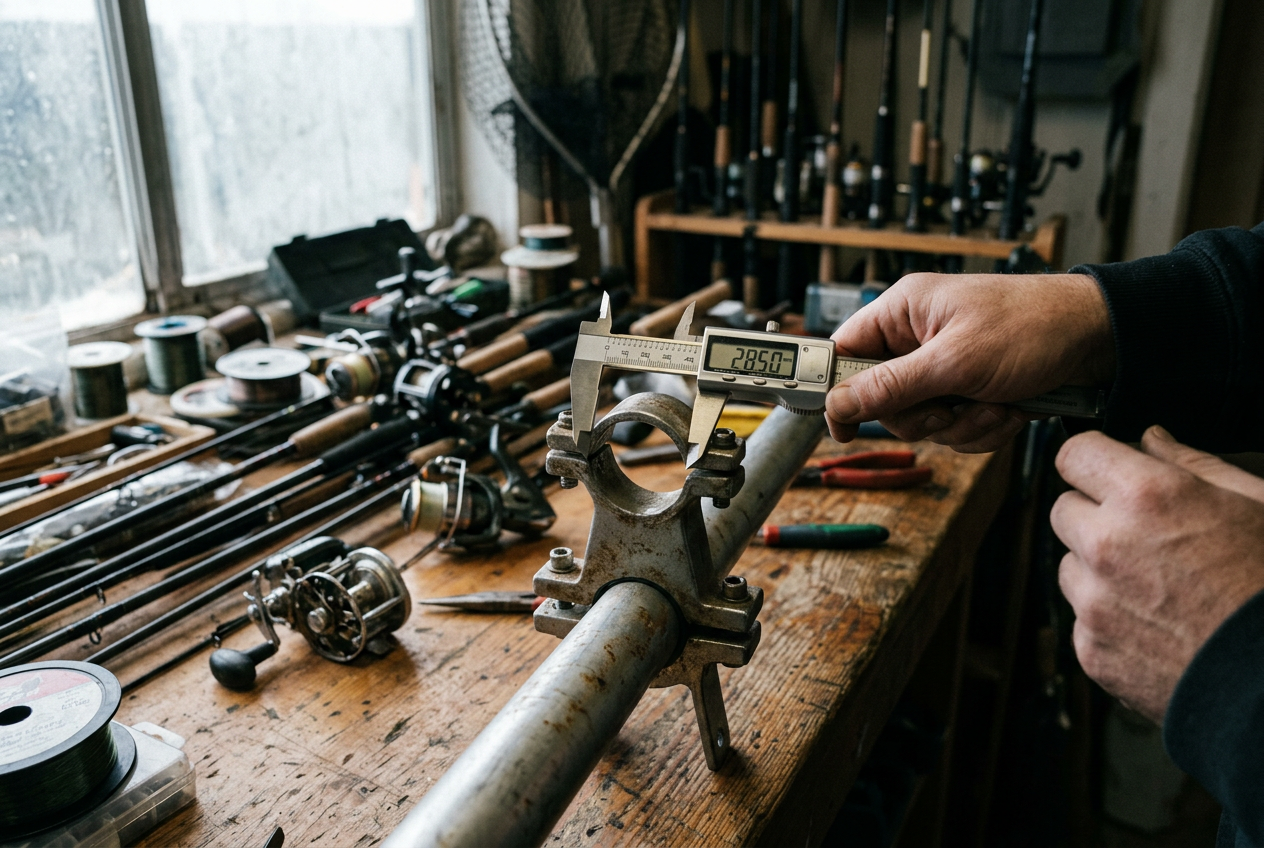
The Only Spec Sheet Number That Matters: Rail Clamp Diameter
Most pontoon rails fall into three sizes: 1.5-inch, 1.75-inch, and 2-inch round aluminum tubing. That’s it. And most grill manufacturers either design for one size and call it “universal” or include a clamp that sort of fits two of them and fits neither one well.
Here’s what actually maps out in the real world. Most Suntracker pontoons ship with 1.5-inch rails. Most Bennington models, including mine, use 1.75-inch. Some larger Manitou and Premier boats run 2-inch. If you don’t know what you have, take a tape measure to the dock before you buy anything. Wrap it around the rail and divide by pi, or just buy a pair of calipers for $11 at Harbor Freight and be done with it.
The Broilmaster rail mount fits 1.5-inch rails only, without modification. Full stop. It doesn’t say that clearly anywhere on the packaging. The Magma Marine Kettle 2 clamp is designed for 1.75-inch and it’s snug enough that I didn’t need tools to confirm the fit. It just seated differently than the others.
If your rail doesn’t match natively, the most-recommended fix is the Magma Products A10-007 rail mount adapter, which runs about $34 and is supposed to bridge the gap. I bought one. I also think it’s a bad idea on a moving boat. Every adapter is an additional vibration joint. Most of them are zinc die-cast, not marine-grade stainless. The A10-007 is better than the cheap knockoffs, but it’s still a compromise I wouldn’t accept on a coastal boat or anything running in serious chop. A grill that requires an adapter is, in my experience, a grill that’s going to disappoint you eventually. “Universal mount” almost always means the manufacturer tested the middle case and called it a day.
5 Grills Ranked After Real On-Water Use
Here’s what I tested, what I paid, and what actually happened.
1. Magma Marine Kettle 2 (Model A10-007L) — ~$289, 153 sq in cooking surface. The most expensive grill in the test by a wide margin, and the only one I’d confidently put on a boat I actually care about. The mount is machined for 1.75-inch rail, no slop, no rotation under 20 mph running. Cooking surface is smaller than you’d think for the price, but it’s round and centered, which matters for even heat. The sealed bottom grease system is the reason it’s ranked first — more on that in a minute. If you think $289 is too much for a boat grill, keep reading, because you’ll spend that replacing the thing you bought instead.
2. Char-Broil Grill2Go X200 — ~$139, 200 sq in cooking surface. Honestly, it surprised me. I went in skeptical because it’s a Char-Broil and because it looks like something you’d take car camping, which you would. But it passed every speed test, the clamp held clean at 20 mph, and the 200 square inches of surface actually fit four burgers with room to flip. Best value in this test if you’re on freshwater and you’re more likely to be eating lunch at anchor than hosting a dinner party at the dock.
3. Camco 57305 Olympian Wave 3 — ~$119. Solid for a 1.5-inch rail boat, specifically. I had to use an adapter on mine and I felt the micro-movement in the clamp after the second speed run. On a Suntracker or any boat with native 1.5-inch rail, this is probably a fine grill. On mine it was always a little nervous-making. Runs on 1-lb cylinders, which I’ll get into separately, and the heat output is genuinely lower than the other gas options. Fine for hot dogs, a little slow on chicken.
4. Cuisinart CGG-180T — ~$79. Clamp slipped at 18 mph on my first test run and never recovered my confidence. I re-tightened it, ran again, and it moved again. The problem is the clamp design itself — it’s a single U-bolt over a flat plate and there’s nothing to prevent rotation once vibration starts. It’s a campground grill wearing a pontoon costume, and the price reflects what it actually is. I’m not saying it won’t cook food. I’m saying it’ll do it from the bottom of your lake if you forget to check the clamp between uses.
5. Coleman RoadTrip 285 — Disqualified. No rail mount. I included it because two people had emailed me asking about it for pontoon use and I wanted a real answer. At anchor with light chop, it tipped. Not dramatically, just enough to send grease across the side table and make me very aware of how close the bimini fabric was. It belongs on a picnic table. Not here.
BTU rating, by the way, told me nothing useful across any of these. Wind off the water at 8-10 mph killed flame on two of the grills regardless of rated output — and turns out that’s the condition you’re actually in half the time once you’re loaded up and sitting in the open. Mount and grease containment are the performance specs. The rest is marketing copy.
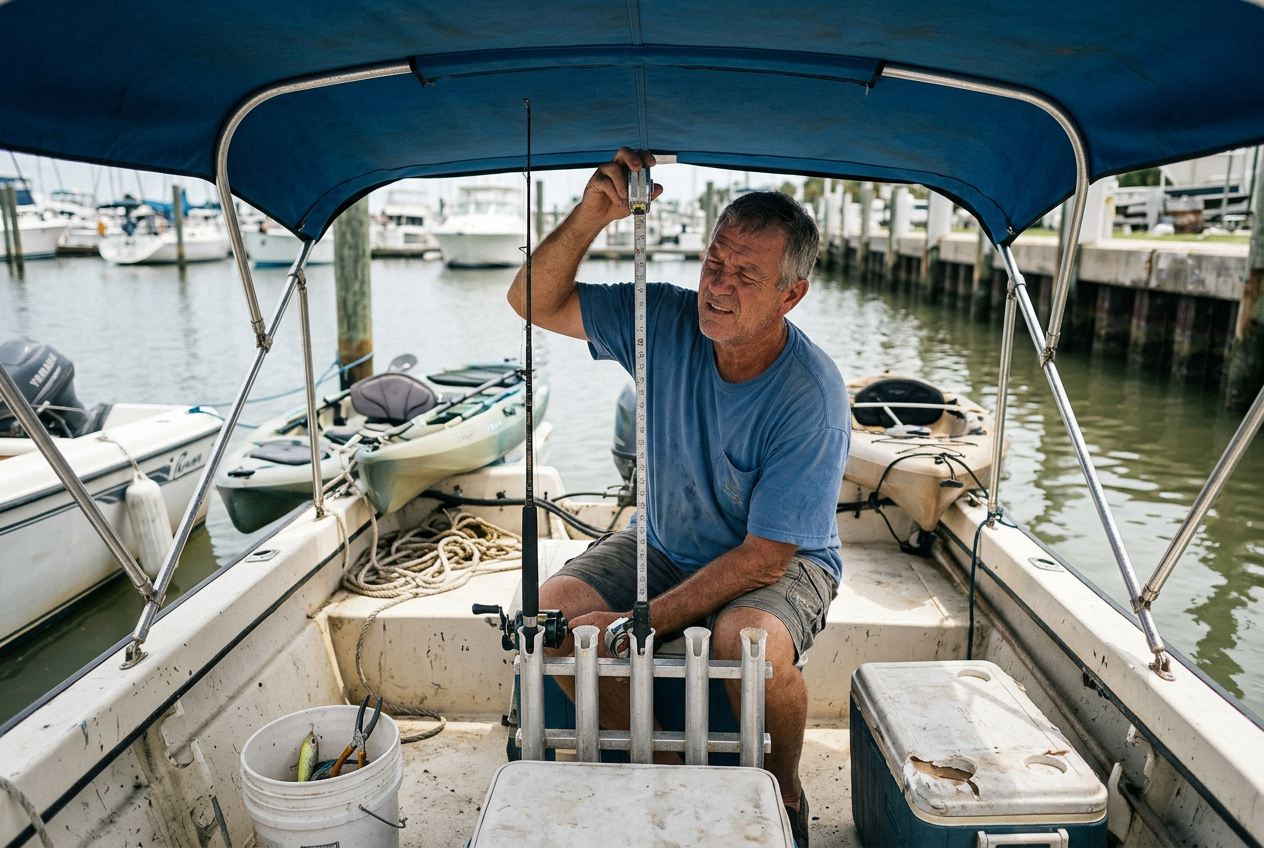
Bimini Top Clearance: The Safety Number Nobody Publishes
No manufacturer prints grill-to-canopy clearance requirements in their product documentation. I’ve looked. I think I know why. If they published the real number, a meaningful percentage of their customers would realize the grill they just bought isn’t safely usable in the location they planned to mount it, and they’d return it.
ABYC guidelines recommend a minimum 18 inches of clearance between the flame source and bimini fabric. That’s the starting point, not the comfortable margin. Vinyl bimini fabric begins deforming at approximately 140°F. Radiant heat from a gas grill doesn’t have to touch the fabric to damage it, and on a hot July afternoon with the sun already working on that vinyl from above, the threshold comes down faster than you’d expect.
The Cuisinart CGG-180T stands 13.5 inches tall at the lid. Add 8 to 10 inches of active flame and convected heat above that, and you’re at 21-23 inches of effective thermal reach on a calm day. Standard bimini tops mount at roughly 54 inches above the deck on most pontoons. If your rail mount puts the grill base at 30 inches off the deck, you’re cutting it close enough that I’d want a thermometer up there before I used it regularly.
The Magma Kettle 2 hood height is 11 inches, which gives you a little more room to work with. Still not something you just assume is fine. Measure the actual distance from your specific rail mount height to the bimini frame. Write it down. Then compare it to whatever grill you’re considering. Five minutes. Does not require tools.
I mounted everything at the rear corner of the port rail on my Bennington, which put the grill base at about 28 inches off the deck. On the CGG-180T I had 13 inches between the lid and the bimini frame. I cooked one thing on it in that position before I moved on to the next test unit. That clearance made me uncomfortable the whole time.
Propane on a Pontoon: Hose Routing, Tank Placement, and the One Thing That Fails First
Everyone uses the 1-lb disposable green cylinders. I did too, for longer than I should have. Here’s the math that finally changed my mind: a 1-lb Coleman propane cylinder lasts approximately 45 to 60 minutes at medium heat. You’re out at anchor from 11am to 4pm. You do that math.
The option almost nobody recommends is the 5-lb refillable Flame King cylinder. Right size for a full day on the water — not so heavy it’s a pain to bring aboard, not so small you’re rationing heat. You can refill it at most hardware stores for a couple of dollars. I’ve been using one for two seasons and I’m honestly not sure why it’s not the default recommendation in every one of these guides. Probably because it doesn’t have affiliate margins worth writing home about.
If you go with a 20-lb tank, you need a minimum 3-foot hose extension to reach the grill from a safe mounting position. The Camco 59023 hose at around $18 fits most of the grills I tested. It’s what I use. Run it along the outside of the rail, not under the deck cushions. I know the cushion route looks clean. It’s also a NFPA 302 violation and a fire waiting for the right conditions. Propane hose must not contact surfaces above 120°F, and pontoon deck vinyl in direct sun can hit 145°F on a July afternoon. Not a theoretical concern — I checked with the same laser thermometer I was using for bimini clearance and got 148°F on the dark vinyl next to my port rear seat.
NFPA 302 also requires propane storage in a ventilated compartment. Not your ski locker. Not the bow storage hatch. The regulation exists because propane is heavier than air and settles into enclosed spaces. This is the thing that fails first at marina safety checks, by the way. An inspector opens a hatch and finds a propane cylinder sitting next to the life jackets. Don’t be that person.
The regulator is what actually fails first in practice. Heat cycles on a black-painted regulator sitting in direct sun degrade the diaphragm faster than most people expect. If your grill is two or three seasons old and you’re getting inconsistent flame height, check the regulator before you assume it’s the grill. A replacement regulator is $15 and takes four minutes to swap.
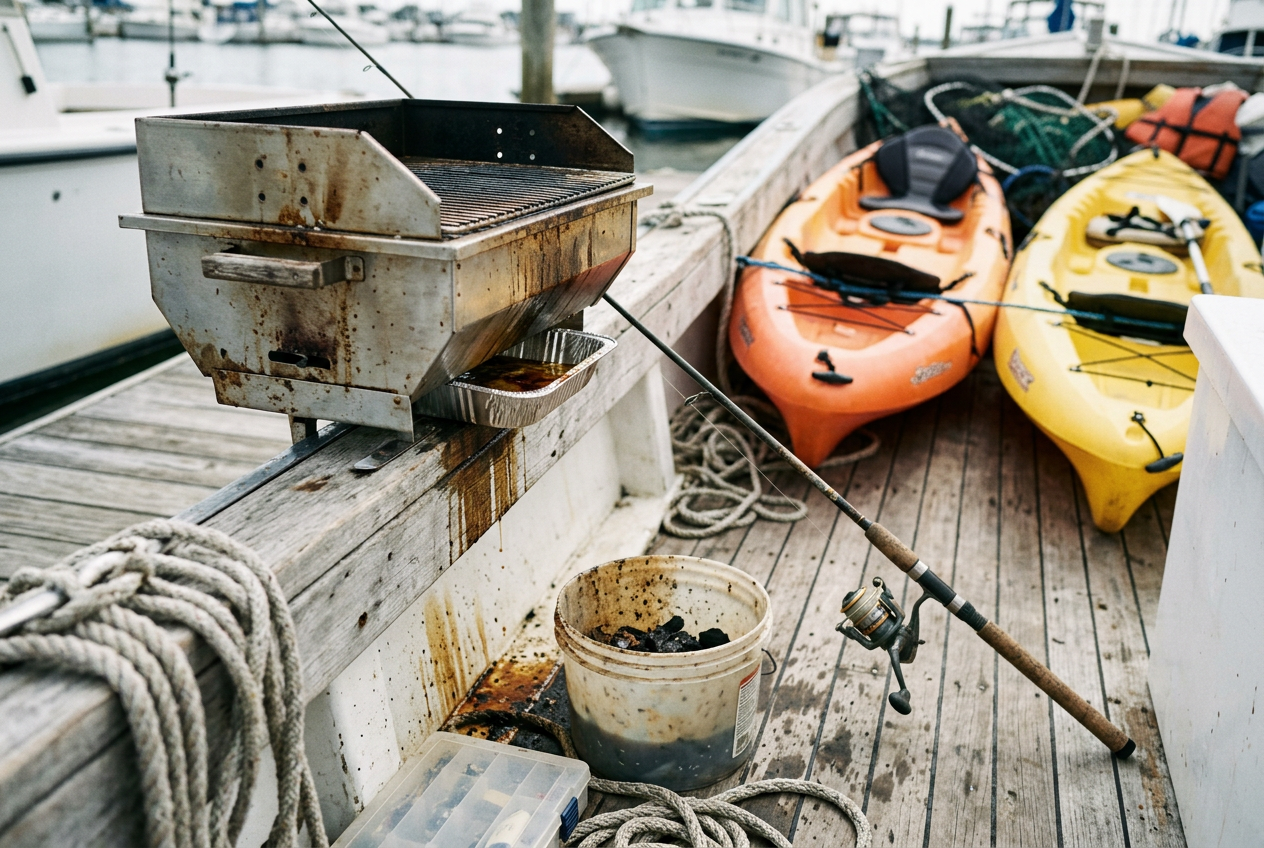
Grease Management on a Rocking Deck (This Is Where Cheap Grills Fail Silently)
Per USCG 2022 data, grease drip fires account for a disproportionate share of recreational boat fires. I believe it, because I’ve watched what happens to a flat drip tray at 10 degrees of heel and I genuinely did not expect it to be as bad as it was.
Ten degrees of heel is nothing. It’s your buddy walking to the cooler on the port side. It’s a wake from a passing ski boat. At that angle, a flat drip tray redirects all accumulated grease toward the low edge and starts running it over the side in about 12 minutes of active grilling. Not dripping. Running. Onto the rail, onto the deck, wherever gravity takes it.
The Char-Broil Grill2Go X200 has a drip tray that holds approximately 4 oz before it overflows under level conditions. That’s not a lot. On a moving boat, it’s less. I managed it by emptying it at the halfway point, which is workable but requires attention I’d rather spend on not burning the burgers.
The Magma Marine Kettle 2 uses a sealed bottom system rated for 15 degrees of list. Grease collects inside the sealed lower bowl and stays there until you empty it intentionally, on your terms, on dry land if you want. It’s not exciting engineering. It’s just correct engineering for the application. A grill without a sealed drip system is a fire hazard on a boat — that’s not hyperbole. Flat drip trays belong on patios that don’t move.
The Cuisinart CGG-180T, for the record, has a flat drip tray. Surprise.
What Marine-Grade Stainless Actually Means (and Which Grills Lie About It)
Short version: 316 stainless contains 2 to 3% molybdenum. 304 does not. That molybdenum content is what makes 316 resistant to chloride corrosion — saltwater, meaning the actual marine environment. You can use 304 on freshwater without much consequence. On a coastal boat, 304 mount hardware will show visible corrosion in 60 to 90 days. I’ve seen it. It’s not subtle.
Magma gets this right in a specific way I want to be clear about: they use 304 on the cooking grates and 316 on the mount hardware. That’s the correct prioritization. The grates run hot, they get brushed and scrubbed, they’ll oxidize and re-season regardless of alloy. The mount hardware lives in spray, handles structural load, and needs to not fail quietly over the course of a season. 316 where it counts.
The Cuisinart CGG-180T mount hardware is chrome-plated steel. Not stainless. Not 304, not 316, just plated steel. It will rust within one season of saltwater exposure. Cuisinart doesn’t advertise it that way, but look at the product specs on the mount clamp and that’s what you’ll find if you dig for it. Calling that grill “marine-grade” because the lid is brushed stainless is marketing fraud, soft as that phrase sounds. Check the mount hardware spec. Not the lid. Not the cooking grate. The clamp that touches your rail and holds the whole thing to your boat.
For freshwater use, 304 throughout is probably fine long-term. For anything coastal — tidal rivers, bays, the ICW, ocean inlets — treat 316 mount hardware as the minimum and everything else as a gamble you’re taking with your rail finish and your structural security.
My Final Buy Recommendations at Three Price Points
Under $100: Camco 57305 Olympian Wave 3 at $89 on Amazon as of Q1 2025, but only if your rail is 1.5-inch. Specifically. If you’re on a Suntracker or another brand that ships with 1.5-inch aluminum rail, this grill fits properly, the mount is adequate, and the price is genuinely hard to argue with for a day-tripper setup. If you need an adapter to make it fit, skip it.
Under $200: Char-Broil Grill2Go X200 at around $139. Best value in the test if you’re on freshwater, if you fish more than you entertain, and if you’re not cooking for more than three people at a stretch. It passed every speed test, the clamp held, and 200 square inches is actually enough for a normal lunch at anchor. Manage the drip tray and you’ll be fine.
Over $200: Magma Marine Kettle 2, model A10-007L, at around $289. If you’re on saltwater — any saltwater — this isn’t the luxury option. It’s the minimum viable product. The sealed grease system, the 316 mount hardware, the proper clamp geometry for 1.75-inch rail: none of that is premium packaging. It’s the grill doing what a grill on a boat is actually supposed to do. Buying anything cheaper for coastal use means buying it twice. I’d rather just tell you that upfront.
Avoid the Cuisinart CGG-180T for any boat application regardless of price. The mount failed in testing. The hardware isn’t stainless. The drip tray is flat. The clearance math is tight. It’s a fine little grill for a campsite and genuinely not the right tool for this job.
Our picks
Our original pick has been discontinued by Amazon. This is the closest current match we could find.

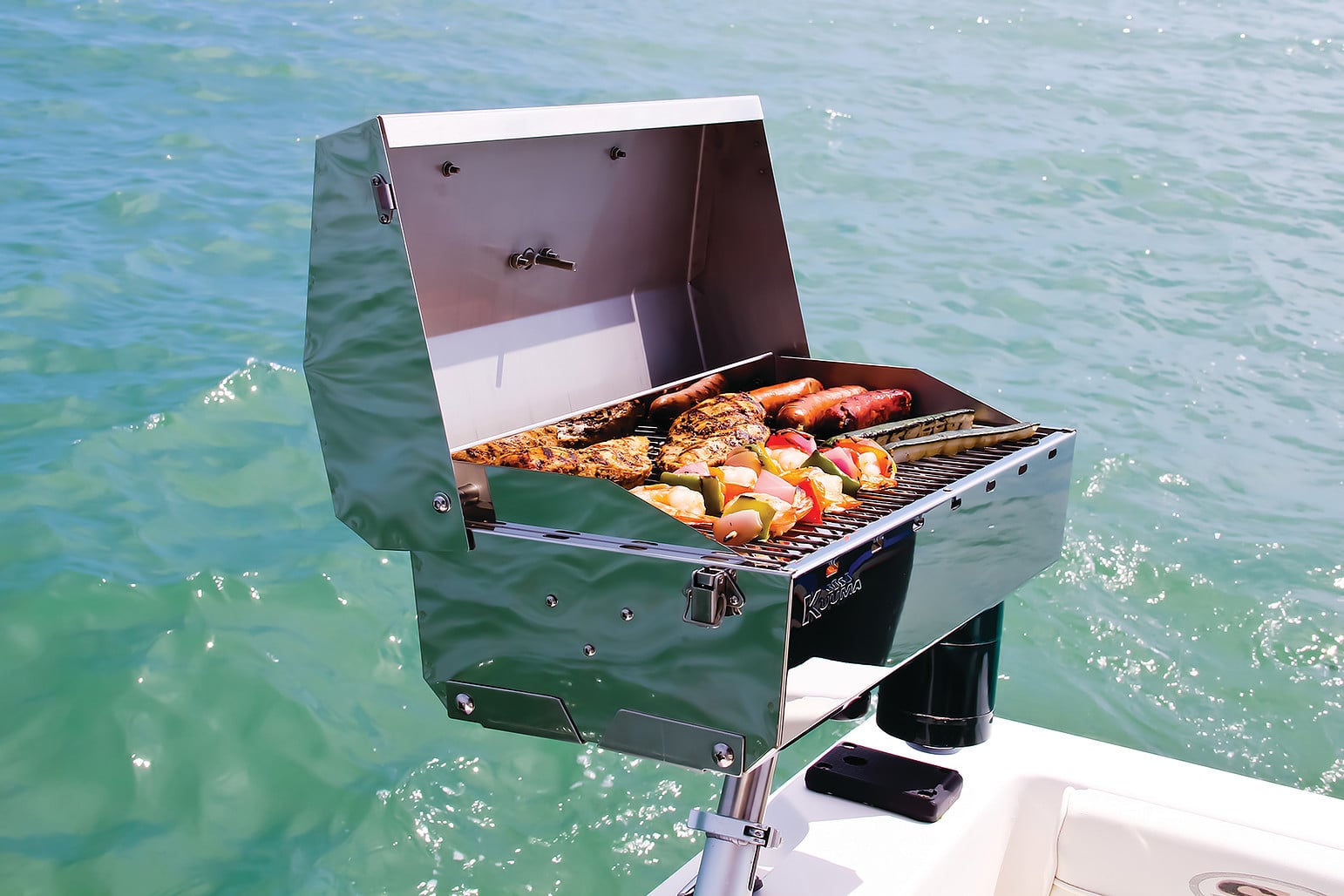
- [Premium 304 Marine-Grade Stainless Steel Boat Grill] This heavy-duty boat grill is constructed from 100% 304 mirror‑polished stainless steel for superior rust resistance and long-lasting durability in harsh marine environments. Built specifically as a reliable marine grill for boats, it maintains a clean, attractive finish through years of outdoor and on‑water use
- [Dual‑Use Design for Pontoon & Tabletop Grilling] This versatile pontoon boat grill includes a stable rod holder mount for secure marine installation and foldable legs for convenient tabletop use. As a flexible pontoon grill with mount, it switches quickly between boat mounting and outdoor table use, making it the perfect adaptable grill for boat owners
- [Spacious 208 Sq.In Cooking Area for Boat BBQ Grill] Featuring a large 18.1” × 11.5” grilling surface (208 square inches), this boat bbq grill provides ample space to cook burgers, fish, seafood, and vegetables for family and friends. The generous cooking area makes this pontoon grill ideal for day trips, weekend sailing, and small group meals on the water
$219.99 In Stock
Paid link · price checked October 22, 2026 09:31
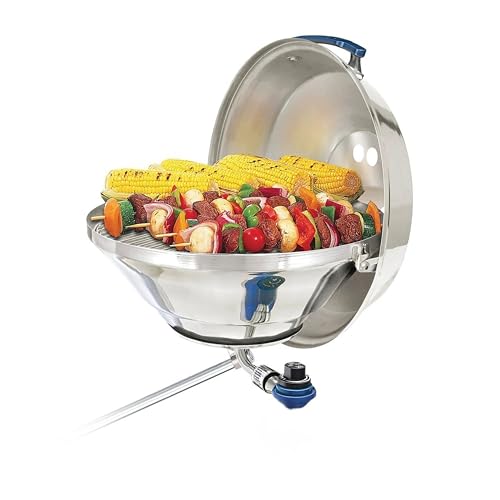
- Made of 100% 18-9 mirror polished stainless steel with a combination "easy to clean" grease catch pan / wind baffle
- Hinged lid won't slam shut and has a "stay cool" handle with air cooled supports
- Swiveling, windproof turbo venturi & control valve virtually eliminate blowouts, places the fuel valve where it's safe and convenient
Paid link
Our original pick has been discontinued by Amazon. This is the closest current match we could find.
- [Premium 304 Marine-Grade Stainless Steel Boat Grill] This heavy-duty boat grill is constructed from 100% 304 mirror‑polished stainless steel for superior rust resistance and long-lasting durability in harsh marine environments. Built specifically as a reliable marine grill for boats, it maintains a clean, attractive finish through years of outdoor and on‑water use
- [Dual‑Use Design for Pontoon & Tabletop Grilling] This versatile pontoon boat grill includes a stable rod holder mount for secure marine installation and foldable legs for convenient tabletop use. As a flexible pontoon grill with mount, it switches quickly between boat mounting and outdoor table use, making it the perfect adaptable grill for boat owners
- [Spacious 208 Sq.In Cooking Area for Boat BBQ Grill] Featuring a large 18.1” × 11.5” grilling surface (208 square inches), this boat bbq grill provides ample space to cook burgers, fish, seafood, and vegetables for family and friends. The generous cooking area makes this pontoon grill ideal for day trips, weekend sailing, and small group meals on the water
$219.99 In Stock
Paid link · price checked October 22, 2026 09:31

- Compact Grill: Weighing only 14.5 pounds, the Kuuma Stow N' Go 125 is easy to transport and perfect for on-the-go grilling adventures
- Stainless Steel Construction: Made from 304 stainless steel, this grill is built to withstand harsh environments, ensuring long-lasting performance
- Generous Cooking Surface: With 125 square inches of cooking space, you have ample room to prepare your favorite meals, making outdoor cooking a breeze
$238.64 Only 6 left in stock – order soon.
Paid link · price checked October 22, 2026 09:31
Our original pick has been discontinued by Amazon. This is the closest current match we could find.
- [Premium 304 Marine-Grade Stainless Steel Boat Grill] This heavy-duty boat grill is constructed from 100% 304 mirror‑polished stainless steel for superior rust resistance and long-lasting durability in harsh marine environments. Built specifically as a reliable marine grill for boats, it maintains a clean, attractive finish through years of outdoor and on‑water use
- [Dual‑Use Design for Pontoon & Tabletop Grilling] This versatile pontoon boat grill includes a stable rod holder mount for secure marine installation and foldable legs for convenient tabletop use. As a flexible pontoon grill with mount, it switches quickly between boat mounting and outdoor table use, making it the perfect adaptable grill for boat owners
- [Spacious 208 Sq.In Cooking Area for Boat BBQ Grill] Featuring a large 18.1” × 11.5” grilling surface (208 square inches), this boat bbq grill provides ample space to cook burgers, fish, seafood, and vegetables for family and friends. The generous cooking area makes this pontoon grill ideal for day trips, weekend sailing, and small group meals on the water
$219.99 In Stock
Paid link · price checked October 22, 2026 09:31